The consulting vet offers hot takes on what’s derailed Web3 gaming, SDT’s upsides, and the importance of bridging the gap between game design and production processes
One of the biggest traps in game development, and one that remains a massive problem even though it’s the very visible culprit in many high-profile failures, is developing a game without incorporating player mental models into planning or design processes from the jump.—Catalin Alexandru
Player Driven introduced our profile of C/A, a Bucharest, Romania-based gaming industry consultancy, and its founding behavioral economist, Catalin Alexandru, last week. One of the more interesting topics we addressed therein was why video game system designers and economists choose one math-based tool over another, such as exponential or logarithmic curves. Alexandru also argued that all the math underlying a game needs to be aligned—all the numbers ideally form a “contiguous mass”—or the risk of failure increases. He also maintained that game designers and production staffs should work toward building “an economy of intrinsic intentions” that help ensure “a game’s structural factors [are] working together.”
That sounds like something a behavioral economist would say.
We’ll wrap up this week by revisiting the cautionary tale of Diablo III’s Auction House. Blizzard’s attempt to solve one problem created a bigger one and, Alexandru argues, Web3 gaming projects have generally slid down the same slippery slope.
We’ll address a more esoteric, philosophical question too: How can the abstract theories, principles, and frameworks that are used in game design (and taught in Computer Science programs around the world) be connected to the in the trenches coding activities that are actually used to make games? Alexandru doesn’t foresee a day when theory and practice converge to form a unified whole…but that’s not stopping him from looking for such a path.
Sounds like we’ve got a case of irreconcilable differences.

In the 1984 film Irreconcilable Differences, a young Drew Barrymore played a precocious ten-year-old who wanted a divorce from her feuding parents (played by Shelley Long and Ryan O’Neal).
Let’s get to it! Don’t forget to subscribe to our newsletter and share this post with a friend.
Diablo III Auction House Meltdown, Meet Web3 Gaming’s Original Sin
EVE Online exists. So does Path of Exile 2, Runescape, Escape from Tarkov, even Diablo II’s d2jsp user-driven secondary markets. Also, websites like PlayerAuctions, which cover a huge variety of games. All of these games use real money economics as a scaffold for their fantasy experience without a player base that is primarily driven by financial reward.—Catalin Alexandru
An early question I posed to Alexandru via email involved a topic he wrote about for his site (called The Game Economy Trilemma), and that included a breakdown of what went wrong with Diablo III’s auction house experiment.
In case you’re unfamiliar with it, Diablo III’s real-money auction house (RMAH) launched in June 2012, about a month or so after Blizzard’s PC/console Action-RPG debuted. The RMAH was shut down in March 2014. What happened in the intervening months was controversial, groundbreaking, funny, and deeply illustrative of what can go wrong when irl money gets mixed up with virtual player-driven markets.
“The Diablo III Auction House,” Alexandru explained to me, “was conceived as a core feature for Diablo III, built on both the prevalence of grey market item trading in general in online games and the success of unofficial player-run ‘Auction House’ sites created for Diablo II, like d2jsp.”
Diablo II launched back in 2000. D2jsp was formed in 2002, and it indeed grew into a successful player-run (third-party) virtual item trading forum and auction house. D2jsp is still up and running.
Alexandru claims that Blizzard built the RMAH for Diablo III “to simultaneously curtail unauthorized trading and recreate a controlled, monetizable version of it.”
Blizzard hoped it had a golden goose by the tailfeathers.
“There was some resistance and skepticism initially but you could argue, eventually, it was a victim of its own success.”
The how of that is fascinating…and the story still resonates today.
The RMAH, according to Alexandru, “short-circuited the main incentive for playing the game—farming for better items, instead of being able to pay for them.”
After the RMAH’s launch a significant share of sellers began to follow its irl money trail, effectively turning Diablo III into a market-focused spreadsheet sim, and a significant share of buyers began fast-forwarding “the grind” by buying potent items. Increasingly, playing the game’s core loop—killing monsters for loot—became superfluous.
“As the trilemma describes,” Alexandru continued, “it’s hard to maintain a price floor when there is a large population of players flooding the market with the same commodity goods.”
We’ll come back to the trilemma shortly.
Tldr; The RMAH changed many players’ logic, math, and incentive for playing Diablo III, and in a way that Blizzard didn’t want or expect.
To Alexandru, the larger lesson was “that secondary markets for digital goods only work within very strict constraints. As it turns out, d2jsp not being official and having Blizzard enforce strict limits to their activity, is what made it work.”
It’s more or less the reason Apple doesn’t put used devices in its retail store displays next to its newest models and only sells a few on its website. They’re in the business of selling new ones at maximum markup. The same is true of most game studios selling digital goods.
Diablo III had loot drops but its designers and production team were stingy, which helped push gamers into the RMAH. Many common items, and items that noobs tended to get from hacking and slashing in the core loop, meanwhile, flooded into the auction house, which pushed their price points toward zero (although Blizzard enforced a $0.25 listing minimum). The opposite dynamic also emerged: Rare items that advanced players needed to progress appreciated in price. Many of these price points moved toward the RMAH’s max, $250.
Players began to do what people in real markets do when the forces of supply and demand exceed “officially allowed” limits: They sought out grey markets.
In one epically ironic case, a legendary mace called Echoing Fury sold on the RMAH for $250…and then the buyer took it over to d2jsp where it sold for an insane $12,000!
Blizzard was soon being hammered on three sides: Noobs weren’t happy to discover that slashing and hacking for an hour netted them an item with a $0.25 street value; Vet players were angry that they’d have to spend, potentially, hundreds of dollars to push their characters toward the max level of 60 or 70; And players who wanted nothing to do with the auction house found the core loop “grindy.”
Blizzard was also criticized for taking a 15% cut whenever players converted their sold items into fiat currency.
Oh yeah, a bot farm problem erupted on top of everything else after some players figured out that they could end-run the RMAH and convert it into an ATM.
Blizzard eventually raised a white flag. The RMAH was removed, and the game’s loot system was overhauled (drops got less stingy) when The Reaper of Souls Expansion came out in March 2014.
Alexandru, a self-described “economy geek,” argued that Blizzard had run headlong into something that’s called the “Impossible Trinity,” or the “economic trilemma,” which economists first described in the 1960s. If you’ve got 30 minutes to spare, Wikipedia has you covered; Alexandru’s aforementioned writeup also has a primer on it.
Tldr #2; Market systems contain inherent tradeoffs.
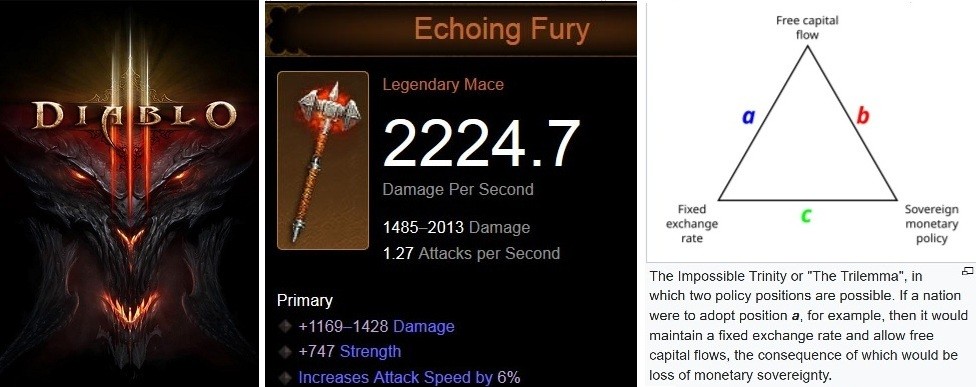
One side of this punishing triangle involves utility, he said, which is linked to end-user demand. As he put it, “something like CryptoKitties, while having some minigames where you can use your kitties as cosmetics, they don’t impact how well you do in those games. But something like a more powerful Pokémon in Pokémon Go absolutely does, even though both are essentially digital collectibles.”
The other two sides, as I came to understand them, involved the interest that game studios and their players have—and, presumably, irl social systems all the way up to nation states have—to (1) reach a critical mass of users in the marketplace and steadily expand the scope/scale of their marketplaces over time, which promotes efficiency via liquidity, and to (2) maintain relatively stable market prices for the available set of items/goods/services (price hyperinflation and hyperdeflation are both ruinous).
Economists maintain it’s all but impossible for a market system to have and eat all three of these pieces of proverbial cake.
As Alexandru put it, “Achieving only two out of three is the only way to have a balanced player-driven economy that can scale to mass market and sustain over the long term, as proven so far at least. There is no known game that has successfully managed all three and scaled, and the entirety of Web3 was predicated on making that happen (which we all know how it turned out).”
Inquiring minds wanted to know more.
Let’s tie off the RMAH meltdown before going there though. The game’s RMAH supported the sides of the triangle connected to utility and scale—and let go of the string on price stability as a result. Some prices soared toward infinity. Others dipped toward an asymptote of zero. The result of the experiment: A faceplant.
My conclusion from Alexandru’s breakdown of the RMAH was that studios need exquisitely sensitive math undergirding their “free market” systems, and they need mechanics and systems that can rapidly counterbalance whatever the buyers and sellers in their marketplaces choose to do, or they, too, can expect to faceplant.
Speaking of which…
Why Web3 Games Keep Slip Slidin’ Away
I went straight at the topic of Web3 games with my next question. I asked Alexandru why games like Sky Mavis’ Axie Infinity and platforms like The Sandbox have failed to attract and retain large audiences.
Don’t you dare get ahead of me!
Many “games use real money economics as a scaffold for their fantasy experience without a player base that is primarily driven by financial reward,” Alexandru responded, pointing to EVE Online, Path of Exile 2, and Runescape as examples along these lines.
Their markets haven’t faceplanted precisely because they’re highly-regulated.
Web3 games, by contrast, jump straight into Impossible Trinity tar pit.
Cannonball!
Web3 gamers want their tokens/items/NFTs to appreciate in irl value. The higher these prices, the lower their mass market appeal, which curtails demand and liquidity.
Utility, meanwhile, is all over the place. Early Web3 game NFTs were purely cosmetic. In the early 2020s, Web3 games added in-game utility. The players of these games, though, have never been able to define the value of utility because nonplayers can buy these tokens/NFTs too.
Web3 gamers don’t control token/NFT prices as a result. Moreover, if utility is high, then these games are pay-to-win. If buying more tokens/NFTs translates to more W’s, then skill and strategy aren’t what separate winners from losers. Who doesn’t agree that pay-to-win games suck?
Web3 gaming’s original sin is that its irl money angle is too integral to the experience. The markets inside EVE Online, Path of Exile 2, Runescape, and similar titles have survived and grown, Alexandru maintains, because the vast majority of players in those communities “approach these experiences as games and not, primarily, as an investment vehicle.”
Work (grinding in-game for real world money), depending on context, can either violate the “magic circle” and negate game-like qualities, as many Web3 critics correctly point out, but, in the right context, it can heighten the fantasy with real world stakes, as long as the rest of the game is competently gated away from the impact of real money.
“This is what Web3 game developers never wanted to understand: They thought the more aspects of the game you can financialize, the better,” said Alexandru. “Which is sort of like a chef putting Tabasco in every dish.”
Hey—I love Tabasco!
There’s nothing wrong with blockchain per se. The problem Web3 games keep running into is this: Behavioral economics and market systems interact in a way that requires the studios behind these games to regulate at least one corner of the Impossible Trinity tightly. And they won’t do it. Their libertarian mindset precludes that kind of “heavy-handed” regulation. The result: Faceplants galore.
“Completely agree that this was a factor in Web3 difficulties,” wrote Alexandru in regard to Web3 gamer’s culpability in the failures of these in-game markets. “Techno-libertarian tendencies blurring the line between real work and play” is part of what’s perennially killed the golden goose that Web3 studios have been trying to raise for >10 years.
Never the Twain Shall Meet?
You hear a lot about “player obsession,” but it’s almost exclusively in the context of cloning a successful game, then fine tuning Live Ops based on real-time data. It’s severely underused in the planning and preproduction process which, to this day, tends to devolve into a haphazard contest of who can impose their design darlings on the rest of the team the hardest. We’re very far from a world where game design practices are even vaguely agreed upon and player-centric in any real way, except for monetization design.—Catalin Alexandru
The last major topic I broached with C/A founder Catalin Alexandru involved the process of converting game designs into a finished, commercial games. Given his breadth of experience, I assumed he had some time-tested means of guiding his clients from Point A to Point B.
I was wrong.
“With very few exceptions,” Alexandru told me, “theory and practice are seen as irreconcilable, and engaging in one must follow in doing a disservice to the other. Good commercial game making is seen as a matter of intuition, force of personality, branding, and blind iteration ‘by feel’ in ‘premium’ games. The flipside of that is the ruthless application of the ‘scientific method’ in F2P, the clone and optimize playbook I described” earlier (see last week’s post).
“Player motivations can be incredibly useful when deployed thoughtfully even at the concept stage,” he continued, “but very few teams have the interest or incentive to do that. There’s also a visceral mistrust of anything ‘theory’ related in game development, the creative side of which hasn’t really outgrown its counterculture roots to find a defensible place in the industry, even as all other aspects of the industry have matured.”
He waded further into the psychological side of behavioral economics.
“There are tools like Quantic Foundry,” that can be used to help bridge the gap between psych-based theories that can help explain gamer motivations and the process of making games that meet those needs, he maintains, but these resources are underutilized. (Player Driven interviewed Quantic Foundry’s co-founder; if you’d like a deep dive on their model, it’s here.)
I asked Alexandru what he thought of Self-Determination Theory (SDT) in a video game context.
“The main documented use of SDT is the one” he said, “where it’s probably the most visible, Warner Brothers’ Shadow of Mordor, which had explicit SDT input. Jason VandenBerghe developed and extensively used an SDT-derived framework at ArenaNet and Ubisoft on Guild Wars 2 and For Honor.”
All three of these games have Metacritic scores >75.
“The idea isn’t to replace design with science but to have a craft framework that leaves plenty of space for creativity precisely by being science-informed rather than pure guesswork or fast following,” he added.
I pointed out that I’d recently interviewed Riot Games’ Stone Librande, and that he, too, used psych-based models in his design workshops at GDC as well as the internal talks he runs at Riot (and the courses he teaches to Carnegie Mellon University grad students; my Player Driven teardown of Librande’s 2026 GDC workshop has more details.)
“Stone is great,” said Alexandru. His game design talks are “are super useful. His one-page design talk is legendary.”
Having said that, Alexandru was skeptical that such high-level approaches to design have much pragmatic value.
“A lot of high-level work sounds good on paper but doesn’t connect to and isn’t backed up in production methodology or tool development, and is not generalized at all across cases,” he said.
“There’s a lot of theory work done from scratch, many promising abstract models, but almost no effort to integrate that work into a cohesive, standardized whole which accounts for the differences in approach.”
Imagine if music theory mostly came down to knowing that certain broad types of sounds make us feel sad or happy, and then when you sat down to write a piece of music you only had that, and no concept of keys or notes. That’s more or less where we are in game design theory despite sincere (but disparate and siloed) efforts by incredibly smart people.
He got dourer.
“There is currently no reliable way to map the complexity of a design outside of code, to iterate meaningfully on it. Iteration then moves to code and outside documentation or notation, which complicates things immensely.”
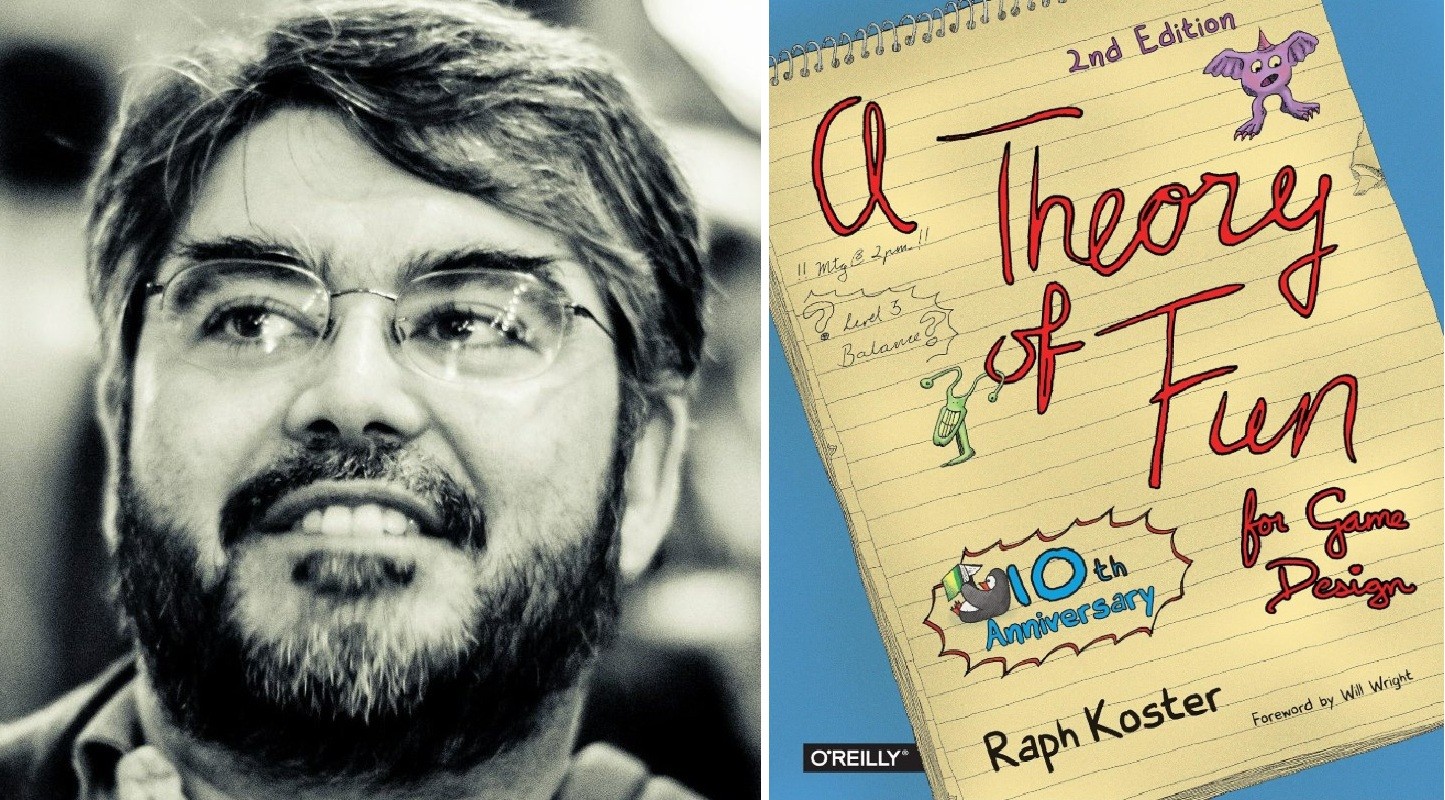
“Not to pick on Stone’s work,” Alexandru continued, but “everything from Raph Koster’s Theory of Fun to the MDA framework suffers from the same problem. All very high level, without mapping the relationships between the abstract concepts of ‘Start states’ or ‘mechanics,’ and the elements designers actually directly work on: Greyboxing levels, spreadsheets, progression systems, skills, discrete content units, etc. The concrete elements [of models like MDA] are stuck in arcane integrated structures that break incredibly easily when modified because there’s little to no work dedicated to documenting or understanding how the parts fit together.”
He wasn’t done.
“What ends up happening, in most cases, is the plan gets thrown out the window and so does intentional, disciplined design, ending up with mostly improvisation or cloning on the mechanical [core loop] side. Sometimes happy accidents happen and the game turns out great. Everyone is so relieved and happy they don’t really stop to question it, and it’s all too easy to take credit for it. Some rare souls manage to build up enough of the right kind of experience and intuition to replicate the process by feel and those people become legendary.”
“I promise I'm not being contrary for the sake of it, and if I could see a way to reconcile a certain existing theoretical framework with what I see as the main issue, I would love to do it. It's not about Stone or his framework specifically, either. I view that as a variation on the same type of popular craft framework (Jesse Schell's [The Art of Game Design:] A Book of Lenses, etc.), most of which are of a piece to me, so I can't help but place it in that context.”
Even Librande admitted in my discussion with him that the elements of his model were rarely used by pro game designers because those concepts were already baked into more pragmatic systems, frameworks, tools, etc.
“I've also looked closely at using Michael Sellers' framework [that] he describes in Advanced Game Design,” continued Alexandru, “which goes the opposite way and tries to incorporate everything with incredible granularity and complexity by basically mapping it 1-to-1 with system dynamics notation. His work is fantastic, but you'd need a PhD equivalent before attempting his design method. That's a joke but it's not far off.”
Alexandru then pointed to a 2015 blog post on The Ludologist that dove into a debate about formalism and anti-formalism in game design. The aforementioned Koster was noted in that post and he actually added a couple of comments about its conclusions.
Tldr #3; Koster, an American game designer, entrepreneur, and author (who’s probably best known for being the lead designer of the landmark 1997 game Ultima Online), basically argued there are social factions in and around gaming that have their own agendas and that prevent any one system from being accepted as the “best” or “right” way to connect the content of a video game to the mechanics, systems, and code-focused processes used to build games.
Here’s a taste of what Koster’s wrote in his comments on The Ludologist:
“I think that so many practitioners think in terms of a divide between content and mechanics because that’s how it works when you actually build a game. Anyone who actually makes games knows that bringing the two together is the hard part—they actually fall separately very naturally, so naturally that it takes real effort to make them unified. This doesn’t mean that they think meaning is carried by one or the other, though. Any good designer knows that meaning is carried by both.”
My takeaway from this exchange was that even if someone, or a team, is able to come up with an innovative, excellent design for a new game, it remains extremely difficult to translate that “magic” into a finished game because there’s no clear means of getting from Point A to Point B.
Alexandru put it this way: “The lack of an integrated ecosystem of commercial + academia + craft + public acceptance (like, for instance, movies or books have) hinders any sort of consensus forming” path forward in the video game industry.
Food for thought…but it’s depressing food for thought.
There are “many facets of the problem and finding the place to start” remains an ongoing challenging, he concluded. “For my money, that is theory because it's so clearly the Achilles' heel right now (though eventually it will need to go beyond into dedicated Figma-style design tooling and possibly in the distant future lead all the way to custom platforms).”
So, there may be a pathway through this maze after all?
Since he’s clearly a fan of incorporating psych-based models like SDT, I asked him if he thought that if such inputs “were somehow linked and mapped better into production processes that innovations (related to both the underlying economies of games as well as monetization) are completely possible, and that those innovations could help grow the video game industry” and, perhaps, even help improve our flawed irl social systems?
“Yes, that’s exactly it,” he said.
Wow. There may well be light at the end of this tunnel.
Alexandru intends to keep pushing in this direction by continuing his “design practice and evangelizing for new game economy models.” He hopes to avoid the “twin pitfalls of too much theory and too much practice as well as too narrow a commercial focus or not commercial enough.”
I’ve been chatting to designers I respect who have the same sense of what’s missing and doing their own education and theory work to find solutions. Collating and deepening all the different strands into a more robust, less abstract framework. Wrapping all of that up in a tool that can prove it out in practice.
Sounds like the Intersheets reference on his website may be a placeholder for his work to find a holy grail that’s capable of bridging the theory-practice gap in video games.