From Diner Dash and Balatro to redesigning capitalism, Zimmerman is interested in creating, iterating, and playing with systems that deliver "mouthfuls of delicious meaning"
I’m a cheap date for game design. I’ll make any kind of game. I make video games. I make tabletop games, card games and board games, and museum installations that are large scale interactive things.—Eric Zimmerman
First things first: happy holidays to you and yours! This is the last Player Driven Substack installment of 2025. We’d like to thank our readers and subscribers for their support and feedback as we’ve worked to get this, er, weighty sleigh off the ground in recent months. If you enjoy our content and haven’t yet subscribed, why not give yourself a (free!) gift that’ll keep on giving in 2026 by SMASHING ↓ THAT ↓ SUBSCRIBE ↓ BUTTON?!
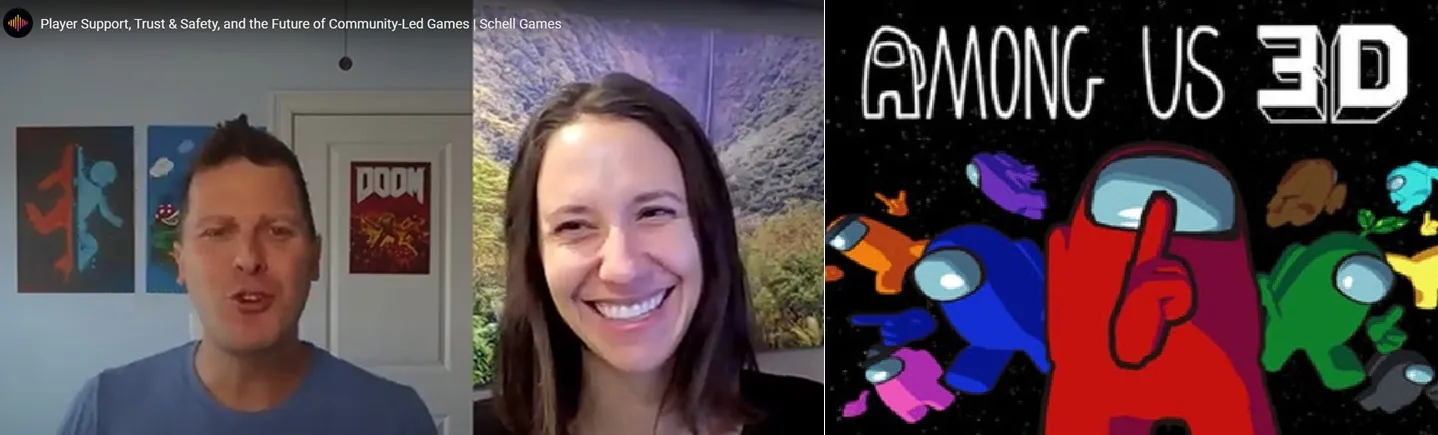
Last month, Greg Posner and I interviewed NYU Game Center Professor Eric Zimmerman for Player Driven. The wide-ranging discussion didn’t disappoint. We explored several interesting connection points between game design, culture, and making meaningful life choices.
Zimmerman originally hailed from Indiana. Both his parent taught art at Indiana University Bloomington. He’s got a bit of a latter-day Elvis Costello vibe about him, and he came across as easy going. I made the mistake of calling him “Professor Zimmerman” right off the bat, and he practically bristled.
“Call me Eric, please.” Sure thing, prof…I mean, Eric!

The apple didn’t fall far from the tree. Eric’s undergrad degree was in painting, and then we got an MFA in art and technology.
“Right after graduate school I entered the game industry,” he told Greg and me early in our November podcast, “and I realized, ‘Oh, this is, like, another really interesting way to make culture.’”
Make culture? We’ll put a pin in that topic and circle back to it.
Eric and another New York City-based game designer, Frank Lantz, co-designed a PC-based strategy game that Philips Media published in 1996, Gearheads. Fun fact: the duo used the term engine to describe how the parts of the game fit together, which helped popularize the now ubiquitous term game engine.
The duo also started to teach a game design course at New York University’s Tisch School of the Arts in the ‘90s. Eric was hooked…and that apple fell right next to the tree.
“In those days, game design wasn’t a thing that you could study,” he recalled. “Games had already been around for decades. You know, Atari had come out when I was a kid, and arcade games. I grew up with arcade games and Apple II Plus. But no one had really, you know, written books about how to design them or how to teach them. So Frank Lantz and I were really kind of exploring that whole field.”
“I remember going to the NYU library and typing ‘games’ into the university computer and we were just, like, running around grabbing books. ‘What the hell are students going to read in our class?’”
They figured it out as they went, and it worked. It was fun too—especially once the process of teaching and learning was imbued with hands-on “game mechanics” and iterative feedback loops.
“We’re still constantly changing the curriculum,” Eric told us. “Teaching is so much like game design. You set up a structure, which are, like, the rules, right? The policies, the assignments, even whether you’re going to grade or not grade. Who’s working with who and in what way, the constraints on the projects you’re doing. And then they play with that, right? It’s the same thing.”
“Some students like learning passively, with a lecture, but I find that more students like learning in a visual way, in a social way, in a kinesthetic way.”
“Teaching really became part of my practice. And it became part of how I understood what games were and how they function…I teach like I’m in there learning with them, and we’re all figuring this thing out together.” That came across in the way he interacted with Greg and me.
“As the person leading that process and having to, like, structure things and name things, and figure things out, that has really taught me so much as a game designer.”
He drew a virtual tic-tac-toe hashtag on the chalkboards of our minds.
“What happens when we start changing rules? I decide, ‘Oh, I can, you know, draw X’s around the edge or I can, like, erase what you did and draw mine.’ Well, yeah, maybe that’s not breaking rules in good way.”
“But let’s say you’re playing with a kid, and they just started out, and they realize you’re about to win. And then you say, ‘Do you want to take your rule back?’ Or help them out, right? So, that’s like bending a rule, but in a way that makes it better for both of you.”
“Or let’s say you’re playing with someone and you’re both pretty good at tic-tac-toe, and you’re like, ‘How do we make this better and more fun? Well then, maybe drawing, you know, a fourth row of squares around [the classic hashtag design] actually suddenly turns this kind of boring game into something that you both are enjoying.”
Playing with rules, breaking rules—in a constructive, positive way for all players—was a recurring theme in our discussion.
“The sweetest pleasure of design is seeing your audience do things you never could have possibly anticipated,” Eric said. “This is the second-order nature of play design: you establish the rules, but the players take it from there.”
In the 2000s, Eric’s professional life reached a new high. In 2003, Diner Dash—a game Eric co-designed while at Gamelab, an NYC-based studio that he co-founded with Peter Lee—debuted, and it took off like a rocket. The game’s IP rights were eventually sold to Glu Mobile (a mobile-first game developer/publisher that EA acquired for $2.4 billion in 2021), and Eric had nothing to do with the variants that followed, but Diner Dash really put the time management strategy sim subgenre on the map in the 2000s. Glu offers Diner Dash Adventures on a phone near you to this day
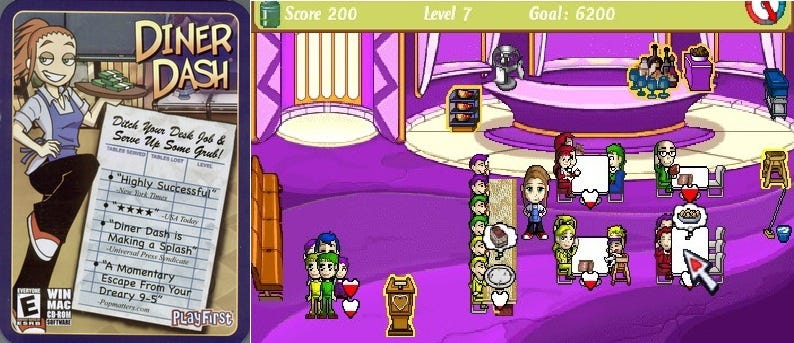
Eric also co-authored book about game design, Rules of Play: Game Design Fundamentals, which was warmly received in 2003 (and it’s still in print).
Early in the podcast, Greg recalled telling his wife that Eric was going to be a guest.
“I was like, ‘You ever play this?’” he asked, holding up his phone with Diner Dash’s splash screen showing. “And her eyes lit up. Like, ‘Yes, I played that game!’ It’s probably one of the first games she played. What’s the biggest thing you think you got right” in terms of designing that game?
Eric grinned as he pondered the question.
“First, I should say that [although] I definitely helped come up with the whole concept” of Diner Dash, he said, “Nick Fortugno was the lead designer at Gamelab, so I don’t want to steal still his credit. Like all games, it was very much a team effort.”
“It was meant to be very accessible. The theme was not, whatever, shooting aliens or killing dragons. It’s, like, running a cafe, and there’s a whole story about a character [Flo] that is….trying to get her business going.”
“The original game is really, really difficult…When I look back at all of Gamelab’s games, I think that Diner Dash, which was the most...successful, was maybe the hardest as well.”
“The levels just get harder and harder, more customers to fulfill and, you know, a little bit stricter on how long they’re going wait before they start getting impatient and leave the restaurant.”
Eric’s and Gamelab’s profile were both buoyed by the massive success of Diner Dash, but he also looks back on the experience with some cringe.
“It’s very, like, uncritical about capitalism,” Eric confessed. “It’s just kind of like, ‘Oh, make a restaurant, make more money, you know, invest more money.’”
“It definitely falls into this kind of...ideology of growth…It’s a little cringy for me. Like, it’s sort of a love letter to capitalism or something. I’ve grown up since then.”
Fair enough! Create. Playtest. Learn. Grow. Repeat.
Read on to learn:
What Eric thinks about one of 2024’s casual-leaning indie darlings, Balatro.
How Eric distinguishes the “dark design patterns” that some designers use to trick players from positive—but still addicting—game loops and mechanics that he prefers to use and teach his students.
Why Eric dubbed the 21st century the ludic century in his latest book, 2022’s The Rules We Break: Lessons in Play, Thinking, and Design, and why he believes that gameplay and gaming-related behaviors could be the key to fixing problems in irl capitalism, democracy, and other deep cultural processes.
Balatro’s Wheels Within Wheels…and Monopoly’s Dark Irony
Games are about meaning, right? Games are about...doing things that are meaningful…All culture is about that. Interacting with culture, buying a comic book and sharing it with your friends or whatever it is, seeing a movie, ranting about it online…In games, we participate in the meaning, and it’s literally like I’m choosing this card over this card for my Balatro deck. The meaning of that action plays out over and over and over again because you go all through all these rounds. Balatro just keeps on giving you mouthfuls of delicious meaning.—Eric Zimmerman
Deep in November’s Player Driven podcast, host Greg Posner casually referenced Balatro, a poker-themed roguelike deck-builder that launched on consoles and PCs early last year (and arrived on mobiles late last year), and said that the game gave him an itch to keep playing.
Eric could definitely relate to that.
“What a game like Balatro does is it creates,” he said, “wheels within wheels, right? Little loops of feedback and pleasure…Buying a new pack and opening it up, right? That’s a little, ooh, a little unexpected dramatic moment!”
“Then, okay, making little decisions, which cards do I buy? How do I go? Then I’m in a match and I’m like, ‘Okay, it’s a slightly larger loop.’”
“Each of those decisions is meaningful and there’s an outcome…And then there’s larger loops, which is like, ‘Oh, I’m actually moving through these blinds and levels and stages.’”
“There’s bigger loops too, which have to do with unlocking cards, unlocking difficulty levels and decks…I think that kind of, sort of, intertwining someone’s sense of pleasure within these kind of loops of feedback…that are not always positive. Sometimes they’re painful. I love it how the Joker makes fun of you in just this cruel way when you lose in Balatro.”
“It’s like you’re...you’re building the car as you’re driving it. And as you’re making improvements, you’re enjoying driving it even more and more. And I think that’s, again, that’s a kind of like looping sort of pattern that ends up making a game like that really compelling. As you can tell, I’ve been playing a lot of Balatro recently!”
Greg double-clicked on Eric’s take on Balatro’s stickiness.
“I love the way you talk about it. Balatro was made by one person,” an anonymous Canadian who goes by LocalThunk (Playstack is the publisher). “And I love the way you describe the loops…Do you think he purposely knew these were all loops or did he just happen to fall into it?”
Eric pondered the question for a moment.
“You don’t design them and then just build them,” he speculated. “Balatro evolved, like all games, from a little prototype, like a little plant…Balatro is really standing on the shoulders of lots of other interesting games.”
“Roguelikes are types of games where you are moving through a space and you’re somehow, like, leveling yourself up, your abilities and powers, in a very customizable way…Like roguelikes, it [Balatro] has permadeath, right?”
“That also gives a real edge to the decisions that you make…If you make bad decisions or even if you get unlucky, you know, and you didn’t hedge against that luck enough…your game is over immediately.”
‘Starting with games like, well, Magic the Gathering, that helped invent collectible card games, and games like Dominion that turned deck building, like, within the game itself…And then lots of digital games like Hearthstone…The really brilliant thing about Balatro is that that’s not sitting on top of some invented combat system of fantasy dragons and casting fireballs.”
“It’s sitting on top of poker,” Eric said. “The onramp into the game, which has these very sophisticated roguelike and deck building mechanics, is sitting on a game that everybody knows. And I think that is such a brilliant concept.”
I asked Eric if games that make people want to scratch the itch to play over and over again were a good thing, or if some crossed a line into fostering addictive behavior.
“All right,” Eric responded. “Let’s open this can of worms, shall we?”
“There’s definitely things that are kind of ‘dark design patterns,’ right, that are used in games and apps where you’re really trying to hook players. And, for example, you know, ‘You can’t go any farther until you pay us more money or recruit more friends into the game.’”
“Or, you know, ‘We’re going to have you do microtransactions that kind of build and build and build in order to, kind of, keep your leaderboard status where it is.’”
“Gambling addiction is something that, you know, is known as well…Of course, humans get addicted to all kinds of things that often are good. You can also be addicted to exercise or reading or sex, things that are normally, like, wonderful.”
“I think, as a game designer, it’s especially important that you are conscious and aware that part of what you’re doing is playing with the pleasure and desire of your audience.”
Eric brought up a 2023 book by his longtime friend and colleague, Frank Lantz, The Beauty of Games.
“One of his points is that when you play a game, it’s like you are able to be self-conscious about your own thought process…Playing games makes you aware of your own thinking…‘What’s drawing me in, what’s attracting me?’”
“There’s also sort of, like, a fine line between that and addiction, especially if you are sort of tricking players, right, out of their money.”
Game design is not just about learning about how systems work and feedback loops or even design processes or technical approaches to programming games…It’s also about understanding people and culture and ethics…As creators of these kind of digital spaces and media, it’s part of what we teach our game designers at NYU…There is an ethical dimension to game design.
There may well have been an irl “dark design pattern” at play when it came to how the iconic game Monopoly came market, another topic we addressed.
“The ironic thing about Monopoly is that it was designed by Lizzie Magie in…the early twentieth century,” Eric explained. “It was originally called The Landlord’s Game…It was designed as a kind of, actually, a serious game…to sort of show what was wrong and unfair with the…existing way that that landlords were taxing their tenants.”
The game also had unusually sophisticated systems in it, he added, that made Lizzie Magie an “unheralded hero of contemporary game design.”
“Parker Brothers,” Eric continued to recount, “basically stole Monopoly, copied Monopoly…Charles Darrow is, you know, credited with inventing it, but it’s really kind of a classic case of, you know, unfair capitalistic practices.”
(Below left: A photo of Lizzie Magie pointing out to reporters in 1936 that Parker Brothers’ new game, Monopoly, was remarkably similar to The Landlord’s Game. Below right: A closeup of Magie’s 1906 The Landlord’s Game board.)
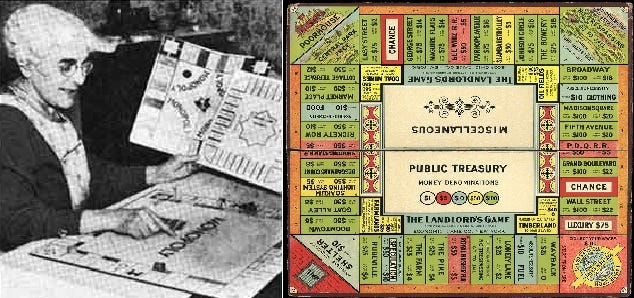
“The irony is not just that Lizzie Magie has been kind of robbed of her authorship, but [that] Monopoly has gone on to become such a global, iconic game…[and] it’s, in many ways, now the icon of the thing that it was originally meant to critique.”
“So, if the landlord’s game was really about trying to have us question and be critical about these structures of capitalism that lead to unfairness between those in power and those not in power, now it’s just…Talk about a love letter to capitalism!”
Perhaps the young Eric Zimmerman liked playing Monopoly a lot more when he was working on Diner Dash?
“The most bitter irony is…that this game, which was invented by this brilliant woman, just became, like, the most the most ironic parody of the thing that the game, that was stolen, was trying to critique in the first place.”
Ouch!
“It’s kind of a bad game, right?” Eric added. Monopoly “goes on forever…It’s like, ‘Oh, you bankrupted halfway through the game? Sorry, you just have to watch us play.’”
“It’s a huge amount of luck” too when it comes to determining who wins. “It’s kind of a deliciously bad game…Culture is not logical.”
Tru dat, Eric!
Playing With Potential Solutions For Big IRL Design Problems
The book is not just to teach professional game designers. I feel that they’re teaching essential 21st century literacies, right? Which are the four C’s of collaboration, communication, critical thinking, and creativity…You need to understand how systems work. You need to understand how rules result in certain kinds of behaviors or how to experiment and prototype a new project or system to see how it’s working…My hope would be that game design is kind of, like, an essential sort of human literacy, like we think of math or reading or music.—Eric Zimmerman
Eric had great passion when it came to discussing the opportunity for design and gameplay to make an impact outside the gaming industry.
In his 2022 book, The Rules We Break, he also repeatedly connected game design processes to broader irl cultural and social issues and challenges.
“I use games and play to teach design” in a general sense, Eric told Greg and me in November. “Design for me is a very, very broad, you know, human endeavor…I’m getting very excited!”
The exercises in his latest book teach things “that we’ve mentioned before: systems thinking, collaboration, communication, the iterative process, designing, observing humans.”
This kind of “thinking is something that you find in a lot of design fields…Other kinds of designers, right, like architects or product designers, industrial designers, who I, you know, I feel they’re sort of my spiritual sisters and brothers, they often have, like, a very long research phase.”
They still ask and must answer similar questions, however.
“What’s our problem? Who are we addressing? Who’s our audience? What problems are we solving? Let’s analyze their [the end user’s] kitchens or their lifestyles…At the end of this process, you end up with a prototype. And what I, my thinking as a game designer, is that you, you make the prototype at the beginning.”
“The actual making is threaded throughout,” in game design, which differs from most irl design processes.
“Rapid prototyping and then learning organically from that process...like growing a plant” is a better description of how game design, prototyping, and releasing works, relative most irl design processes (that tend to be far more expensive and less amenable to post-launch iterative “patching”).
I posited that, in some systems, players jailbreak the system they’re in, and can destroy it. I asked Eric if there were limits to breaking the rules.

“It’s actually a really, really deep and profound question,” he answered. “There’s lots of ways that we can think about it.”
“If hacking into the server is breaking a rule and bringing down the game for everyone, then yeah, that’s not…[a] positive, wonderful, creative example of breaking rules.”
“Bernie De Koven was a wonderful designer and a mentor of mine who has since passed away….Bernie’s book, called The Well-Played Game: A Player’s Philosophy, is an amazing book…The well-played game is a game where everybody together, who’s playing...acknowledges that we can change the rules of the game in order to make it a better game for everyone.”
He circled back to his tic-tac-toe rule-changing example (cited in the first section).
“This was Bernie’s idea, which is [about] rethinking the the notion that games are these fixed sets of rules…They’re more like a social contract.”
This line of reasoning “blurs the distinction between players and designers.” Especially in the PC video game space, there are “interesting mods and, I don’t know, cultures of speed running and machinima. People, like, making their own versions of games.”
“This whole set of ideas of breaking the rules can apply to things outside of games, too,” Eric continued. “What if, for example, we thought of democracy as a kind of system, right, of rules?”
“What would it mean for us to think about democracy as a design problem?” he wondered. “We don’t have to take things kind of as they’re given. We can think about how we might redesign it, to fix some of these problems in our creaky 200-year-old, badly patched system of government here in the United States, which we can see now every day is being gamed in ways that are, maybe, not in line with the spirit of the original design.”
Tru dat, too! But does this well-played game idea, the limits of breaking the rules, and the capacity of game design to teach players the art of redesigning the systems they’re in for the better also apply to contemporary U.S. capitalism? You betcha.
“If you’re sharing a pizza with friends and someone just grabs half the pizza for themselves, you’re like, ‘Hold on a second. What are you doing?’ You know, they’re like, ‘Well, I’m hungry.’ ‘But, you know, there’s five of us here. We each get a piece and a half.’”
“Games are a wonderful space, in part, because they are these kind of imaginative narrative situations that are a little bit separate, usually, from everyday life. They’re actually a good place for us to practice those things and learn about those things.”
Ludic is Latin for play. Eric believes the world’s billions of gamers are learning things somewhat differently than previous generations because of the deeply interactive nature of the medium. When a player runs into a problem in a game, they’ll generally try to solve it themselves. 99 games games out of 100 (my own supposition) embed the solution to that problem in the game environment (and the other 1% are bad games!). People who play games, any kind of game, for hours a day, may tend to have an enhanced sense of their own agency as a result. Agency in a game feels good. In fact, a game without agency isn’t a game, it’s a prison (my own supposition again).
“For me as a game designer,” Eric said in the podcast, “I like to think about experiences that only games can make…[and] that leverage the unique capabilities of games. For example, that they’re interactive…that they’re dynamic systems, right?”
“What’s happened with digital technology is that [the] notion of just, kind of, linear media [like TV] is sort of, like, becoming displaced, right?” he posited. “In fact, all of our media, I think, are turning that way.”
“Games are weirdly, remarkably—like chess and Go and Parcheesi—they are weirdly contemporary…Games, in a sense, are the…human medium that has always had a kind of connection to where we are now.”
In The Rules We Break, Eric drew a direct line from this view to U.S. capitalism’s flaws. In the intro text to a section about systems thinking, for example, he noted that the U.S. “has the resources to eliminate domestic poverty” but we have failed to do so.
He argued the prevailing “zero-sum narrative” is one of many stories that humans tell themselves. If enough people choose to switch to an alterative narrative, he wrote, a new consensus about solving our poverty-related challenges might emerge. To get there, he continued, we’d need to focus on “stories that might shift the culture and spin out new policies.” That would be a well-played game, indeed.
How might the “players” of U.S. capitalism be roused to redesign “the vast game of capitalism for the better?” he wondered in The Rules We Break. “We need to leverage the benefits and insights of a systems-based approach to understanding the world” to get to that spot. Ludic food for ludic thought!
I’ll close this out by closing the loop on the Eric’s “making culture” comment that was noted in the intro. After the podcast, I followed up via email to ask him how the creation of culture and game design related in his mind. This was his (deeply illuminating) response:
When I use the word “culture” I think about it as being on one side of a coin that represents how I think about game design. One part of that coin is the “craft” of games—the aspects of games that are intrinsic to the form of games—like rules, play, systems, mechanics, etc. The other side of that coin is everything else—the landscape of “culture” into which games might fit or not fit, the social situations for which we design, the meanings that humans bring to their experiences. In some ways the two sides of the coin are opposites, but in some ways, they are very much intertwined. As a game designer and a design educator, I think it’s important to always be engaged with both sides simultaneously—the craft and the culture of games.—Eric Zimmerman