I started Amir Satvat’s Games Community because I saw members of the games community losing their jobs and needing help. I remembered everything I had gone through trying to get into the industry and thought I could do something with the skill sets I had. It all began with our first resource, now one of 13, which was a games jobs workbook. - Amir Satvat
What goes up must come down.
It’s hardly breaking news that the video game industry experienced a massive surge in players and spending during the scary and chaotic early lockdown phase of the COVID-19 pandemic. In late 2022, those trends began running in reverse. One of the many consequences of that reversal was that thousands upon thousands of game developers, and other professionals in and around the video game industry, lost their jobs as studios and publishers tightened their collective belts.
The slide hasn’t yet ended. A recent GamesIndustry.biz article suggested, for example, that about a quarter of European game developers lost their jobs in the past year alone. Put together by InGame Job and Values Value, the associated survey of >1,600 industry professionals implied that designers, artists, and QA specialists were especially hard-hit.
Stepping back, a Wikipedia page that has tracked these layoffs states that, worldwide, some 45,000 video game industry workers were laid off between the middle of 2022 and the middle of 2025. It’s been a bruising, demoralizing hit, especially since the demand for games has generally bottomed out and rebounded. A few of the many publishers that have slashed their game-related workforces in the past three years include Embracer Group, Microsoft, Electronic Arts, Sony Interactive Entertainment, Epic Games, Take-Two Interactive, Ubisoft, Sega, and Riot Games.
An unlikely hero has stepped into this painful breach: Amir Satvat’s Game Community. Its tagline is, “We Help Gamers Get Hired. Zero Profit, Infinite Caring.” The choice of the word gamers was intentional.
As Amir explained to me in a LinkedIn exchange (that preceded the Player Driven podcast interview to which we’ll shortly turn), “I chose the word gamers even though it comes with some connotations, because I wanted people to understand this [community] wasn’t just for folks already in the industry. It’s for anyone who wants to work in games or even just loves games, regardless of their background.”
One of the services this purely volunteer community offers today is free tickets to industry events and conferences that can be pivotal in terms of networking, finding mentors, and landing jobs.
“One of the really fun things about our community is one of our resources, and I call it ‘ticket to ride,’ Savat explained. “Because of the great generosity of donors in the community, we’ve given away free passes to over 30 events in just like 15 months or something like that. We’ve given away over 2,000 free passes to events. I’m most proud that we’re an official partner for GDC and Gamescom. And one out of every 60 people at GDC [2025] came from our community.”
From its humble, one man band beginning, Amir Satvat’s Game Community has rapidly expanded to become, arguably, the most effective salve that’s been applied to the gushing industry layoff wound.
In our LinkedIn exchange, Savat reflected on the earliest days of his community. He noted that it was challenging to find other volunteers and mentors, and that it was tough “just building a base, as you have to do anywhere on social media. It was slow going. I kept at it by believing in myself, the cause, and the idea that helping people was worth any amount of effort.”
That effort has paid off (literally, for thousands of industry professionals, at least!). According to Christopher Dring’s Substack - a longtime games journalist and editor, Dring also published an interview with Satvat in September over on The Game Business Show - Satvat’s community has helped some 4,000 gaming industry workers land new gigs. If accurate, that’s 9% of everyone who’s been laid off to date. Satvat has also amassed and manages a network of 2,500 industry volunteers that have conducted tens of thousands of mentoring sessions, CV/resume reviews, mock interviews, and more. It’s been a huge, huge helping hand.
Those efforts haven’t gone unnoticed. Last December, Satvat won the inaugural Game Changer award at The Game Awards. Held in Los Angeles, CA, and hosted by Geoff Keighley, The Game Awards reportedly attracted a global audience of 154 million.
Greg Posner and I attended Games For Change in New York City this summer. I took the photo below during Satvat’s acceptance speech for the festival’s Giving Award. In true “Satvat fashion,” he dedicated the award to his parents and wife.
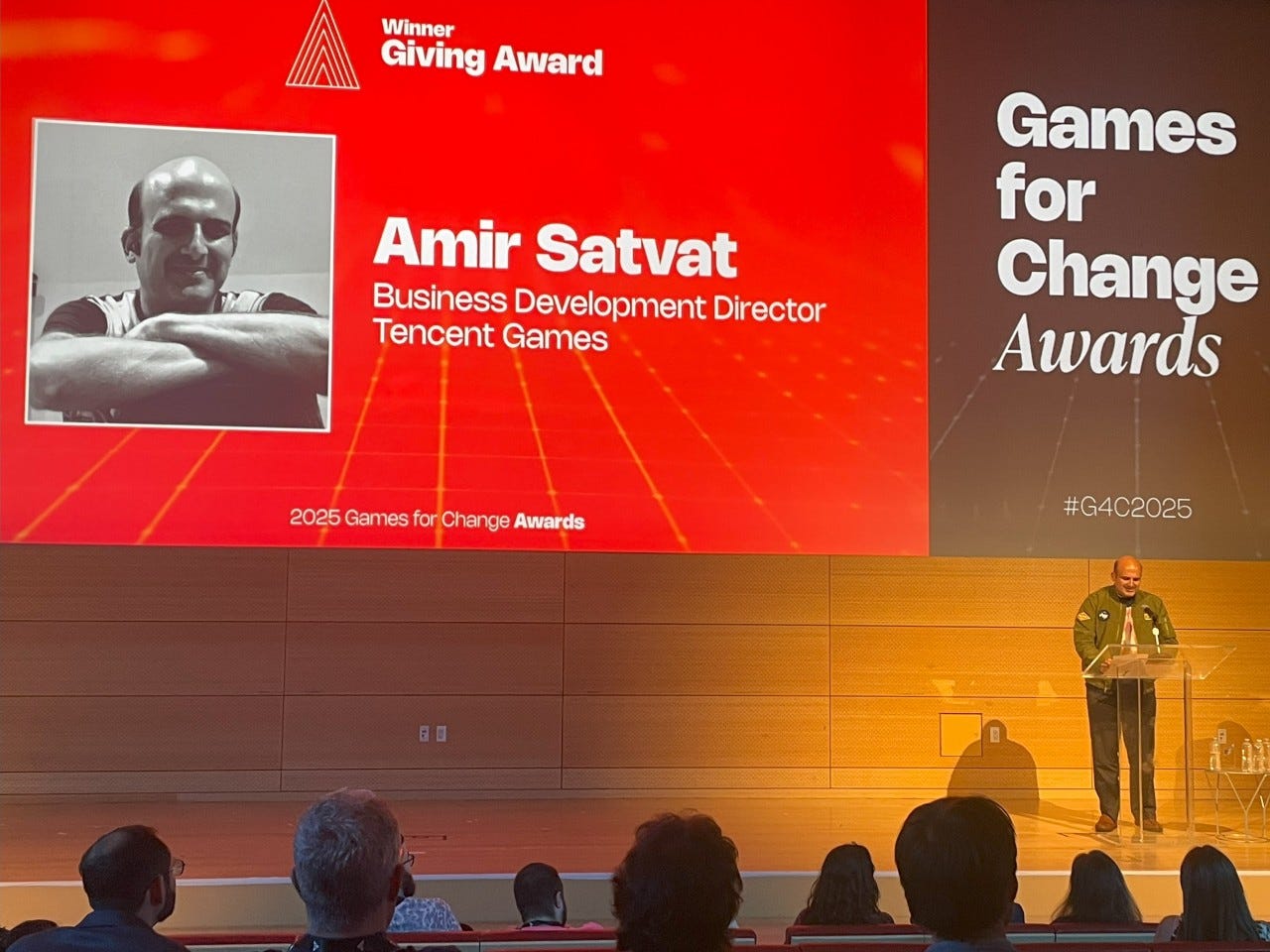
Afterwards, on LinkedIn, I asked him why he did so.
“I’m an only child and very close to my parents and my wife,” he responded. “They’ve lived incredibly selfless lives, and I honestly didn’t know how many chances I’d get to speak in a moment like that. I wanted to use that opportunity to honor them. So much of what people do to make the world better is unseen and uncelebrated, but it still matters deeply. I wanted to shine a light on that kind of quiet goodness.”
Amen.
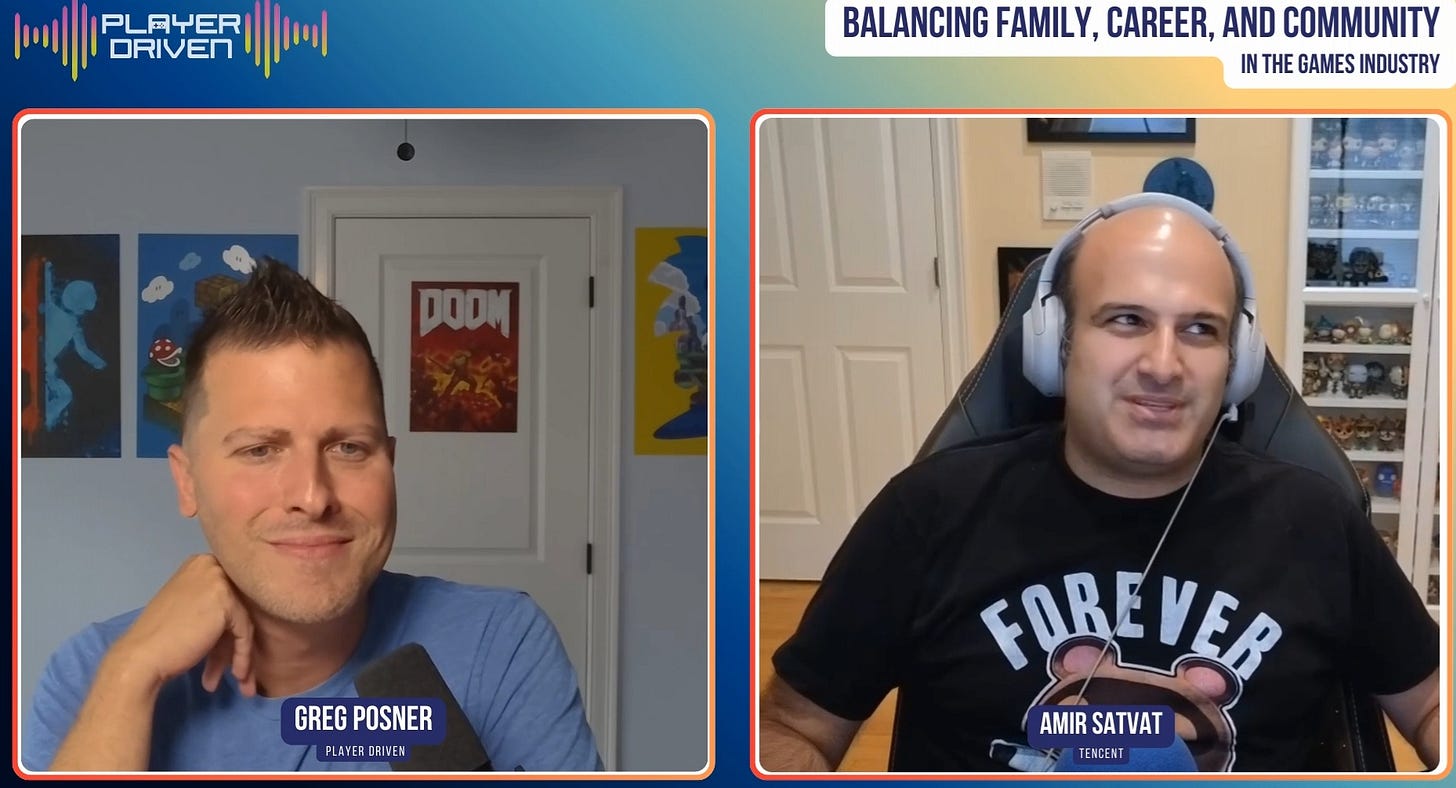
Before diving into three topics I found especially intriguing in Greg’s and Amir’s Player Driven exchange, Balancing Family, Career, and Community in the Games Industry with Amir Satvat, I must confess something: I’m biased. I like Amir and everything for which his community appears to stand. It’s like an irl stone soup story. It’s like how Wikipedia came together and caught fire, or a less dire variant of the story arc of Schindler’s List.
More than that, I was laid off from IDC, where I’d mostly researched the video game market for the past 15 years, this September. Shortly after meeting Satvat, I found myself in the same boat as the vast majority of those in his community. He was kind enough to give me a shout out on LinkedIn. It felt good. It felt really good.
You rarely discover who someone is when things are going well. You find out who they are when the chips are down. The pool into which Satvat chose to dive in 2023 was full of strangers who needed help.
Why did he do it? Is it all too good to be true?
One of my takeaways from the podcast is that Amir comes across as a sincerely generous and compassionate soul…that’s backstopped and tempered by a disciplined steeliness. Satvat has been around the block a few times. He appears to grasp that selflessness and compassion must be laser-focused for their effectiveness to be maximized. It’s this stouter, regimented side side of Satvat and his community that we’ll shed more light on below.
About a decade ago, a flash in the pan mobile hit game burst onto the scene: Flappy Bird. Its sole developer wasn’t prepared to have the spotlight of the gaming world trained on him. Imho, if Amir Satvat’s Game Community continues to grow and evolves into a more potent, substantive resource for game industry pros, its “special sauce,” in no small measure, will be a case of Satvat’s steely preparation meeting an opportunity for altruism.
On Breaking Into the Industry at 38, and Playing An IRL Time Management Sim Today
Every month or two, I literally block out, in Excel, a time grid, which is a guess that I, of course, vary off of, of like, here’s what the plan is for each day of the week based upon what I think is going to happen. I find that helpful for really a number of reasons, but one specific one, which is I try to tell myself, “Well, I need….and I’m totally making it up...15 hours a week to do the community stuff.” If that’s true, and I’m now budgeted 15 hours, how am I going to use that time and is that a sufficient allocation? So I try to be very purposeful about all of these types of things. - Amir Satvat
Amir’s road into gaming was circuitous. He earned an undergrad degree in business at Boston College and followed that up, in 2011, with an MBA from The Wharton School.
“I would say back to high school-ish, I had always hoped to eventually do something big that was community-related in games,” recalled Satvat. “That was, like, my dream. It wasn’t to be like VP of whatever, whatever production or something at some place, or be a game director. It truly wasn’t. And part of this comes from kind of my upbringing. My mom has always been very involved in, like, community work, volunteering, helping others, and that left a very deep impression on me.”
In between undergrad and grad school, Satvat did a stint as an analyst at Goldman Sachs, during which he focused on healthcare company performance.
“Because there weren’t healthcare care jobs” after graduating from The Wharton School, he says, “I made a little bit of a sidestep to tech BD [business development] and strategy. And then after doing that for a while, finally, at Amazon, I was able to make an internal transfer in 2020 from tech BD and strategy to games BD and strategy.”
(In our LinkedIn exchange, Satvat described his break into gaming this way: “I broke into the video game industry at the age of 38. I finally made it through because of the help of both my managers at AWS…Their support…made all the difference.”)
Satvat’s upbringing, family life, and educational and professional background clearly set him up to approach what would become Amir Satvat’s Game Community like a business. It’s tagline may be “Zero Profit, Infinite Caring,” but that doesn’t mean the business savvy and BD skills of its founder aren’t applied to the community’s processes on a daily basis.
“I think every person should have a basic understanding of corporate finance that you can learn through any number of MOOCs or YouTube courses online. Understanding how to read a 10K, understanding how the financials of a business work. Increasingly, let’s face it, there’s a lot more scrutiny on investment and costs. Like it or hate it, having some type of thoughtfulness about pursuing an audience, monetization, having, like, a long tail on games, it’s just more and more important.”
“BD itself is so different from organization to organization,” Satvat continued. “When I was at Prime Gaming in games, in that business, you know, we were providing skins, cosmetics, currency, free games, these types of things because it was a benefit program for being in Prime Gaming. And I had a team of BDs at the time. There it was really like a velocity shop. Like, we had to close tens of deals a year because you had to have that content for members every single month. If you contrast that with a place like Tencent [his current employer], where it’s a much more patient environment, definitely very different dynamics. So even within games, it’s different.”
Fast forward to today, and Satvat is constantly juggling his full-time job, the sprawling community, family obligations, and more, like an irl time management sim.
“I have, you know, blocks of time that are non-negotiable, both with respect to my job and community, for my family,” he explains. “Every day, my wife and I drive the kids to school together. Every day in the afternoon, my parents, bless them, bring them back. Every day from 5 to 8 or 5:30 to 8.30, that’s our family time where we do dinner. I spend some time with my wife and the children. They have their baths. They have their books. They go to bed. I...get up early enough to do all the work I need to do to have that family time.”
“And then, after that, I do our community stuff. And it can be a lot, but of course now I have a lot more people who help. I think when I started a lot of it, I was driving myself, but that’s becoming less true.”
“I do a huge amount of not only the content creation that I post on LinkedIn, but a lot of the community updates on the weekends. And I do it in batches and schedule or plan it out for the upcoming weeks.”
Networking and AI
I give a lot of advice to people on how to network and meet other people because we have a ton of data suggesting it is literally the most important thing you can do to get a job. It’s almost impossible to get anything on a cold application. - Amir Satvat
For Satvat, social networking isn’t something that those in the industry should only focus on if they’ve been laid off. Rather, it should be a routine activity everyone engages in because that helps to facilitate and nurture bonds, and it opens the door to sharing and learning in a low-pressure environment.
“Way too much of the time, people are like, ‘Oh, unfortunately, i just lost my job. Time to start networking. Time to start doing LinkedIn.’ And I’m like, ‘No, no, no. Like, you need to be doing that all the time.’ Or the reverse, they’re like, ‘I just got a job. Thank God I don’t have to post on LinkedIn anymore and I can disappear.’”
If someone is able to pay their bills and keep a roof over their heads, and if they have “a one year plus horizon, you can reach now out to someone and just say, ‘I’d like to get to know you better. I’d like to chat,’ and you can mean it. And there’s not like a secret agenda that, like, by email three, you’re like, ‘Can you get me a job?’ Doing that does not get you the job. What gets you the job, in my opinion, is when the person on the other side says, ‘Man, Greg is like so cool and he’s, like, so fun to talk to.’”
“It’s not some high-minded conversation about, like, I don’t know, subscription monetization trends or whatever. It’s just, like, relaxing. It’s talking about nonsense. It’s talking about what people are playing, how their families are, where they went on vacation.”
The more you can just level down conversation and intensity from, like, the one end of the scale, which I think you should never do, which is, like, “Can you get me a job?” to “I just want to spend time with you and have a fun conversation with you as a human,” that gets you where you want to go.
Satvat also suggests that current and aspiring game industry pros should approach AI like an ongoing educational opportunity. Some professions require continuing education to keep their credentials.
“My father, who’s a physician, you know, when you’re a doctor as part of being a physician, you actually have to take a certain number of credits of continuing education to remain certified,” said Satvat. “I’m like, well, why don’t we all think like a doctor and be, like, ‘Well, if I’m not doing X number of hours of continuing education, am I still certified to do my job?’”
“The thing that I really am pro is people in our community being employed. And if you want to maximize those odds, you don’t have to love AI. But you should be aware of…how it works and what the function is...It’s more likely you’ll lose your job to someone in a similar function who is capable of using AI and, like, you’re not.”
Too Good To Be True?
I put on display for others how I truly feel, which is, like, I don’t do this for money. I don’t do it for recognition. Although I suppose at some level that’s inevitable when you’re doing something that has a lot of visibility. - Amir Satvat
Time will tell if the distilled altruism which has, apparently, guided Amir Satvat’s Game Community from its inception, is maintained. To date, there has been no hint of an ulterior motive or nefarious agenda at play, although that hasn’t stopped a tiny fraction of observers from from presuming it exists.
“I, like any person who has some degree of public visibility, get some negativity too,” said Satvat. “It saddens me sometimes that so many of us carry such a disappointment and skepticism in the world, because we’ve been disappointed, because we believed in things and people that weren’t what we thought they were, because people ended up having some ulterior motive that, like, we couldn’t see at the outset. It does sadden me sometimes that a very, very small percentage of people, like, can’t believe that we would do something like this for the reasons we say we do. Like, there must be some angle. Like, he works at a company, there must be some angle. He works in, like, business development or has a finance background or whatever.”
Despite his detractors and skeptics, Satvat intends to keep plodding forward, one day at a time, and he seems to be in a good place personally and professionally in late 2025. It’s hard to argue that his high school dream hasn’t come true. If there is such a thing as karma, he’s also aware that his “pay it forward” investment has generated a massive return, and in true “Satvat fashion,” he appears eager to reinvest those proceeds into his community (and beyond, such as raising funds for Gamers For CHOC).
“It’s very humbling, sincerely, to be in this position. I think beyond all the resources and the sites, an often overlooked part of it, that I think a lot of people don’t see…is just the trust and one-to-one confiding from the community as well. That really surprises me, like, the hundreds of notes, sometimes in a week that I’ll get from people just being like ‘Amir, I’m like really sad, this happened,’ or even, like, more seriously, ‘Amir, like I lost my house, or I really need your help. I don’t know what to do with like my career and, like, my work.’ It’s pretty heavy stuff. You try your best to be that thing that people are looking for. It’s humbling, but also tough sometimes.”
“You have points in your career where you’re like, ‘I want to get title X’ or perhaps a better way of thinking about it, because I’ve never been that kind of orientation myself, ‘I would like to have this type of scope or be in this different type of situation’…I think people often get googly eyes for, ‘Oh, I want to be the VP. I want to be the head of whatever.’ And God bless it. There’s many wonderful people who occupy those roles and they’re a right fit for those people.”
“I’m like, ‘It’s just, it’s not for me.’ Like the amount of work balanced into everything else in my life is, like, plenty. And I think that’s actually a skill that we don’t talk nearly enough about in organizations, which is it’s okay to be, like, ‘I have enough. I have enough money. I have enough responsibility. I actually don’t need a promotion.’ I feel like in many organizations I’ve been a part of, that’s almost unusual…There’s almost this expectation that if you’re, like, sane, you would always unidirectionally want to keep going up. And that shouldn’t always be true.”
“I’m very lucky and grateful to Tencent that they give me the three things, sincerely, that’s all I wanted…BD, strategy, I get to do a little bit of both. I’m grateful that I can do my work with the community because that means a lot to me, and they respect that…I just hope everything stays exactly like it is for as long as possible so I can keep enjoying it and helping.”
At Games For Change, there was an idea floating around called generous giving. It can take many forms, but the bottom line is that when people in the games industry give generously to others in and around the community, and to the planet in terms of combating climate change and so on, that this giving creates a positive feedback loop of ongoing, optimistic change. In our LinkedIn exchange, I asked Satvat his thoughts about this idea.
“I love this question,” he responded. “I truly believe the purpose of life is to make others’ lives happier and better. It starts from the idea that you’re not just here for yourself, you’re here for others. The return on investment I care about is seeing people’s lives improve. If more of us lived that way, I think we’d all be better off.”