Who’s Really Driving the Game Industry Right Now? Microsoft, Nintendo, and the AI Crossroad
Live
•
February 5, 2026
•
Greg Posner


Who’s Really Driving the Game Industry Right Now? Microsoft, Nintendo, and the AI Crossroad
Live
•
February 5, 2026


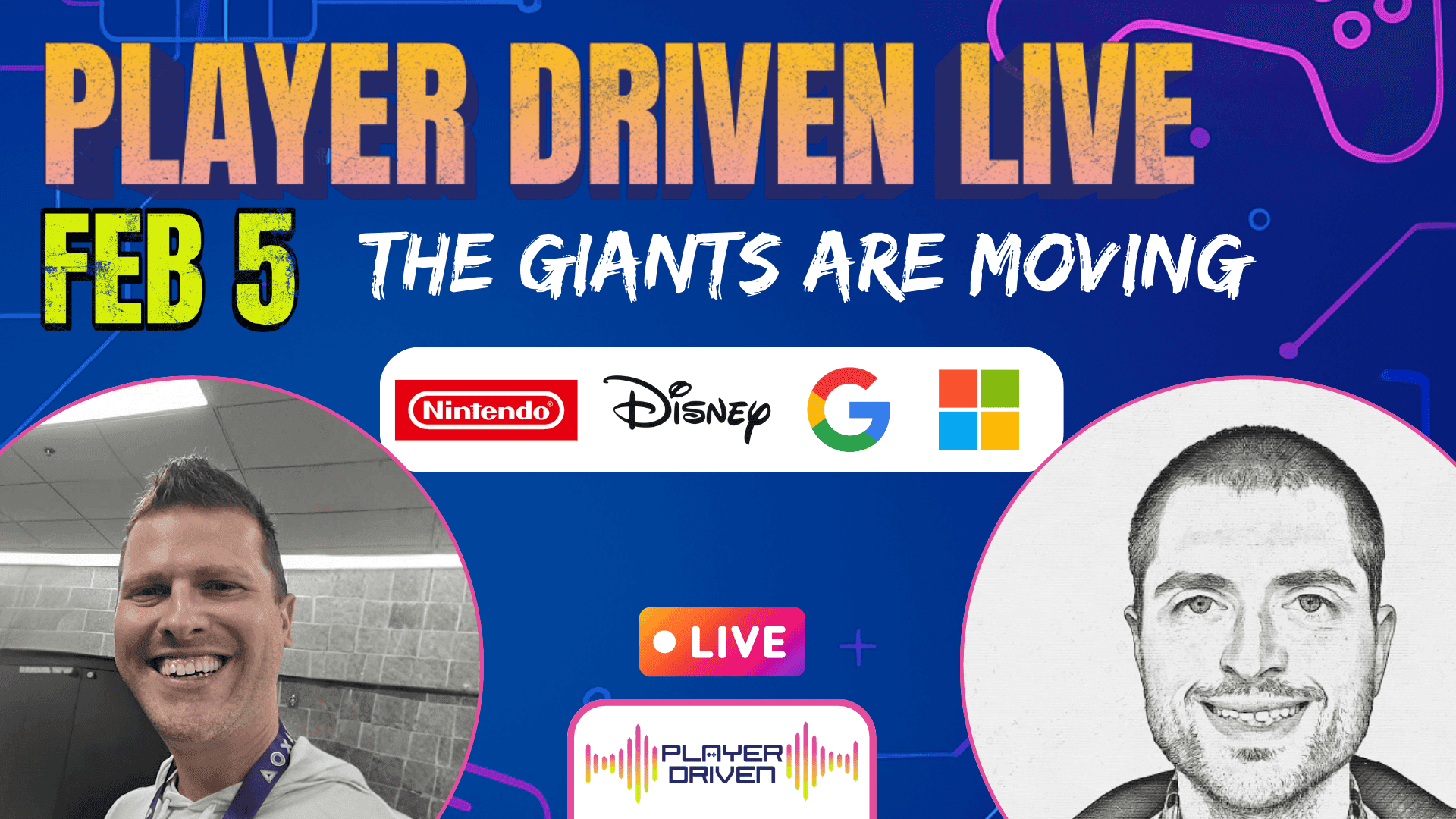
The gaming landscape is shifting beneath our feet. This week on Player Driven Live, we break down a whirlwind of high-stakes earnings calls, massive leadership changes, and the generative AI technologies that are forcing every major player to pick a side. From Microsoft's supply chain struggles to Nintendo’s absolute dominance with legacy IPs, here are the key takeaways from our February 5, 2026, episode.
Microsoft: The $68 Billion Question
Microsoft’s latest earnings were a paradox. While they generated massive profits, they missed revenue expectations by 9%—largely due to an inability to meet the explosive demand for AI chips and data centers.
The Gaming Dilemma:
The Acquisition Loop: Every major jump in Microsoft’s gaming revenue has come from buying growth (Mojang, ZeniMax, and Activision Blizzard King).
The Minecraft "Voldemort": Despite owning Minecraft—a game that makes up 7% of the entire gaming market—Microsoft rarely highlights it in corporate discussions.
Profit Margins vs. Opportunity Cost: Gaming remains less than 10% of Microsoft's total revenue. As AI infrastructure costs skyrocket, the pressure on gaming to hit 30% margins is becoming a significant internal strain.
Nintendo: Printing Money with "B-Tier" Legends
While others chase the latest hardware specs, Nintendo continues to "cook" by focusing on what they do best: timeless entertainment.
Explosive Growth: Nintendo reported net sales up 99% and net profit up 51% year-over-year.
The Mario Kart Juggernaut: Mario Kart World has already sold 14 million units, proving that Nintendo’s "A-list" exclusives are still the safest bet in the industry.
Physical Media is Alive: Nearly 59% of Nintendo’s software sales are still physical, a stark contrast to the rest of the industry's digital-first shift.
The AI Crossroad: Tool or Terror?
Google’s recent Genie 3 demonstration has investors trying to price out the future of game creation. But is AI a "printing press" moment or a bubble waiting to burst?
Efficiency vs. Artistry: AI is a "hammer"—it can be used to build or destroy. While it excels at automating repetitive tasks or finding technical solutions in seconds, it cannot replicate the core "game loops" that make a title fun.
The "Bag Holder" Risk: Microsoft is heavily exposed to OpenAI. If the AI bubble pops, the financial fallout for "Big Tech" could lead to massive budget cuts across their gaming divisions.
Disney’s New General: Josh D'Amaro
Disney has officially named Josh D'Amaro as the successor to Bob Iger. By elevating the head of their Parks and Experiences division, Disney is signaling that ecosystems and franchises matter more than any single distribution channel.
Why this matters for gaming: D'Amaro already oversees Disney’s gaming strategy and their $1.5 billion partnership with Epic Games. We expect Disney to lean further into "experience-based" gaming rather than traditional development, essentially offloading the risk of game production to partners like Sony and Epic while they reap the licensing rewards.
Final Thoughts: What’s Next?
The industry is currently defined by an air of uncertainty. Whether it's the shift toward transmedia (like the upcoming Yoshi and Zelda projects) or the tension between cloud infrastructure and console hardware, the winners of 2026 will be those who can maintain their "human" creative spark while using AI to cut the noise.
Microsoft: The $68 Billion Question
Microsoft’s latest earnings were a paradox. While they generated massive profits, they missed revenue expectations by 9%—largely due to an inability to meet the explosive demand for AI chips and data centers.
The Gaming Dilemma:
The Acquisition Loop: Every major jump in Microsoft’s gaming revenue has come from buying growth (Mojang, ZeniMax, and Activision Blizzard King).
The Minecraft "Voldemort": Despite owning Minecraft—a game that makes up 7% of the entire gaming market—Microsoft rarely highlights it in corporate discussions.
Profit Margins vs. Opportunity Cost: Gaming remains less than 10% of Microsoft's total revenue. As AI infrastructure costs skyrocket, the pressure on gaming to hit 30% margins is becoming a significant internal strain.
Nintendo: Printing Money with "B-Tier" Legends
While others chase the latest hardware specs, Nintendo continues to "cook" by focusing on what they do best: timeless entertainment.
Explosive Growth: Nintendo reported net sales up 99% and net profit up 51% year-over-year.
The Mario Kart Juggernaut: Mario Kart World has already sold 14 million units, proving that Nintendo’s "A-list" exclusives are still the safest bet in the industry.
Physical Media is Alive: Nearly 59% of Nintendo’s software sales are still physical, a stark contrast to the rest of the industry's digital-first shift.
The AI Crossroad: Tool or Terror?
Google’s recent Genie 3 demonstration has investors trying to price out the future of game creation. But is AI a "printing press" moment or a bubble waiting to burst?
Efficiency vs. Artistry: AI is a "hammer"—it can be used to build or destroy. While it excels at automating repetitive tasks or finding technical solutions in seconds, it cannot replicate the core "game loops" that make a title fun.
The "Bag Holder" Risk: Microsoft is heavily exposed to OpenAI. If the AI bubble pops, the financial fallout for "Big Tech" could lead to massive budget cuts across their gaming divisions.
Disney’s New General: Josh D'Amaro
Disney has officially named Josh D'Amaro as the successor to Bob Iger. By elevating the head of their Parks and Experiences division, Disney is signaling that ecosystems and franchises matter more than any single distribution channel.
Why this matters for gaming: D'Amaro already oversees Disney’s gaming strategy and their $1.5 billion partnership with Epic Games. We expect Disney to lean further into "experience-based" gaming rather than traditional development, essentially offloading the risk of game production to partners like Sony and Epic while they reap the licensing rewards.
Final Thoughts: What’s Next?
The industry is currently defined by an air of uncertainty. Whether it's the shift toward transmedia (like the upcoming Yoshi and Zelda projects) or the tension between cloud infrastructure and console hardware, the winners of 2026 will be those who can maintain their "human" creative spark while using AI to cut the noise.
Microsoft: The $68 Billion Question
Microsoft’s latest earnings were a paradox. While they generated massive profits, they missed revenue expectations by 9%—largely due to an inability to meet the explosive demand for AI chips and data centers.
The Gaming Dilemma:
The Acquisition Loop: Every major jump in Microsoft’s gaming revenue has come from buying growth (Mojang, ZeniMax, and Activision Blizzard King).
The Minecraft "Voldemort": Despite owning Minecraft—a game that makes up 7% of the entire gaming market—Microsoft rarely highlights it in corporate discussions.
Profit Margins vs. Opportunity Cost: Gaming remains less than 10% of Microsoft's total revenue. As AI infrastructure costs skyrocket, the pressure on gaming to hit 30% margins is becoming a significant internal strain.
Nintendo: Printing Money with "B-Tier" Legends
While others chase the latest hardware specs, Nintendo continues to "cook" by focusing on what they do best: timeless entertainment.
Explosive Growth: Nintendo reported net sales up 99% and net profit up 51% year-over-year.
The Mario Kart Juggernaut: Mario Kart World has already sold 14 million units, proving that Nintendo’s "A-list" exclusives are still the safest bet in the industry.
Physical Media is Alive: Nearly 59% of Nintendo’s software sales are still physical, a stark contrast to the rest of the industry's digital-first shift.
The AI Crossroad: Tool or Terror?
Google’s recent Genie 3 demonstration has investors trying to price out the future of game creation. But is AI a "printing press" moment or a bubble waiting to burst?
Efficiency vs. Artistry: AI is a "hammer"—it can be used to build or destroy. While it excels at automating repetitive tasks or finding technical solutions in seconds, it cannot replicate the core "game loops" that make a title fun.
The "Bag Holder" Risk: Microsoft is heavily exposed to OpenAI. If the AI bubble pops, the financial fallout for "Big Tech" could lead to massive budget cuts across their gaming divisions.
Disney’s New General: Josh D'Amaro
Disney has officially named Josh D'Amaro as the successor to Bob Iger. By elevating the head of their Parks and Experiences division, Disney is signaling that ecosystems and franchises matter more than any single distribution channel.
Why this matters for gaming: D'Amaro already oversees Disney’s gaming strategy and their $1.5 billion partnership with Epic Games. We expect Disney to lean further into "experience-based" gaming rather than traditional development, essentially offloading the risk of game production to partners like Sony and Epic while they reap the licensing rewards.
Final Thoughts: What’s Next?
The industry is currently defined by an air of uncertainty. Whether it's the shift toward transmedia (like the upcoming Yoshi and Zelda projects) or the tension between cloud infrastructure and console hardware, the winners of 2026 will be those who can maintain their "human" creative spark while using AI to cut the noise.
Share
Copy link
Share
Copy link
Share
Copy link
Related
Subscribe for player.driven updates
© Player Driven
2026