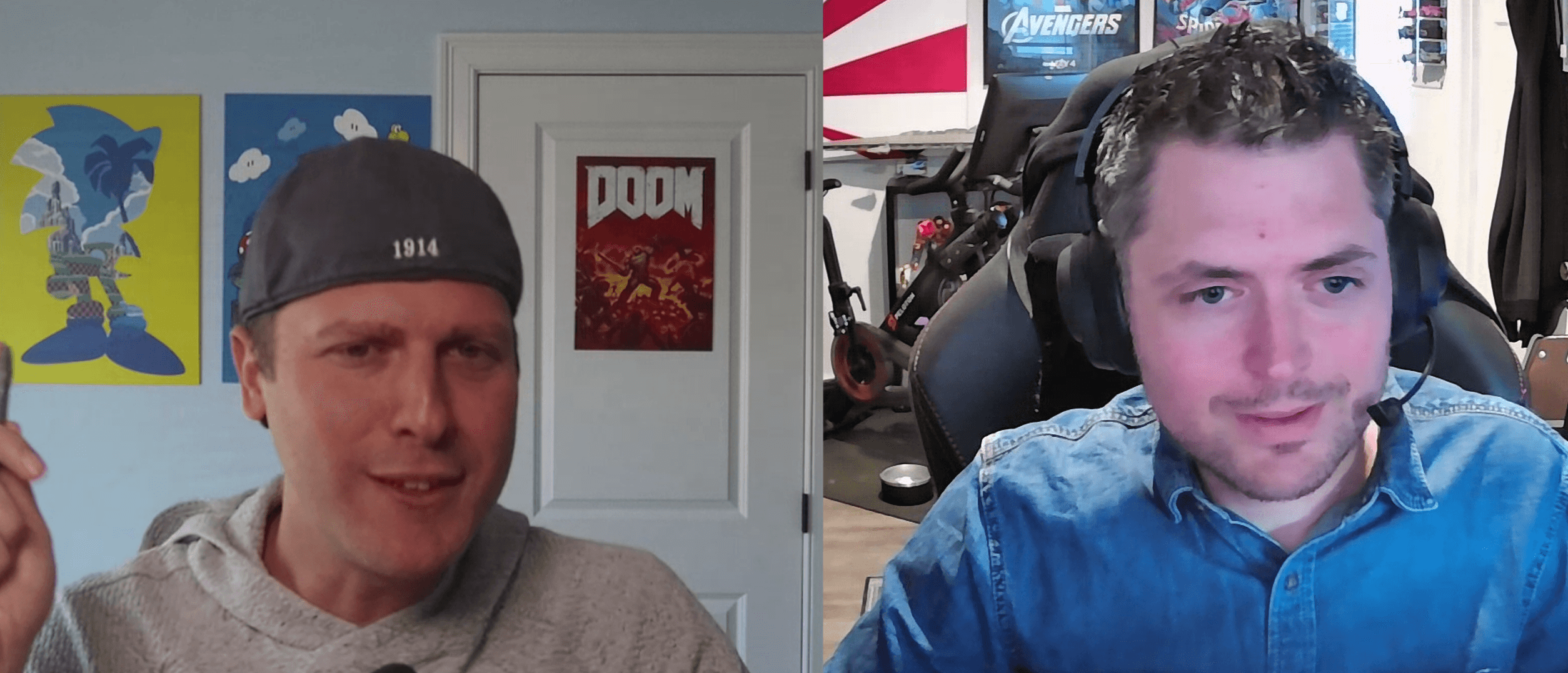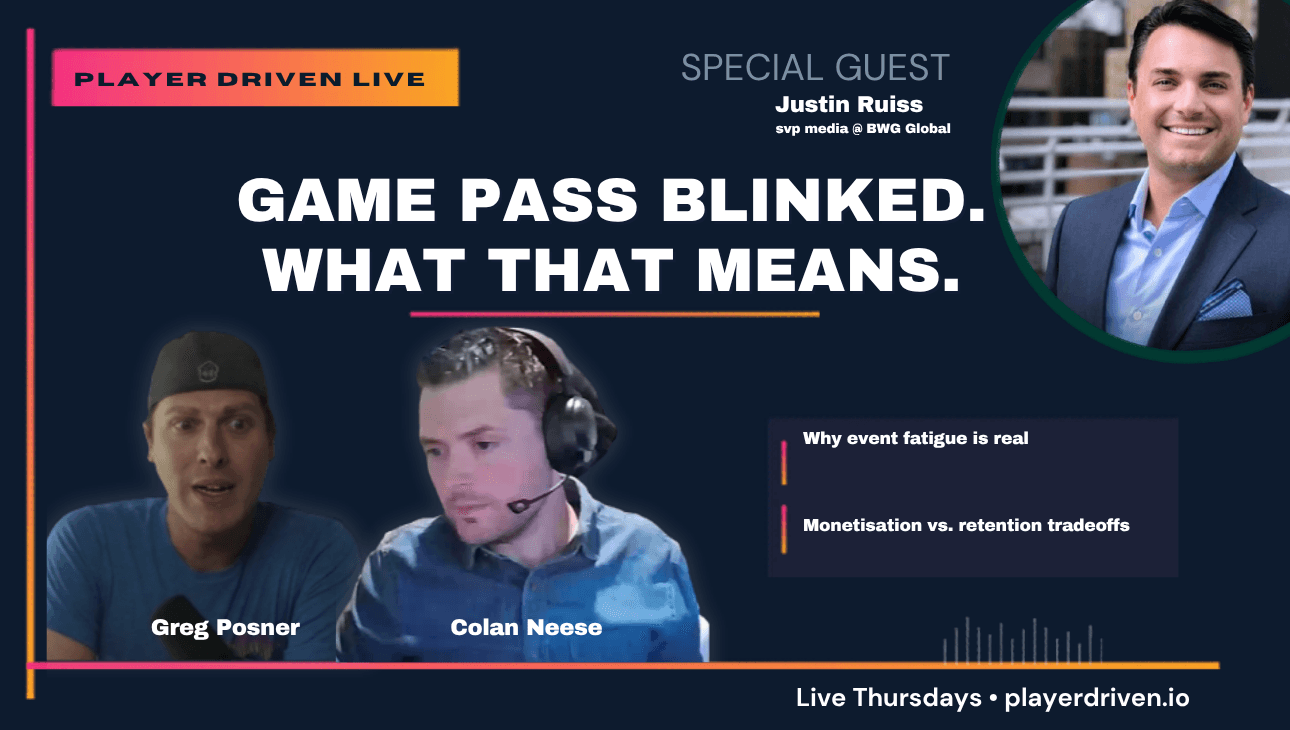
Microsoft dropped more industry news in 72 hours this week than most companies release in a quarter. The centerpiece: Call of Duty is leaving Game Pass. On this week's Player Driven Live, we brought in Justin Ruiz — SVP of Media Research at BWG Global, a primary research firm that runs executive-level forums across media, gaming, and ecommerce — to break down what's actually happening inside the Xbox business model, what it means for the future of gaming subscriptions, and whether an ad-supported gaming future is closer than anyone wants to admit.
Here's what we covered.
Call of Duty Leaves Game Pass — And Nobody Should Be Surprised
Colan called this three months ago. Microsoft spent an estimated $300 million putting Call of Duty on Game Pass in the first year alone — and Lord knows how much more with Black Ops 7 — and it didn't work the way the model promised.
The problem wasn't just that Black Ops 7 underperformed. The problem is structural: lifetime value doesn't equal cash in hand. And right now, Microsoft is in a cash-in-hand business. They're building server farms to feed the AI infrastructure boom, and subscription revenue tied to LTV projections doesn't write those checks.
The only way to get cash is to sell a product. The only way to sell a product is to stop giving it away for free.
What's notable is that Microsoft also quietly lowered the price of Game Pass at the same time — reportedly after seeing roughly 25% subscriber bleed on the Ultimate tier. They found the price point people weren't willing to pay, which means they're now chasing win-back on users they already lost. That acquisition cost is real.
The broader takeaway: this isn't a pivot. It's a correction to a business model that was always going to run out of road. Sony windowed their titles after nine months from the start. Nintendo won't even put current-gen titles on their subscription catalog. Xbox tried to build Netflix for games and learned the same lesson film studios learned — your biggest titles are your leverage, not your giveaways.
The Ad-Supported Gaming Future Is Coming — The Question Is Who Gets There First
Justin brought the media buyer perspective, and it reframed the whole conversation.
Gaming platforms represent one of the most valuable advertising environments that brands have barely touched. Captive audience. Near-100% video ad completion rates. First-party data from credit cards, browsing behavior, and platform accounts all in one closed loop. For a media buyer used to fighting for 30% completion on social, those numbers are extraordinary.
The tiering model is already inevitable. Colan laid it out using the Disneyland analogy: there will always be the one-percenters paying for zero friction (the Sherpa tier), the middle class paying for Lightning Lane access, and the standby line — which is what ad-supported gaming looks like. You get to play eventually, but you take your medicine getting there.
Most people will end up in the standby line. Some will pay for reduced ads. Very few will pay for the premium no-ad experience. That's the model across every media category right now, and gaming is not exempt.
The better question is: which platform gets there first?
It's not going to be Valve. They're a private company printing money and have zero incentive to introduce friction. It's not going to be Sony — ads aren't in their DNA at scale. It's not going to be Nintendo under any circumstances. That leaves Xbox as the most likely candidate to pioneer in-platform advertising in gaming, and their track record in advertising is, charitably, troubled — Xandr, the failed Netflix ad partnership, losing search to Google — but the structural opportunity is real regardless of execution history.
The key insight Justin flagged: the reason in-game advertising has never worked at scale is that every company trying to do it doesn't own the inventory or the platform. Networks like Anzu are trying to broker ad space in games they don't control on platforms they don't own. When it works, the platform squeezes them. When it doesn't, they have nothing to stand on. Microsoft owns both the platform and, now, a significant portion of the game catalog. That's a genuinely different position.
Reddit, Meta, and Where Ad Spend Is Actually Going
Justin's research firm runs 30 media buyer forums per month. The data from their latest social media survey showed a few things worth flagging for anyone in the gaming marketing space:
Meta still dominates. Facebook and Instagram take the lion's share of ad spend with no signs of losing ground.
TikTok is still appreciating. Historically strong for brand-focused campaigns, TikTok is now seeing direct response and performance activity grow alongside it.
Reddit is the sleeper story. Contextual targeting on Reddit is proving genuinely powerful, and for gaming specifically, it's where players live, do research, and make purchase decisions. Justin was direct: if you're not authentic on Reddit, don't bother. Brands that try to insert themselves without earning credibility get run off fast.
Amazon and Roku are holding strong on CTV. Both are seeing solid attribution and growth on the connected TV side, which matters increasingly as gaming and streaming converge.
The Discord Wild Card: Partnership, Acquisition, or AI Play?
One of the more interesting threads of the episode was the teased Xbox/Discord partnership news. Nobody knows yet what it actually is — Colan speculated it could be as mundane as Nitro bundled with Game Pass — but the more interesting question is what a deeper relationship could look like.
Colan made a compelling case that Discord's real destiny has always been acquisition, not IPO. The platform is deeply niche in gaming, investors are unlikely to see the return they need from a standalone public company, and the combination of Discord's community data with Microsoft's platform ambitions could justify a deal on multiple levels — advertising scale, Steam-competitive community infrastructure, and crucially, proprietary training data for Microsoft's AI models as they navigate their complicated divorce from OpenAI.
Greg's framing: what Steam is actually missing is community. Game Pass plus Discord integration doesn't just make Microsoft more competitive — it creates something that doesn't exist yet in gaming: a true platform-native community layer with real data on top.
Whether this is the play or not, the public partnership news signals at minimum that both companies see value in getting closer. The details will matter.
Halo's Future: Extraction Shooter, Shadow Drop, and a Franchise on Life Support
The last major Xbox story of the week: a leaked hint at a Halo extraction shooter.
Colan's reaction was immediate and not complimentary. His thesis: the franchise has been mismanaged since Microsoft parted ways with Bungie, the Showtime series made it worse, and nobody under 38 is organically invested in Master Chief at this point. Pivoting toward extraction shooters — a crowded genre with Tarkov, Marathon, and Arc Raiders all competing — feels like chasing a trend too late with an IP that needed a fundamentally different strategy.
Greg offered a counterpoint: there's a rumored Master Chief Collection shadow drop on PlayStation ahead of summer, and if executed right, that's actually a smart play. Give PlayStation users their first taste of Master Chief for free heading into school vacation season, then drop the multiplayer experience and monetize through microtransactions. It's the windowing model applied to franchise building — use the catalog as top-of-funnel and capture in-game spend on the back end.
The debate surfaced a broader tension: Halo's identity is multiplayer. The people who love it grew up on GameSpy tunnels and Halo 2 matchmaking. Justin floated the idea of a tight, single-player narrative experience — no multiplayer, 8 hours, $30 to $40, let MachineGames do it — as a way to rebuild franchise credibility before swinging for the fences again. Colan pointed to Perfect Dark as a cautionary tale: same logic, very different outcome.
There's no clean answer here. The franchise has real equity with a specific demographic and almost none with the audience that's currently spending money on gaming. Whatever Microsoft does next with Halo has to stick.
Games Worth Watching: Bond, Forza Horizon 6, Saros, and Assassin's Creed Pirates
The back end of the episode got into the game slate, with a few takeaways:
007: Road to a Million (IO Interactive's Bond game) is generating real momentum. Greg watched the gameplay demo and came away genuinely excited — the environmental interaction, mission flexibility, and cinematic quality fill a gap that Sony left when they stopped making Uncharted. Colan agreed it looks solid but flagged the real risk: it's launching the same week as Forza Horizon 6, which is going to dominate the conversation.
Forza Horizon 6 is Colan's early call for the Q2 "it game." He also made the interesting observation that Forza may be the one franchise that genuinely benefited from Game Pass — because car sims have a high skepticism barrier at purchase, but once players get in for free, they convert. It's reportedly outselling Gran Turismo on PlayStation, which is a win for Xbox as a publisher even if the hardware story is complicated.
Saros has quiet momentum for the roguelike crowd.
Assassin's Creed Pirates is on the agenda for next week. Colan flagged Ubisoft's event happening the same day, and the broader Ubisoft story — the bell curve of goodwill, the missed opportunities with Black Flag's naval combat, the live service overhang — is a full episode on its own.
Crimson Desert got a mention too, with general consensus that it's a keyboard-and-mouse game that was incorrectly shipped to console players.
The Bigger Picture
What tied this episode together was a single underlying current: the gaming industry is repricing its core assumptions about how to make money. Subscription as a growth engine is running into the same wall every other media category hit. Advertising is the next layer, and the first platform to execute it well — with the data, the inventory, and the patience to not blow it on execution — will have a meaningful structural advantage.
Microsoft has the pieces. Whether they have the execution is the open question they've been asking themselves for 25 years.
Player Driven Live airs weekly. Join the conversation in our Discord — link at playerdriven.io.