When most of the gaming industry talks about where games get made, the conversation defaults to California. Los Angeles. The Bay Area. Maybe Seattle. New York City almost never enters the picture. But the data says it should.
Gaming jobs in New York City have tripled since 2008. The average wage in the industry is approximately $106,000, roughly 14% above the citywide average. Over half of NYC's game development firms are independent — solo founders or teams of fewer than five. And on May 9, 2026, the city is hosting the second annual NYC Video Game Festival at Convene Brookfield Place, capping a four-year buildout that has grown from 400 students on the deck of the Intrepid to more than 1,500 attendees in midtown.
For an industry obsessed with West Coast dominance, NYC's gaming buildout is one of the more interesting workforce development stories happening anywhere in the country. And it has been almost completely invisible to anyone outside the city.
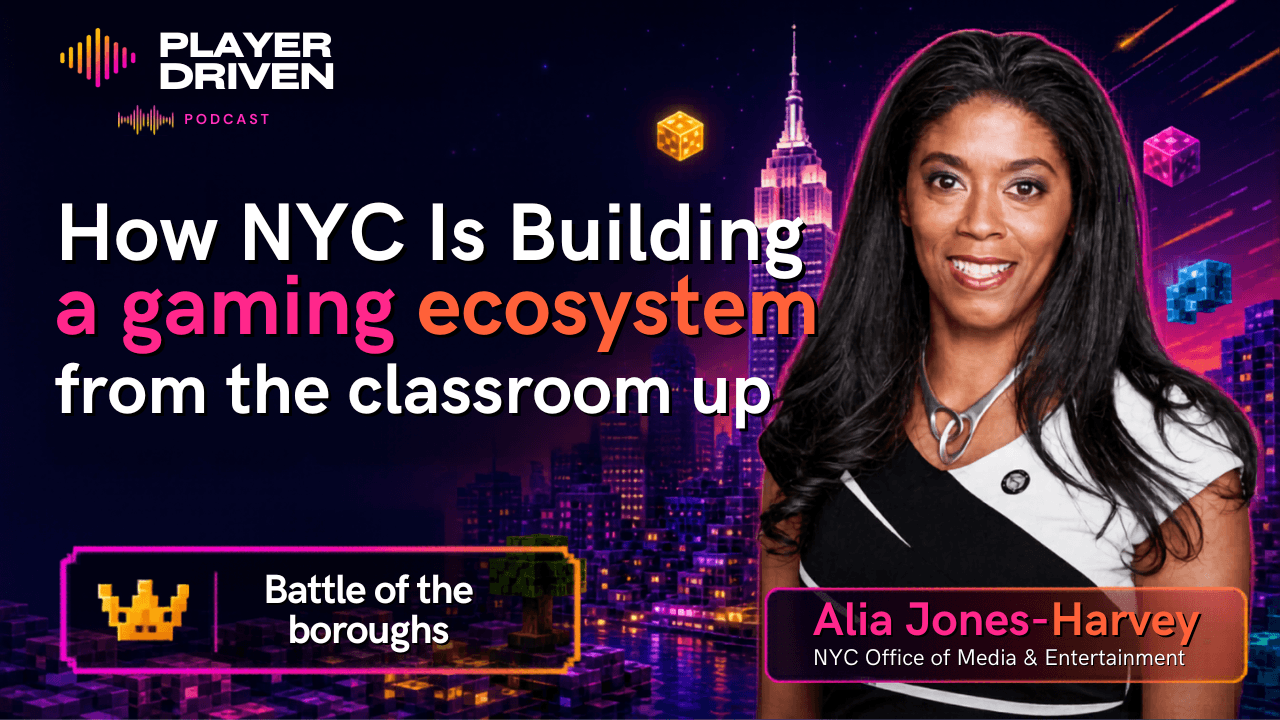
This piece is built around a recent Player Driven conversation with Alia Jones-Harvey, Associate Commissioner of Education and Workforce Development at the New York City Mayor's Office of Media and Entertainment (MOME). It walks through what the city has actually built, the data that justifies the investment, and where the strategy goes from here.
The 2021 Study That Started Everything
The foundation for NYC's current gaming strategy is the 2021 NYC Games Industry Economic Impact Study, commissioned by MOME under Commissioner Anne del Castillo. Three findings from that study still drive the city's playbook:
Jobs and wages are growing fast. The number of gaming industry jobs in NYC has tripled since 2008. The average wage in the industry is around $106,000 annually, which is 14% higher than the citywide average wage of $93,000. This is not a low-margin creative industry. It is the kind of high-wage, high-skill employment most cities are actively trying to recruit.
The community is bigger than the headcount suggests. While the study counts roughly 7,600 full-time gaming industry jobs in NYC, it identifies an additional 18,000 freelance creatives and game developers working in the city. That brings the actual gaming community to more than 25,000 people, most of them working independently or on small teams.
Most NYC studios are tiny. Over half of game development firms in NYC are independent — solo developers or teams of fewer than five. This is a city of indies, not major publishers. Any strategy that ignored this would have been built for the wrong industry.
These three findings — the jobs, the freelance scale, and the indie composition — shape almost every program MOME has rolled out since.
Battle of the Boroughs: A Pipeline Born in the Pandemic
The most visible piece of the NYC gaming strategy is also the one most outsiders haven't heard of: Battle of the Boroughs, the city's K-12 Minecraft competition.
The program's origin is more organic than most government initiatives. As Jones-Harvey explained, two leaders from the New York City Department of Education — Jose Perez and Anthony Casasnevis — brought the idea to MOME after the formation of a digital games industry council. During the pandemic, students at one school had organically started an esports group inside Minecraft. From that, a citywide format emerged: school teams from each borough compete to design a more sustainable version of New York City inside Minecraft.
"I was so excited by the idea that students were actually using games to apply real-world solutions. They are already gamers. They are already excited about gaming. And now we're using that to fold in teamwork, public speaking, strategy, critical thinking, research, problem solving."
— Alia Jones-Harvey
The pitch from Perez and Casasnevis came with a specific request: would MOME sponsor an in-person final event where the borough champions could compete? The first one was held on the Intrepid four years ago, in June, on the day the mayor came aboard to award trophies. About 400 people attended. Twenty expo partners showed up. Microsoft, Samsung, and Adobe contributed hardware. The winning high school took home all the chairs and desks from the competition — the first new game lab seeded by the program.
The event has grown every year since:
Year | Venue | Attendees | What was new |
|---|---|---|---|
Year 1 | The Intrepid | ~400 | 20 expo partners, mayor awards trophies |
Year 2 | Brooklyn Public Library | 1,000+ | 40 partners, VR experiences, robot dogs, shoutcasters |
Year 3 | Convene Brookfield Place | 1,500+ | Collegiate esports added, indie playtesting integrated |
The Year 3 venue is the same one that will host the May 9 festival, which has now formally been rebranded as the NYC Video Game Festival.
The Connected Pipeline
What makes Battle of the Boroughs interesting is not the program itself. It is what the program connects to. Jones-Harvey was clear that the festival is, in her words, "the ecosystem all in harmony working together" — and the ecosystem has four layers.
1. K-12 Students Building in Minecraft
Battle of the Boroughs sits at the bottom of the pipeline. Public school teams across the five boroughs design more sustainable versions of NYC inside Minecraft. The program teaches teamwork, research, critical thinking, and public speaking — skills that have nothing to do with coding but everything to do with being a working adult in any creative industry. The mayor's stated goal, per Jones-Harvey, is to seed a game lab at every NYC public school. The system has more than a thousand schools. So far, they're a handful in.
2. CTE Schools Teaching Game Design
When MOME first started this work, exactly one Career and Technical Education (CTE) school in NYC was running a game design curriculum on Unity. Today there are five CTE high schools with state-approved game design programs, meaning students can graduate from a NYC public high school with formal credentials in game design.
The CTE program is curriculum- and pedagogy-driven, and the state must approve each school's program. The fact that five have now been certified means game design is no longer a side project for after-school clubs. It is a formal academic pathway.
3. City College and Higher Education
NYC's flagship public higher education investment in gaming is at City College, which now offers a bachelor's degree in game design. The most interesting detail about that program — and one that Jones-Harvey returned to repeatedly during our conversation — is where the degree is housed.
"The game design program actually sits in the school of the arts. While there is a coding element of games, the art is what I think is as significant as the coding element of games."
This is not just a curriculum-design choice. It is a philosophical statement about what gaming is. By housing game design in arts rather than engineering, City College is recognizing the discipline as a creative practice first and a technical practice second. Jones-Harvey said her next frontier is getting NYC public school arts programs to make the same recognition — to treat games as art alongside STEM, not as a STEM-only category.
4. Indie Developer Community
The top of the pipeline is the indie scene that absorbs the talent the rest of the system produces. NYC's indie game development community is dense and tightly networked. Organizations like OS NYC and Wonderville host regular playtesting events for indie studios. The city sponsors Play NYC, Games for Change, and the Game Devs of Color Expo — three of the most important community events for indie developers in the country.
What MOME has discovered through outreach is that NYC indies don't operate in isolation. They actively support each other on coding, narration, art, animation, music, and playtesting. Most indie studios in the city are too small to staff every discipline — so they swap. That mutual-support network is what Jones-Harvey calls "the special nature" of the NYC gaming community.
Why "Community" Is the Through-Line
Across every program MOME runs, one word keeps coming back: community. It is the through-line that ties the entire strategy together.
"It is a community-driven industry, and I think that's the special nature of it."
— Alia Jones-Harvey
This framing is not marketing. It is the actual logic of the strategy. Growing the industry means feeding the pipeline of students. Feeding the pipeline of students means supporting the indie studios they will eventually join or build. Supporting indie studios means giving them peer networks they can plug into. Each layer depends on the layer below it. The system only works as a connected whole.
This is also why the NYC Video Game Festival functions as the strategy's centerpiece. The festival is the only event where students, parents, educators, college programs, indie developers, and industry sponsors are physically in the same room. Parents who came expecting to watch their kid play Minecraft end up walking past indie studios actively building games in NYC. Students who came to compete end up seeing collegiate esports teams from CUNY schools. Indie developers who came to playtest end up meeting the next generation of users — and getting honest feedback that their adult playtesters can't always provide.
Jones-Harvey put it bluntly: at the festival, "you have these kids that are now passionate about these games that are being made in the city. And, eventually, maybe they're going to want to look for jobs or follow these things."
That is the business case for community-driven industry building, articulated in one sentence.
NYC Video Game Festival 2026: What to Expect on May 9
The 2026 NYC Video Game Festival is on Friday, May 9, 2026, from 9 AM to 6 PM at Convene Brookfield Place in lower Manhattan. The event is free and open to the public.
What's on the schedule:
Battle of the Boroughs finals. The borough-champion teams compete to design the most sustainable NYC build in Minecraft.
Collegiate esports circuit. Added to the festival in Year 3, featuring teams from CUNY schools and other NYC-area colleges.
Indie game playtesting. NYC indie developers showcase work-in-progress games and get live feedback from attendees.
Drone soccer. Added in 2026 in celebration of the FIFA World Cup coming to the New York/New Jersey area.
F1 simulators and AI-powered activations. Expanded technology demonstrations on the floor.
Career expo. Forty-plus partners spanning higher education programs, NYC studios, and industry sponsors.
The festival also formally kicks off NYC Summer of Games, MOME's umbrella initiative connecting the festival to Games for Change, Play NYC, the Game Devs of Color Expo, and other community events running through the summer.
For the latest details and registration, see MOME's NYC Video Game Festival page.
Why This Matters Beyond NYC
The most interesting thing about NYC's gaming strategy is not what it has built. It is who is now copying it. Jones-Harvey acknowledged that other states and cities have started mimicking the Battle of the Boroughs format, attempting to run their own school-based Minecraft competitions tied to industry development.
That is, in her words, "exciting and flattering." But the deeper insight is that NYC has built something other markets are now treating as a template. The pipeline approach — connecting K-12 to CTE to higher education to indie community — is a blueprint that any city with a gaming workforce ambition could adapt. Most haven't yet.
For working professionals in the gaming industry, NYC's strategy raises a real question: if the West Coast is no longer the only city actively investing in gaming as workforce development, where else should we be paying attention? And what does an East Coast gaming hub look like if it actually succeeds?