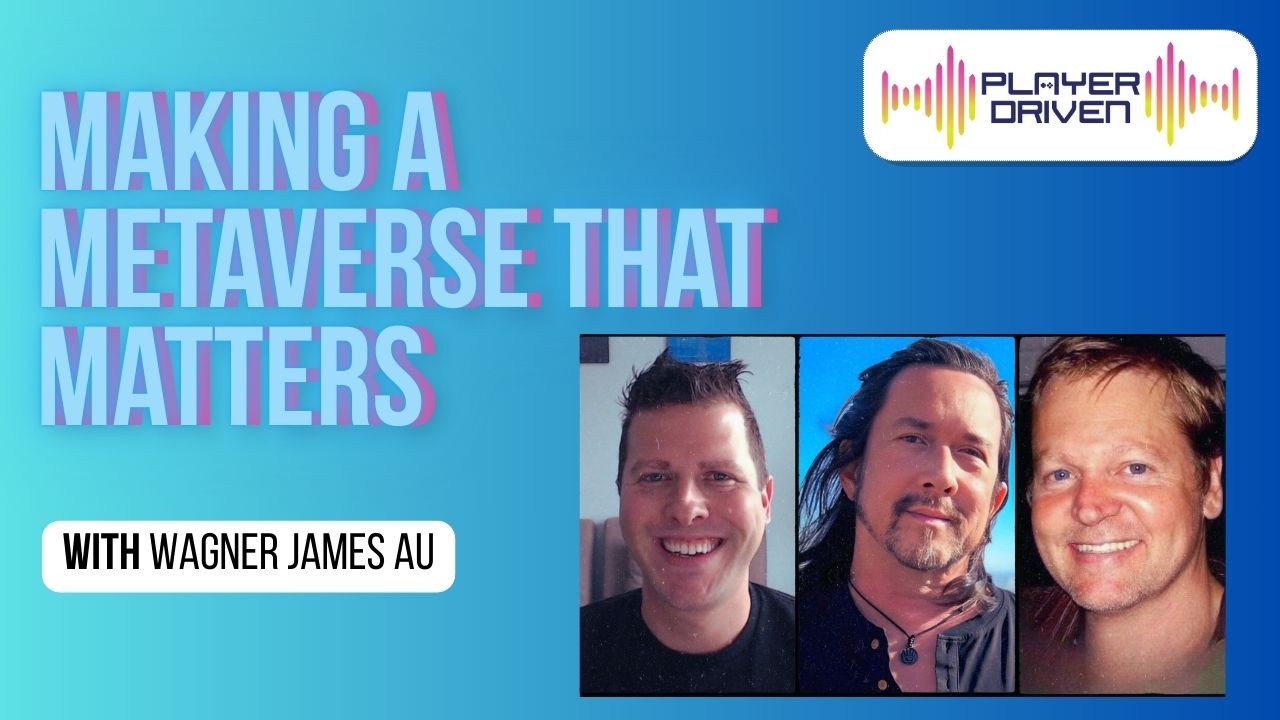
Making a Metaverse that Matters
Podcasts
•
December 9, 2025


What Roblox, Fortnite, and Second Life Got Right While Big Tech Lost the Plot For the better part of five years, the word metaverse has been dragged through every hype cycle imaginable. VR headsets. Crypto land. Digital real estate. AI glasses. Corporate boardrooms inside cartoon offices. Somewhere along the way, the actual meaning of the metaverse got lost in press releases and product launches. On a recent Player Driven episode, we sat down with Wagner James Au, author of Making a Metaverse That Matters and one of the longest-running embedded journalists inside Second Life. Joining the conversation was industry analyst Lewis Ward, bringing deep context from decades of tracking virtual worlds, XR, and interactive platforms. What followed was not a speculative future-gazing session. It was a grounded, sometimes uncomfortable look at what actually makes a metaverse work and why so many attempts failed publicly while quieter platforms scaled in plain sight.
The Metaverse Was Never About Headsets
One of the most important corrections James makes early in the conversation is simple but devastating to most corporate strategies. The metaverse is not defined by VR. It is defined by what happens when millions of people share persistent 3D spaces with identity, expression, economy, and social gravity layered on top.
Second Life had all of this more than 20 years ago. Fully customizable avatars. Real-time creation tools. A functioning currency that could be exchanged for real-world money. Social hubs where people formed genuine relationships that carried into the real world. It looked strange, it was clunky to onboard into, but once you were in, you rarely left.
James pointed out something that feels obvious in hindsight but gets ignored constantly. The most powerful feature of any virtual world is not visual fidelity. It is access to other people.
Why Avatars Change How People Behave
One of the most fascinating parts of the discussion centered on avatars and identity. Avatars are not cosmetic choices. They are psychological interfaces. James explained the Proteus Effect, where users who feel confident in their avatar often carry that confidence into real-world behavior.
For younger players especially, avatars become test spaces for identity. You can be bolder. You can be quieter. You can experiment with how you move through social spaces without the same emotional risk as real life. This is why forced realism almost always fails. People do not go to virtual worlds to mirror who they already are. They go to explore who they might become.
Roblox understands this deeply. Fortnite understands it through skins and performance. VRChat thrives almost entirely on it. And it is exactly where Meta misread the room by trying to recreate office culture instead of social culture.
Roblox and Fortnite Didn’t “Build a Metaverse.” They Built Gravity.
At one point in the episode, James drops a stat that reframes the entire conversation. Roblox now sits around 360 million monthly active users. That scale did not come from marketing itself as a metaverse. It came from being instantly fun, instantly social, and instantly accessible.
Both Roblox and Fortnite succeeded because you can jump in quickly with friends, on nearly any device, and start doing something together within seconds. There is no philosophical onboarding. There is no “what is this place supposed to be” confusion. You play, you socialize, and everything else layers in naturally.
Contrast that with the framing that Meta introduced. The metaverse was pitched as workspaces, shopping malls, and meetings. Second Life tried a similar path early on and learned the hard way that you cannot lead with real-world utility before people actually want to be there.
Fun is not a feature. It is the prerequisite.
The Quiet Lesson Second Life Taught the Industry About Money
Second Life was one of the first virtual worlds to let creators cash out real income. Some creators made millions building virtual fashion, architecture, and scripted experiences. It also accidentally created one of the earliest case studies in virtual financial collapse.
Unregulated virtual banks popped up. High-yield investment schemes followed. Eventually, one imploded and wiped out massive amounts of virtual wealth. Gambling followed a similar arc. Linden Lab had to step in and regulate both.
What surprised most observers was what did not happen. The community did not collapse. The users did not disappear. The world stabilized because people were not there primarily to make money. They were there because they had friends, routines, identity, and belonging.
James summed it up with a line that applies to every Web3 experiment that came after. If people arrive for profit first, the platform will collapse when the profit disappears.
This is where most NFT-based worlds failed. They monetized before they mattered.
Intrinsic Motivation Is the Only Thing That Scales Long-Term
Lewis Ward pushed the conversation into one of the most important psychological distinctions in games. Intrinsic motivation versus extrinsic motivation.
Intrinsic motivation is why people play. Mastery. Social connection. Expression. Fulfillment. Belonging.
Extrinsic motivation is layered afterward. Currency. Rewards. Marketplaces. Speculation.
When platforms reverse the order, players feel exploited. This is why play-to-earn collapsed so quickly. Players immediately recognized when the fun was secondary to financial mechanics.
By contrast, games that feel meaningful first naturally grow economies later. Fortnite’s cosmetic economy is a direct result of social identity, not a replacement for it.
Community Always Beats Technology
Second Life still averages around 600,000 active users today. Many of them have been there for over a decade. That level of retention is almost impossible in modern live service standards.
The reason is simple. Once a player makes one meaningful friend inside a virtual world, churn collapses. Relationships create gravity. Gravity creates permanence.
James explained that Second Life’s brutal onboarding only works because veteran users personally guide new players. The platform itself does not convert people. People convert people.
This is the most overlooked lesson in the metaverse conversation. Community is not a marketing output. It is the infrastructure.
Why Safety and Governance Decide Everything
VR does not remove human behavior. It amplifies it. When Meta launched Horizon Worlds without fully implemented trust and safety systems, harassment became a public brand narrative almost immediately.
By contrast, platforms like VRChat built layered reputation systems where good behavior unlocks access over time. Toxic users self-isolate. Healthy communities self-reinforce.
James and Lewis both made a point that should concern anyone building persistent digital worlds. If you do not design around identity protection, harassment prevention, and economic trust, you are not building a metaverse. You are building a legal and brand liability.
So What Actually Makes a Metaverse That Matters?
By the end of the conversation, the answer was surprisingly simple. A metaverse that matters is not built by control. It is built by trust.
You make it fun immediately. You make creation frictionless. You encourage diversity of expression and background. You regulate toxicity before you optimize monetization. You let communities lead creatively instead of scripting their behavior.
The most successful virtual worlds today are not those with the biggest marketing budgets. They are the ones that understand how humans behave when they feel safe, expressive, and connected.
Final Thought
The metaverse was never supposed to be a product category. It was always meant to be a social evolution of how people gather, play, and build meaning together online.
Roblox did not need to tell anyone it was a metaverse. Fortnite did not need to sell anyone on the idea. Second Life did not survive for two decades because it optimized conversion funnels.
They all survived because people stayed for each other.
And that truth will outlive every hype cycle that comes next.
The Metaverse Was Never About Headsets
One of the most important corrections James makes early in the conversation is simple but devastating to most corporate strategies. The metaverse is not defined by VR. It is defined by what happens when millions of people share persistent 3D spaces with identity, expression, economy, and social gravity layered on top.
Second Life had all of this more than 20 years ago. Fully customizable avatars. Real-time creation tools. A functioning currency that could be exchanged for real-world money. Social hubs where people formed genuine relationships that carried into the real world. It looked strange, it was clunky to onboard into, but once you were in, you rarely left.
James pointed out something that feels obvious in hindsight but gets ignored constantly. The most powerful feature of any virtual world is not visual fidelity. It is access to other people.
Why Avatars Change How People Behave
One of the most fascinating parts of the discussion centered on avatars and identity. Avatars are not cosmetic choices. They are psychological interfaces. James explained the Proteus Effect, where users who feel confident in their avatar often carry that confidence into real-world behavior.
For younger players especially, avatars become test spaces for identity. You can be bolder. You can be quieter. You can experiment with how you move through social spaces without the same emotional risk as real life. This is why forced realism almost always fails. People do not go to virtual worlds to mirror who they already are. They go to explore who they might become.
Roblox understands this deeply. Fortnite understands it through skins and performance. VRChat thrives almost entirely on it. And it is exactly where Meta misread the room by trying to recreate office culture instead of social culture.
Roblox and Fortnite Didn’t “Build a Metaverse.” They Built Gravity.
At one point in the episode, James drops a stat that reframes the entire conversation. Roblox now sits around 360 million monthly active users. That scale did not come from marketing itself as a metaverse. It came from being instantly fun, instantly social, and instantly accessible.
Both Roblox and Fortnite succeeded because you can jump in quickly with friends, on nearly any device, and start doing something together within seconds. There is no philosophical onboarding. There is no “what is this place supposed to be” confusion. You play, you socialize, and everything else layers in naturally.
Contrast that with the framing that Meta introduced. The metaverse was pitched as workspaces, shopping malls, and meetings. Second Life tried a similar path early on and learned the hard way that you cannot lead with real-world utility before people actually want to be there.
Fun is not a feature. It is the prerequisite.
The Quiet Lesson Second Life Taught the Industry About Money
Second Life was one of the first virtual worlds to let creators cash out real income. Some creators made millions building virtual fashion, architecture, and scripted experiences. It also accidentally created one of the earliest case studies in virtual financial collapse.
Unregulated virtual banks popped up. High-yield investment schemes followed. Eventually, one imploded and wiped out massive amounts of virtual wealth. Gambling followed a similar arc. Linden Lab had to step in and regulate both.
What surprised most observers was what did not happen. The community did not collapse. The users did not disappear. The world stabilized because people were not there primarily to make money. They were there because they had friends, routines, identity, and belonging.
James summed it up with a line that applies to every Web3 experiment that came after. If people arrive for profit first, the platform will collapse when the profit disappears.
This is where most NFT-based worlds failed. They monetized before they mattered.
Intrinsic Motivation Is the Only Thing That Scales Long-Term
Lewis Ward pushed the conversation into one of the most important psychological distinctions in games. Intrinsic motivation versus extrinsic motivation.
Intrinsic motivation is why people play. Mastery. Social connection. Expression. Fulfillment. Belonging.
Extrinsic motivation is layered afterward. Currency. Rewards. Marketplaces. Speculation.
When platforms reverse the order, players feel exploited. This is why play-to-earn collapsed so quickly. Players immediately recognized when the fun was secondary to financial mechanics.
By contrast, games that feel meaningful first naturally grow economies later. Fortnite’s cosmetic economy is a direct result of social identity, not a replacement for it.
Community Always Beats Technology
Second Life still averages around 600,000 active users today. Many of them have been there for over a decade. That level of retention is almost impossible in modern live service standards.
The reason is simple. Once a player makes one meaningful friend inside a virtual world, churn collapses. Relationships create gravity. Gravity creates permanence.
James explained that Second Life’s brutal onboarding only works because veteran users personally guide new players. The platform itself does not convert people. People convert people.
This is the most overlooked lesson in the metaverse conversation. Community is not a marketing output. It is the infrastructure.
Why Safety and Governance Decide Everything
VR does not remove human behavior. It amplifies it. When Meta launched Horizon Worlds without fully implemented trust and safety systems, harassment became a public brand narrative almost immediately.
By contrast, platforms like VRChat built layered reputation systems where good behavior unlocks access over time. Toxic users self-isolate. Healthy communities self-reinforce.
James and Lewis both made a point that should concern anyone building persistent digital worlds. If you do not design around identity protection, harassment prevention, and economic trust, you are not building a metaverse. You are building a legal and brand liability.
So What Actually Makes a Metaverse That Matters?
By the end of the conversation, the answer was surprisingly simple. A metaverse that matters is not built by control. It is built by trust.
You make it fun immediately. You make creation frictionless. You encourage diversity of expression and background. You regulate toxicity before you optimize monetization. You let communities lead creatively instead of scripting their behavior.
The most successful virtual worlds today are not those with the biggest marketing budgets. They are the ones that understand how humans behave when they feel safe, expressive, and connected.
Final Thought
The metaverse was never supposed to be a product category. It was always meant to be a social evolution of how people gather, play, and build meaning together online.
Roblox did not need to tell anyone it was a metaverse. Fortnite did not need to sell anyone on the idea. Second Life did not survive for two decades because it optimized conversion funnels.
They all survived because people stayed for each other.
And that truth will outlive every hype cycle that comes next.

The Metaverse Was Never About Headsets
One of the most important corrections James makes early in the conversation is simple but devastating to most corporate strategies. The metaverse is not defined by VR. It is defined by what happens when millions of people share persistent 3D spaces with identity, expression, economy, and social gravity layered on top.
Second Life had all of this more than 20 years ago. Fully customizable avatars. Real-time creation tools. A functioning currency that could be exchanged for real-world money. Social hubs where people formed genuine relationships that carried into the real world. It looked strange, it was clunky to onboard into, but once you were in, you rarely left.
James pointed out something that feels obvious in hindsight but gets ignored constantly. The most powerful feature of any virtual world is not visual fidelity. It is access to other people.
Why Avatars Change How People Behave
One of the most fascinating parts of the discussion centered on avatars and identity. Avatars are not cosmetic choices. They are psychological interfaces. James explained the Proteus Effect, where users who feel confident in their avatar often carry that confidence into real-world behavior.
For younger players especially, avatars become test spaces for identity. You can be bolder. You can be quieter. You can experiment with how you move through social spaces without the same emotional risk as real life. This is why forced realism almost always fails. People do not go to virtual worlds to mirror who they already are. They go to explore who they might become.
Roblox understands this deeply. Fortnite understands it through skins and performance. VRChat thrives almost entirely on it. And it is exactly where Meta misread the room by trying to recreate office culture instead of social culture.
Roblox and Fortnite Didn’t “Build a Metaverse.” They Built Gravity.
At one point in the episode, James drops a stat that reframes the entire conversation. Roblox now sits around 360 million monthly active users. That scale did not come from marketing itself as a metaverse. It came from being instantly fun, instantly social, and instantly accessible.
Both Roblox and Fortnite succeeded because you can jump in quickly with friends, on nearly any device, and start doing something together within seconds. There is no philosophical onboarding. There is no “what is this place supposed to be” confusion. You play, you socialize, and everything else layers in naturally.
Contrast that with the framing that Meta introduced. The metaverse was pitched as workspaces, shopping malls, and meetings. Second Life tried a similar path early on and learned the hard way that you cannot lead with real-world utility before people actually want to be there.
Fun is not a feature. It is the prerequisite.
The Quiet Lesson Second Life Taught the Industry About Money
Second Life was one of the first virtual worlds to let creators cash out real income. Some creators made millions building virtual fashion, architecture, and scripted experiences. It also accidentally created one of the earliest case studies in virtual financial collapse.
Unregulated virtual banks popped up. High-yield investment schemes followed. Eventually, one imploded and wiped out massive amounts of virtual wealth. Gambling followed a similar arc. Linden Lab had to step in and regulate both.
What surprised most observers was what did not happen. The community did not collapse. The users did not disappear. The world stabilized because people were not there primarily to make money. They were there because they had friends, routines, identity, and belonging.
James summed it up with a line that applies to every Web3 experiment that came after. If people arrive for profit first, the platform will collapse when the profit disappears.
This is where most NFT-based worlds failed. They monetized before they mattered.
Intrinsic Motivation Is the Only Thing That Scales Long-Term
Lewis Ward pushed the conversation into one of the most important psychological distinctions in games. Intrinsic motivation versus extrinsic motivation.
Intrinsic motivation is why people play. Mastery. Social connection. Expression. Fulfillment. Belonging.
Extrinsic motivation is layered afterward. Currency. Rewards. Marketplaces. Speculation.
When platforms reverse the order, players feel exploited. This is why play-to-earn collapsed so quickly. Players immediately recognized when the fun was secondary to financial mechanics.
By contrast, games that feel meaningful first naturally grow economies later. Fortnite’s cosmetic economy is a direct result of social identity, not a replacement for it.
Community Always Beats Technology
Second Life still averages around 600,000 active users today. Many of them have been there for over a decade. That level of retention is almost impossible in modern live service standards.
The reason is simple. Once a player makes one meaningful friend inside a virtual world, churn collapses. Relationships create gravity. Gravity creates permanence.
James explained that Second Life’s brutal onboarding only works because veteran users personally guide new players. The platform itself does not convert people. People convert people.
This is the most overlooked lesson in the metaverse conversation. Community is not a marketing output. It is the infrastructure.
Why Safety and Governance Decide Everything
VR does not remove human behavior. It amplifies it. When Meta launched Horizon Worlds without fully implemented trust and safety systems, harassment became a public brand narrative almost immediately.
By contrast, platforms like VRChat built layered reputation systems where good behavior unlocks access over time. Toxic users self-isolate. Healthy communities self-reinforce.
James and Lewis both made a point that should concern anyone building persistent digital worlds. If you do not design around identity protection, harassment prevention, and economic trust, you are not building a metaverse. You are building a legal and brand liability.
So What Actually Makes a Metaverse That Matters?
By the end of the conversation, the answer was surprisingly simple. A metaverse that matters is not built by control. It is built by trust.
You make it fun immediately. You make creation frictionless. You encourage diversity of expression and background. You regulate toxicity before you optimize monetization. You let communities lead creatively instead of scripting their behavior.
The most successful virtual worlds today are not those with the biggest marketing budgets. They are the ones that understand how humans behave when they feel safe, expressive, and connected.
Final Thought
The metaverse was never supposed to be a product category. It was always meant to be a social evolution of how people gather, play, and build meaning together online.
Roblox did not need to tell anyone it was a metaverse. Fortnite did not need to sell anyone on the idea. Second Life did not survive for two decades because it optimized conversion funnels.
They all survived because people stayed for each other.
And that truth will outlive every hype cycle that comes next.
Share
Copy link
Share
Copy link
Share
Copy link