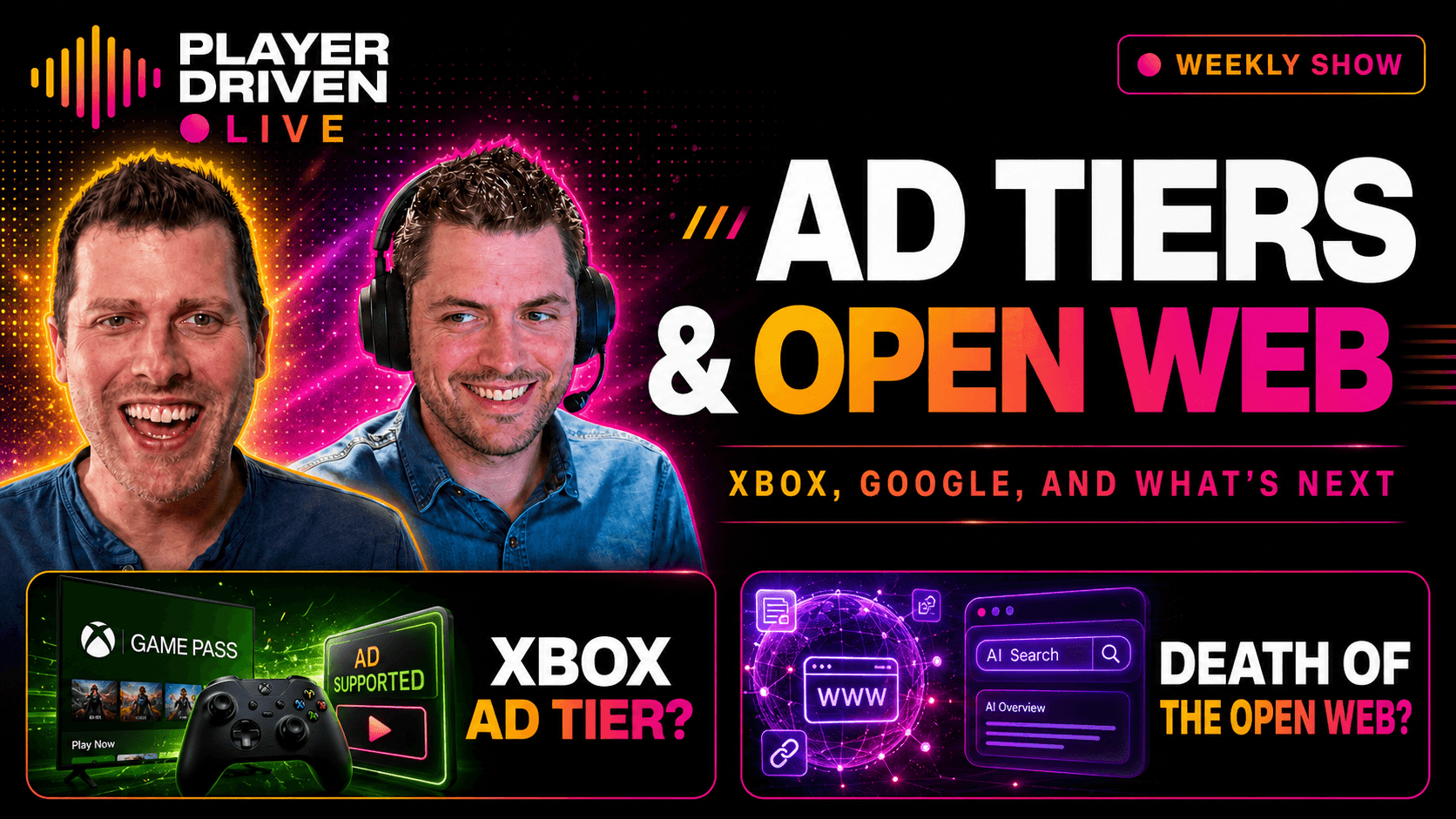
There is one question hiding underneath every interesting argument in gaming right now, and this week's Player Driven Live tripped over it twice in the same hour.
The question is simple. Who pays for attention?
For thirty years the answer in this industry was easy. Players paid sixty dollars, then they paid for DLC, then they paid for a subscription, then they paid with their time. Studios paid for marketing. Platforms paid for exclusives. Everybody understood the trade.
That trade is breaking. Console hardware is drifting toward luxury pricing. Game Pass alone is not big enough to fund Microsoft's gaming ambitions. The websites that used to surface the games we played are being quietly digested by AI summary boxes. And the people who used to find each other inside community forums are now finding each other inside a chatbot that does not give them a forum to come back to.
This week on the show, host Greg Posner and Colan Neese (SVP Gaming, ASI Screen Engine) worked through two stories that, on the surface, looked unrelated. One was about Microsoft hiring Matthew Ball and the persistent rumor of a free, ad-supported Xbox tier. The other was about Google I/O and what AI Mode is doing to the open web. Stay with it for an hour and the two stories collapse into one argument about how attention gets paid for in 2026, and what that means for anyone whose job depends on players finding a game, sticking with it, and feeling like there is a community around it worth showing up for.
Here is what surfaced, and what it means for the practitioner layer of this industry.
Argument One: Microsoft is About to Make You Pay for Xbox in Ads, Not Dollars
The week's biggest hire was Matthew Ball joining Xbox. Ball is the analyst behind a state-of-gaming report the industry has read religiously for years and the author of The Metaverse. He is now off the analyst treadmill and inside Microsoft, reporting into Asha (the new face of Xbox who has spent the last two months very publicly rebuilding the brand on social).
On the show, the read was sharp. Neese called it: Ball's entire body of work has argued that consoles failed to become aggregators. The platforms that won the last fifteen years (Apple, Google, Meta, Amazon) won because they organized consumer demand on the demand side, not the supply side. Consoles never did that. So why hire the guy whose framework you have spent a decade not implementing? Because you are finally going to implement it.
The most likely move, according to Neese's read, is the one Microsoft has been circling for months: a free, ad-supported tier of Xbox. Not a price cut. Not a discount. A version of the platform that costs zero dollars and asks you to watch an ad when you launch a game, when you switch a game, and probably when you load a save.
Three things make this read credible.
The hardware math is broken. Next-gen consoles are tracking toward a $1,000+ retail price. Sony is fifty million units ahead of Xbox on installed base and the gap is still climbing. The argument that consoles are becoming luxury products is not wrong. If you accept that premise, the only way to grow share is to make the entry point free for the people who cannot afford the luxury version. Neese pushed it further on the show: a free tier is also a growth vehicle into markets like Southeast Asia where most of the addressable console TAM actually lives, and where the entire competitive set (mobile, League of Legends, YouTube, Spotify) is already free. As Neese put it, empires are built on the price point of free.
Microsoft already owns the inventory. A platform-wide ad tier only works if you have enough games to put ads against. As Neese pointed out, Microsoft is now the largest publisher in the world. A free, ad-supported version of Minecraft, which is consistently a top ten earner every month it has ever been on sale, is a baller move. They own that asset. They can do whatever they want with it.
The flywheel is real. The ad tier will end up larger than the paid tier. That is how every freemium product on the internet has played out. More users means more data, which means better targeting, which means more advertisers, which means more revenue per user, which funds more content acquisition, which pulls more users in. Microsoft is bad at ads today (Neese was direct: "a failing ad company"), but they are still better positioned than Sony, which is a Japanese hardware manufacturer that has never built an ad business in its DNA.
There is a counter, and Posner pushed it hard on the show. The optics are bad. If the Xbox experience becomes ad-saturated, the optics for a price-sensitive gamer become: "Why would I buy this when I can get the same exclusives on PlayStation, on PC, and on the cloud, and watch fewer ads?" Xbox has spent the last three years putting its first-party games on every platform that will host them. Day one Game Pass titles ship to PlayStation now. The console-as-walled-garden play does not exist anymore. So the ad tier has to be additive to the audience, not a punishment for the existing one.
Why this matters for community, support, and live ops
Here is where the practitioner lens kicks in.
If Microsoft launches an ad-supported tier in 2027 (Neese's guess: GDC announcement, holiday rollout), the player support and community teams inside every Xbox-published studio are going to inherit a fundamentally different player. Free-tier players churn faster, complain louder, and have a lower lifetime value but a higher contact rate. Anyone who has run player support inside a free-to-play game has seen this exact dynamic for a decade. The difference is that the genre experience is no longer the variable. The same player with the same expectations is now playing premium AAA content on a free tier and a premium tier inside the same ecosystem.
Community managers should be modeling now what the conversation in their Discord looks like when half the audience is paying full freight and the other half is watching ads. That conversation already exists in mobile. It is about to come to console.
Live ops teams should be asking publishers a harder question: when Xbox decides to monetize access to a game through ads, what is the contract say about player segmentation, event pacing, and economy tuning? Neese's read on the show was that Microsoft will treat it as a distribution decision: "It's on Xbox to decide how they get their money back or don't." That is plausible. It is also a live ops problem looking for someone to own it.
If you are a player support lead inside an Xbox first-party studio, the questions to be raising upward right now are: What is the support SLA for a free-tier player versus a Game Pass Ultimate player? Are they in the same queue? Are we staffing for the change in contact volume that comes with that audience? Has anyone gamed out the refund policy for a free-tier player who can't return a game because they never bought one?
These are not hypothetical. Microsoft is moving slowly (Neese: "It's an oil tanker"), but the direction is clear. Plan for it.
Argument Two: The Open Web is Dying, and Game Discovery Goes With It
Halfway through the episode the conversation turned to Google I/O and the unveiling of AI Mode, which is exactly what it sounds like: instead of giving you a page of blue links, Google now gives you a chat response that answers your question and never sends you anywhere. The information was sourced from the web. The traffic that information used to generate for the web is gone.
Neese's framing on the show was unsparing: this is the death of the open web. The audience response was split. Posner pushed back. The open web is not dying; it is migrating. People who used to read forums are now in Discords. People who used to write blogs are now writing newsletters. Attention is not disappearing, it is just reorganizing into places where the platform cannot scrape it the way it scrapes a public webpage.
Both reads are partly right, and the implications for gaming are bigger than the implications for most other industries.
The websites that fed the gaming community are structurally exposed. GameFAQs, IGN, Eurogamer, PCGamer, Polygon. These outlets were built on a web economy where Google sent traffic to a page, the page served ads, and the ads paid for the writing. AI Mode breaks that loop. The information ends up in the chat response. Neese gave a specific example from the show: he is playing Crimson Desert right now and needed to solve a shrine puzzle. He asked Google AI. Out came a wiki summary inside the AI prompt, with links to video walkthroughs on YouTube, and he never visited GameFAQs or IGN. That is a one-player anecdote and also a one-quarter business model collapse for the gaming press.
Neese's prediction: "GameFAQs will probably cease to exist in its current form. IGN is owned by Ziff Davis, they make money, but you can see where this is going in eight to ten years." Take that with whatever salt you want. The directional point is correct.
Video FAQs become the new FAQ. Google still owns YouTube, so Google still has an incentive to surface video content as the primary answer to "how do I solve this puzzle." The information layer moves from text-on-a-website to video-from-a-creator. The creator gets a slice of ad revenue. Google mines the video for the AI summary above the fold. The information ecosystem keeps running. The independent gaming press does not.
Community fills the gap unevenly. Discord is where the conversation actually lives now. So is a private subreddit. So is a Slack for a specific studio's community. So is a paid newsletter. Posner's read: the people who matter are building communities where they own the relationship, not where Google does. Neese agreed in the abstract and was bleaker on the macro: "The open free web is becoming a thing of the past."
There was a real disagreement on the show worth listening to in full. Posner thinks the open web migrates and survives because humans naturally route around degraded platforms (the AOL-to-Google-to-something-next pattern). Neese thinks the demand-side monopoly is structurally different from the supply-side monopolies of the railroad era because you cannot break up consumer attention by court order. Both can be right. The migration happens, and most of the institutions that fed the migration die in the process.
Why this matters for community, support, and live ops
If you are running player support, you are about to see the contact mix shift.
Players used to find answers on GameFAQs, on a fan wiki, in an IGN guide, in a Reddit thread. The smart ones still will. The marginal player who used to find the answer on the second blue link of a Google search and now gets an AI-generated answer that is sometimes wrong, sometimes outdated, and sometimes hallucinated will write into your support queue instead. That is a contact deflection failure that no one in your CRM platform has tagged yet, because the deflection used to happen for free, in the open web, and you never had to count it.
For community managers, the implication is sharper. The community is no longer being routed to your forum because there is no forum in the AI Mode answer. There is no "see the discussion on the developer's official Discord." If you want players in your community, you have to put the link in the game, in the launcher, in the patch notes, in the in-game event, in the newsletter, in the YouTube description, in the Twitch panel. You have to be the source of the answer, because Google is no longer in the business of helping anyone get to you.
For live ops, the discovery problem is now your problem. New player onboarding used to assume a player arrived with at least some context about what your game is and how it works because they had read about it somewhere. That assumption is weaker every month. The first sixty seconds of your game are now doing the work the open web used to do for free.
The studios that figure this out first are the ones who already think of their community as their primary discovery channel. Roblox studios already do this. F2P mobile studios already do this. Indie devs on Steam who built communities before they shipped already do this. Most AAA console studios are five years behind.
The Through-Line
Both stories are about the same thing.
The Xbox ad-tier debate is about a platform deciding that consumer attention has gotten so expensive to acquire that the only way forward is to make the product free and charge somebody else for the attention.
The death of the open web is about consumer attention getting so cheap to aggregate that the people who used to be paid for producing the underlying information are not getting paid at all anymore.
These are the same trade, run in opposite directions. In both cases, the people who used to own a relationship with the player (the publisher, the press, the platform) are watching that relationship get intermediated by somebody bigger.
The practitioners who work directly with players (community managers, support leads, live ops, trust and safety) are the last layer of that relationship that still has direct contact. The Discord moderator who knows a player's username. The support agent who has answered their ticket twice. The live ops PM who timed an event around their region's holiday calendar. That layer is now load-bearing in a way it has never been before, because everything above it (platform, press, search) is being commoditized.
If you work in the practitioner layer, your job did not just get harder. It got more important.
What to do on Monday
Player support leaders: start tagging contacts that came from AI-generated misinformation. You probably do not have a code for it yet. Add one. You will be amazed at the volume by the end of Q3.
Community managers: audit every place a new player could find your community link this week. In-game, launcher, patch notes, store page, YouTube description, Twitch panel. Fix the gaps. Stop assuming Google search is doing it for you.
Live ops teams: model the impact of a free, ad-supported Xbox tier on your contact volume and economy. Even if it never ships, the exercise is worth doing, because the same question applies to every free-to-play motion in your roadmap.
Trust and safety leads: ad-supported audiences shift the behavior baseline. Free-tier accounts have a different abuse profile than paid accounts. If your moderation tooling treats them the same, your tooling is wrong.
Indie devs: the open web is not coming back. Your discovery problem starts and ends inside your community. If you do not have one, that is the Q3 plan.