The role has shifted from forum moderation to product strategy. Here's what the strongest community teams in the industry have figured out — and what the rest are still getting wrong.
Community management in gaming used to be a support function. Someone to keep the Discord civil, post the patch notes, and tell players when the servers were coming back up. That definition is dead, and most studios haven't updated their job descriptions to match.
The community manager working on a live game today sits closer to product than to support. They translate player sentiment into roadmap input. They run feedback loops that determine whether a feature ships or gets rebuilt. They are, in practice, the person inside the studio who knows what the audience actually thinks — which makes them one of the most consequential hires a publisher can make.
The five lessons below come out of conversations with the people doing this work at studios of every size, from indie teams to publishers with hundreds of millions of players. They are not theoretical. They are the operating principles that separate community teams who get a seat at the table from the ones who get cut when budgets tighten.
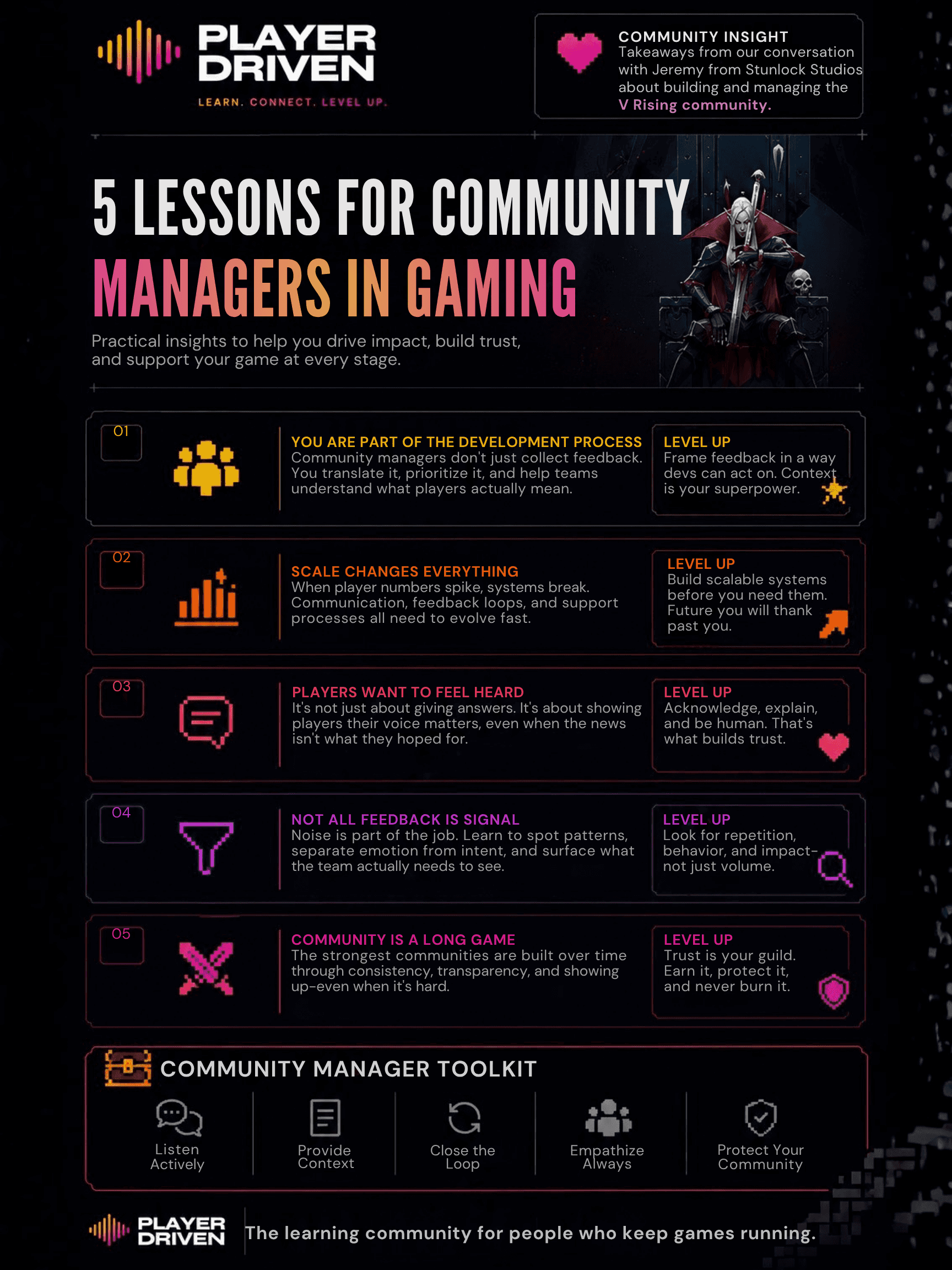
1. You are part of the development process
The biggest shift in community management over the last five years is the move from "we pass feedback to the team" to "we are part of the team that decides what to do with it."
Stunlock Studios, the developer behind V Rising, is one of the clearest examples of this in practice. When the studio took V Rising from Early Access through 1.0 and beyond, the community team wasn't sitting in a parallel track summarizing forum posts. They were in the room when design decisions got made, because the design decisions depended on what they were hearing.
The shift sounds obvious until you look at how most studios actually run. Community feedback gets compiled into a weekly digest, sent up the chain, and read by a producer who has no context for which complaints are signal and which are noise. By the time the information reaches a decision-maker, the texture is gone.
The studios doing this well treat their community managers as translators, not couriers. The job is not to deliver a transcript of what players are saying. The job is to deliver the meaning behind it: what players actually want versus what they are asking for, which complaints reflect a systemic issue versus a vocal minority, and what tradeoffs the team should be weighing.
Level up: Frame feedback in a way devs can act on. A list of complaints is useless. A pattern, a hypothesis, and a recommended response is a contribution to the product.
2. Scale changes everything
A community of 10,000 players and a community of 1 million players are not the same job at different sizes. They are different jobs.
At 10,000 players, a community manager can read most of what is being said. At 100,000, they can read the loud parts. At 1 million, they cannot read anything without tooling — and the systems that worked at small scale will collapse without warning.
This is the most common failure mode in community ops, and it almost always shows up at the same moment: a game blows up. The Early Access success story. The viral TikTok moment. The streamer who picks the game up on a slow Tuesday and brings 200,000 new players with them. Every system the team built for the previous order of magnitude starts breaking at once. Discord moderation can't keep up. Support tickets pile up. The feedback loop that used to feed product decisions becomes a fire hose nobody can drink from.
The teams that survive these moments built for them before they arrived. They had a moderation escalation path before they needed one. They had social listening tools running before the spike. They had a process for surfacing the top three issues each week before there were a thousand issues to surface.
Most teams do the opposite. They build the system after the crisis, while the crisis is still happening. The cost is measured in player trust that takes months to rebuild.
Level up: Build scalable systems before you need them. The next growth spike will not give you warning. Future you will thank past you for the moderation playbook you wrote when you had time.
3. Players want to feel heard more than they want to be agreed with
This is the lesson that most often gets misunderstood by leadership.
When a studio runs into a player backlash — a balance change, a monetization decision, a delayed feature — the instinct from above is usually some combination of "ignore it and it will pass" or "reverse the decision and apologize." Both are wrong, and both miss what players actually want.
What players want is acknowledgment that they were heard. Not agreement. Not capitulation. Acknowledgment.
The Helldivers 2 PSN account requirement controversy in 2024 is a useful case study. The decision itself was unpopular, but what turned it from "unpopular decision" into "review-bomb event" was the silence. When Arrowhead's CEO eventually responded directly — acknowledging the player frustration, explaining the constraints the studio was operating under, and committing to a path forward — sentiment shifted within days. The underlying decision didn't fully reverse for weeks. The acknowledgment did most of the work.
This is the part of the job that doesn't scale with automation. A copy-pasted "we hear you" reply reads as worse than no reply at all. The acknowledgment has to be specific, has to demonstrate that the team understood what was actually being said, and has to come from a human.
Level up: Acknowledge, explain, be human. Trust is built in the explanation more than in the outcome.
4. Not all feedback is signal
A community team that treats every complaint as equally important will burn out within six months. A community team that learns to triage will last for years.
The job is not to surface everything. The job is to surface what matters. Three filters separate signal from noise:
Repetition. A complaint mentioned by one player is a data point. A complaint mentioned by 200 players across three platforms is a pattern. Volume alone is not the metric — repetition across independent channels is.
Behavior. Players say one thing and do another all the time. The community team that pays attention to what players actually do — which features they use, where they churn, what they recommend to friends — has a better read on the audience than the team that only listens to what gets posted.
Impact. Some issues annoy players. Some issues cause players to quit. Conflating the two is one of the easiest ways to spend a roadmap quarter on the wrong problem.
The community manager's value to the studio is in this triage work. Anyone can compile a list of complaints. A practitioner can tell you which three of those complaints will actually move retention if addressed.
Level up: Look for repetition, behavior, and impact — not just volume. The loudest channel is rarely the most important one.
5. Community is a long game
The strongest gaming communities — Path of Exile, Warframe, Old School RuneScape, Deep Rock Galactic — were not built in a launch window. They were built over years, through dozens of decisions where the team chose long-term trust over short-term metrics.
That choice is harder than it sounds. Every quarter brings pressure to monetize harder, ship faster, and lean into the kind of engagement tactics that pay off in the next earnings call. The community teams that protect the long game are usually the ones explaining to leadership why the short-term play would cost more than it earns.
The shorthand most practitioners use is "trust is your guild." It is the asset that took the longest to build and would take the longest to rebuild if spent. The studios that understand this make decisions accordingly. The studios that don't tend to learn the lesson the expensive way, usually after a single quarter of decisions has erased five years of goodwill.
Level up: Trust is your guild. Earn it, protect it, never burn it.
The Community Manager Toolkit
The five lessons above resolve to five practices:
Listen Actively. Treat community channels as primary research, not a customer service queue.
Provide Context. The value you add is interpretation. Anyone can quote a forum post.
Close the Loop. When players give feedback, tell them what happened with it. Even the answer "we considered this and decided against it" is better than silence.
Empathize Always. The player on the other end of an angry message is a person who cared enough to write it. That energy is convertible.
Protect Your Community. From bad actors, from internal short-termism, and from the version of the studio that would trade trust for a quarter of revenue.
Player Driven is the learning community for people who keep games running. Subscribe to the newsletter or join the Discord at playerdriven.io.