A Window Into Alex Seropian's UGC-based Studio, Look North World
Blogs
•
January 20, 2026
•
Lewis Ward


A Window Into Alex Seropian's UGC-based Studio, Look North World
Blogs
•
January 20, 2026


It's a bird, it's a plane, it's a studio working to fly in someone else's sky!
I’m also a father of three. It was Father’s Day this weekend. And, you know, there’s just a lot of odd parallels between raising kids and starting companies. - Alex Seropian
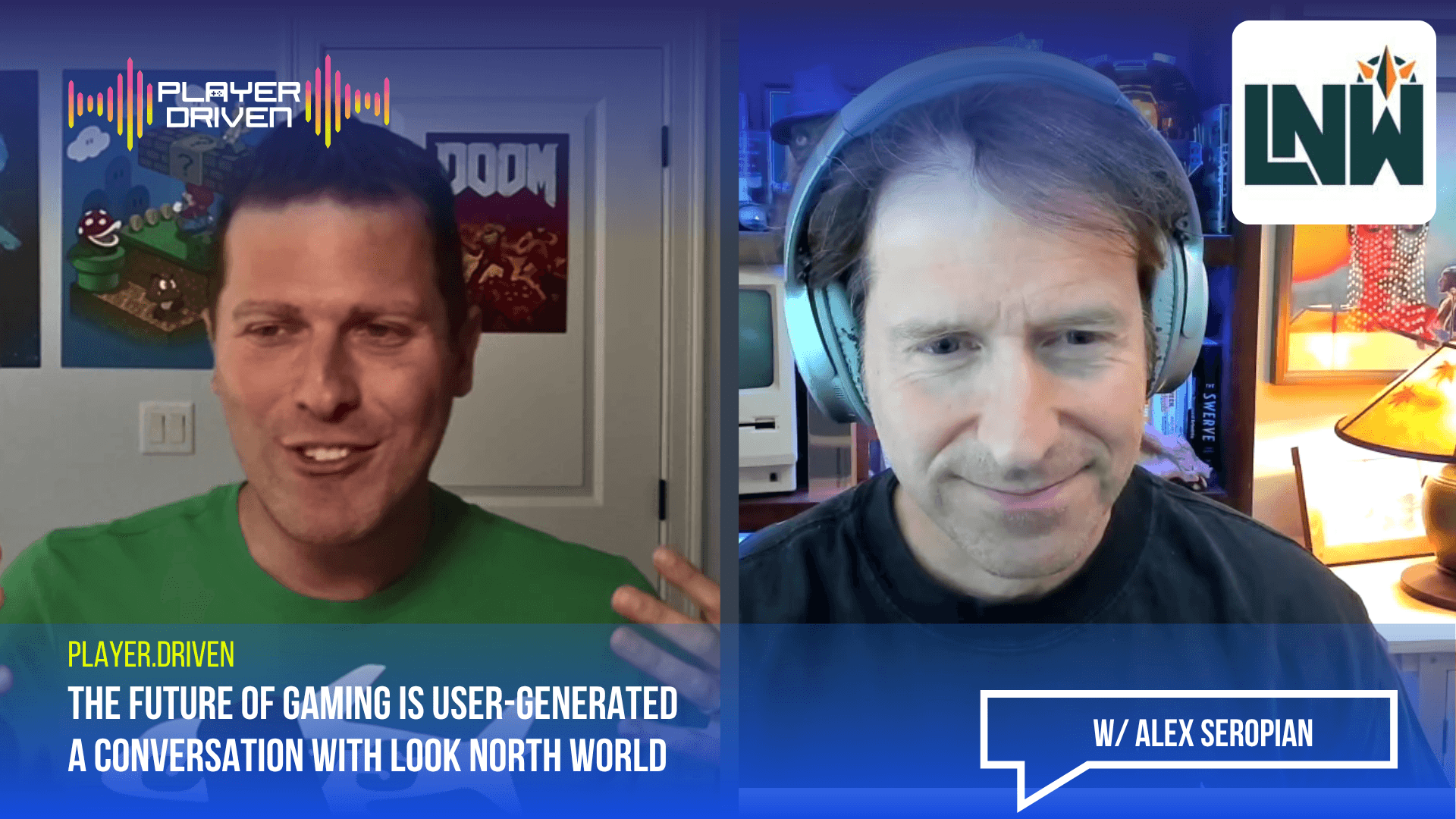
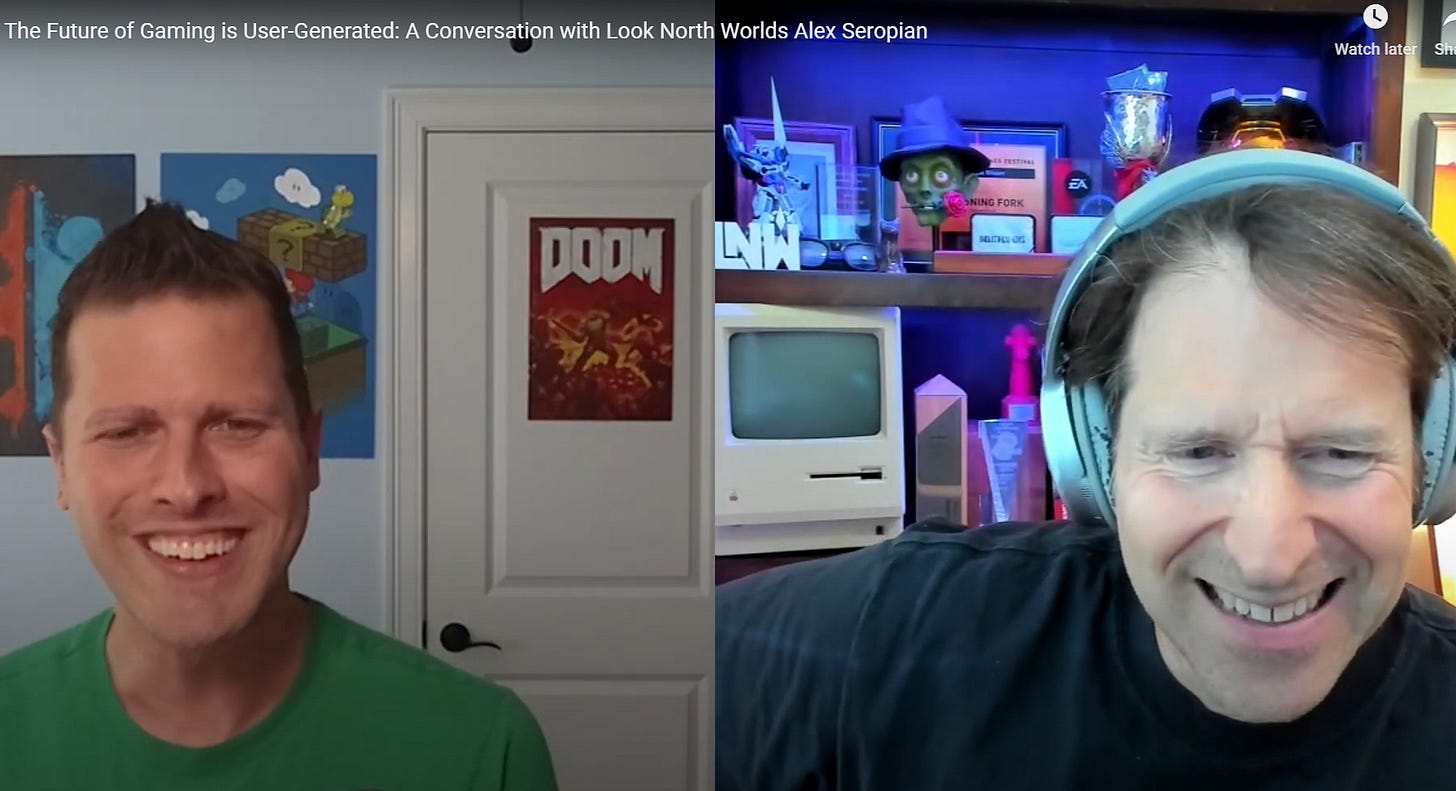
Alex Seropian knows a thing or two about raising kids and starting companies. As Seropian outlined in a Player Driven podcast episode released in July, he co-founded the iconic video game studio Bungie in the early 1990s. Bungie developed the genre-defining first-person shooter Halo: Combat Evolved, among other titles, which sold millions of copies and was pivotal in getting Microsoft’s new Xbox console platform off the ground.
“We had been doing multiplayer games for for a long time,” Seropian told Player Driven host Greg Posner. “It definitely was in the DNA of the studio, back to, you know, we had this game Minotaur…[T]he scale of how everything worked out [with Halo] was way beyond any expectations.”
Seropian left Bungie in the early 2000s and founded Wideload Games shortly thereafter. Disney acquired that studio, which championed small teams and narrow scope projects, in 2009. Seropian then ran Disney Interactive Studios for many years. In 2012, he left Disney to establish Industrial Toys, which made mobile shooters. That studio was bought by Electronic Arts (EA) in 2018. EA shuttered Industrial Toys in 2023, which is when Seropian and five others co-founded Look North World (LNW).

LNW is a distributed company based in Los Angeles, CA. Part of what distinguishes the studio’s pedigree is that, to date, it has only made content for platforms with mature UGC (user-generated content) ecosystems and large player/user bases. LNW’s initial focus was making islands for Epic Games’ Fortnite UEFN.
Buoyed by an initial seed funding round of $2.25 million, LNW doubled its resource pool last July. (Additional details are here; second round investors included Hibbard Road Partners, London Venture Partners, Hasbro, Bandai Namco, Overwolf, Crush Ventures, and PixCapital.)
Seropian appears to have enjoyed more than raising his fourth studio “baby” in 2025. Near the end of the podcast, Posner asked him if he plays games with his kids, and Seropian’s face lit up.
“[W]e play lots of games,” he said. “Many of them are sort of like IRL physical games. Like, we’ve got a long running Euchre game going. Also, we play this card game called Wizard…It’s like a deck of real playing cards with a few extra cards in it, which is a lot of fun. We’ve done a couple of D&D campaigns. My son, who’s in the middle, is a Valorant player.”

Posner also asked Seropian if he had anything special for Father’s Day dinner. Seropian’s Armenian roots shone through in the response.
“Oh, we had a shish kebab feast yesterday with everything. You know, lula kebab, chicken kebab, you know, pilaf, grilled vegetables, hummus, tzatziki. It was off the charts.”
As we’ll explore below, Seropian and company are working to find a formula that’ll put LNW on a glide path to sustainable flight in the brave new ether of UGC-based gaming. The studio has crawled, wobbled, stumbled, fallen, gotten up, and taken its first steps forward over the past 2+ years. An “off the charts” success is hasn’t been, but UGC gaming success stories are as rare as viral influencer and YouTuber sensations. There’s a lot of effort, timing, and luck involved.
Will LNW find its footing, start running, and take flight in 2026+, or is it on an Icarian mission? Nobody knows. Seropian appears determined to identify a formula and process that works, though, and he’s as prepared as anyone to weather the storms of UGC-based studio flight and come out the other side intact - and, hopefully, smiling.
Fire, Aim, Ready?
We have a pretty diverse group of creators. Different ages, genders, points of view, walks of life…We can operate at kind of like a publisher scale because these games are so small. Like I said, we shipped, I think, over 20 games last year. So we can try a lot of things and support a lot of folks being creative in the studio. - Alex Seropian
Outlaw Corral and Carrera Coast were among LNW’s first UEFN islands. According to Fortnite.gg, a fan-run site that appears to estimate a range of Fortnite- and UEFN-related metrics by pulling data from an API that Epic Games provides, both these LNW islands are now defunct. In fact, several of the 16 games listed on LNW’s site are nonplayable UEFN islands. Presumably, these creations failed to attract and maintain enough player interest to warrant ongoing support.
This is par for the course in UGC. Like success in the adjacent media influencer market, in UGC-based gaming market success is, in no small measure, about being able to:
develop a vast number of “educated guesses” about what the target audience will respond to
throw that content up against the user base “wall” to see what sticks
learn from what stuck and what didn’t
and rapidly generate more educated guesses to push up the “stick rate.”
UCG game development processes don’t appear to differ fundamentally from traditional game development processes. The biggest difference, perhaps, is that the scale of each educated guess is far, far smaller and the volume of these guesses is much, much larger in UGC. It’s like a permanent game jam with real-world stakes (LNW appears to have about a dozen employees today). It must be fun, exhausting, and rife with misfires.
“We started right when UEFN came out,” Seropian told Posner. “Our assumption of a player’s expectation on the platform was wrong by, I don’t know, two or two or three viewpoints…The thing that you identified, just as an observer right off the bat, genius, [is that] everybody on here is playing Battle Royale.”
“In the beginning, you know, maybe you want to, like, not take too many steps away from the core experience.”
Translation: Outlaw Corral and Carrera Coast were clear misses. Seropian was simultaneously learning UEFN’s creative ropes along with his creators.
“I’m going to work on things where I’m going to learn something,” Seropian continued. “I’m going to get better at a particular element of the craft. And that’s what I personally will invest my time creating.”
Industrial Toys’ first game, Midnight Star, used Unreal Engine 3. It’s likely that Seropian came to LNW with a solid grasp of Unreal Engine dev pipelines, project management skills, etc. Behind the scenes, he’s not only guiding LNW’s creators but getting under the hood to squeeze more juice out of Unreal Engine and UEFN’s toolset. His parenting skills have likely come into play when conveying these lessons to his diverse creative team.
Despite numerous UEFN island flops, Seropian remains bullish on UGC-based gaming.
“I really think this is a thing, another evolution, and, this is what we call it, like, the platform economy, where a lot of creativity is happening inside these other games,” he reflected. “I think it’s gonna result in a lot of new play modalities that we haven’t even discovered yet.”
“I’ll talk about Fortnite because we’re in that ecosystem a lot. If you look at what’s happening there with Disney coming in with Star Wars, and all the other IP and content, that’s all entirely interoperable.”
“Could you even have imagined as a kid that, ‘Oh, there’ll be this place online that we can hang out and Spider-Man’s going to be there. It looks like Batman. And Luke. And you can you can fly an X-Wing.’ You could do all this stuff, right? And you know that would be like the plot of Lawnmower Man or or Ready Player One.”
“[I]t’s, you know, now the metaverse. We don’t call it the metaverse because…I don’t know why that word’s got so much stink on it. But that’s kind of where what’s happening. That’s kind of exciting.”
One of the first pivots or side bets Seropian and company appear to have made was co-creating with external UEFN talent. LNW established a Creator Label and touted it as one of the studio’s “most exciting initiatives” in last July’s announcement detailing its second seed funding round.
According to Fortnite.gg, these Creator Label efforts haven’t borne much fruit either. Last September, to take one example, LNW announced the release of Tower of Heck, a Creator Label island developed by FarBridge. As of year November, the island is no longer playable.
Ditto for another Creator Label island, Patchwork Parkour. It came out in February of this year and Fortnite.gg shows that its player count rapidly fell to zero. Ouch!
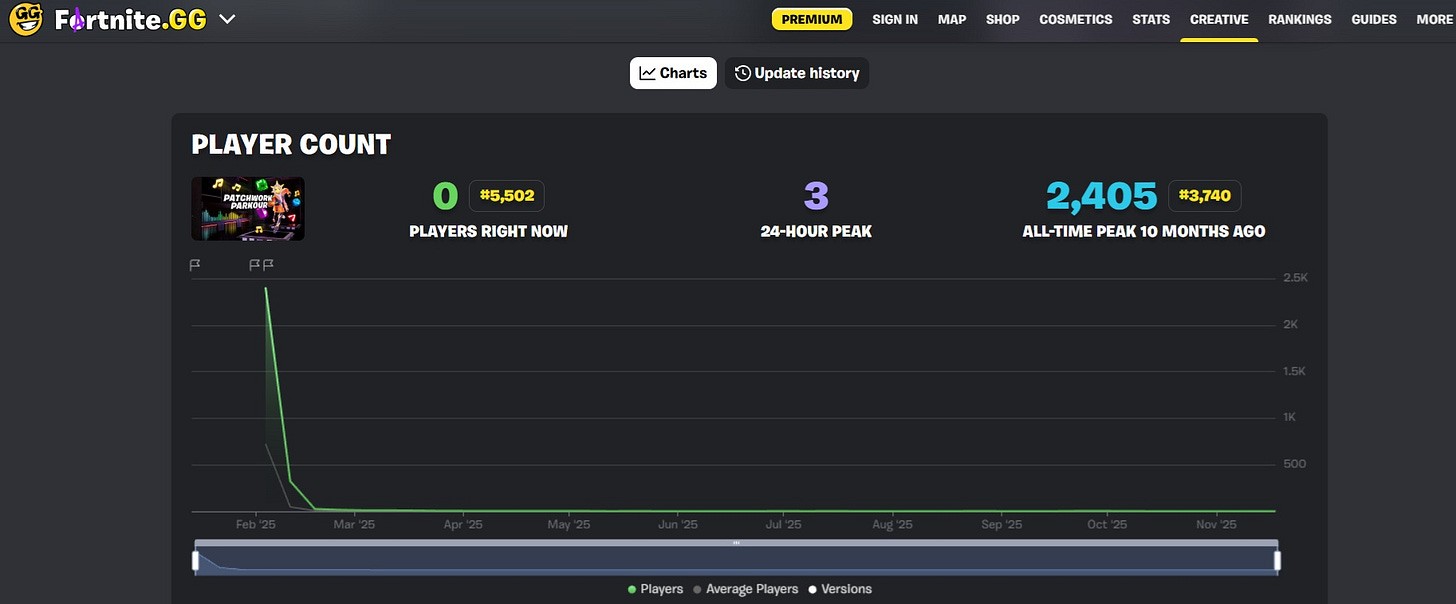
The point of reviewing such Fortnite.gg data isn’t to throw shade at Seropian, LNW, or its Creator Label talent. As noted earlier, flops are the norm in Seropian’s “platform economy” market. The point of showing these flops is to set the table for another pivot or side bet Seropian and company placed last year that does appear to have borne juicy fruit (and we’ll circle back to this topic below).
“Innovation is like this word that can mean a lot of things or it can mean nothing,” Seropian told Posner. “But where new ideas tend to come from are places that support experimenting, support learning.”
If you’re Microsoft or if you’re EA or Take-Two, they’re going to get Grand Theft Auto 6 right, you know, and they’re putting a lot of money into it. What that means is the the new stuff….doesn’t fit an existing model. The innovation, you know, it tends to come from places where it’s okay to take risk.
“And these platforms…UEFN is one. I would say Roblox is another.”
Posner turned to the topic of discoverability challenges on these UGC platforms.
“Discoverability of good content has gotten more and more challenging, both for the consumer and the creator,” said Seropian. ‘There’s just more and more and more stuff. If I’m a creator, there’s more opportunity. But it does mean that, you know, that power curve…like the top 1% makes all the money and the bottom 99% makes nothing.”
“That curve gets really challenging from a commercial perspective. It’s way less expensive and easier to get to a point of sale, but you’re competing. Like, you know, like you say, discoverability is the big thing.”
That, and finding an audience that’s willing to pay for content! Last May, LNW appears to have struck a gold vein…but it wasn’t on Fortnite or Roblox.
Spreading the Risk…and the Reward
A larger production would have, like, one of our teams, which is typically five people…And they may be working with a co-dev partner, which may add another, like, you know, three to ten people. So, we we have done projects that are larger in scope. - Alex Seropian
Co-dev partnerships appear to be LNW’s sole player-driven revenue bright spot to date. Specifically, co-dev projects that combine well-known IP with premium mods. Even more specifically, LNW’s top commercial success, by far, appears to have been CusrseForge mods for Studio Wildcard’s ARK: Survival Ascended.
Readers of the Player Driven’s Substack will be forgiven if they just got whiplashed: yes, this is the same scenario that we detailed two weeks ago in the context of Francisco “Sandi” Montaño’s smash hit ARK mods.
We previously noted that Overwolf, which owns and operates CurseForge, is an LNW investor. The same funding announcement from last July also stated that LNW’s ARK x POWER RANGERS Premium Mod had proven “incredibly successful” and had topped 800,000 downloads. That mod, which includes skins, weapons, and emotes, costs $10. It’s available to ARK: Survival Ascended players on PCs, PlayStation 5 and Xbox Series X/S consoles. As of late November of this year, that mod’s download tally was >4.1 million. Assuming no freebies or discounts, that’s $41 million.
“Go, Go, Power Rangers!”
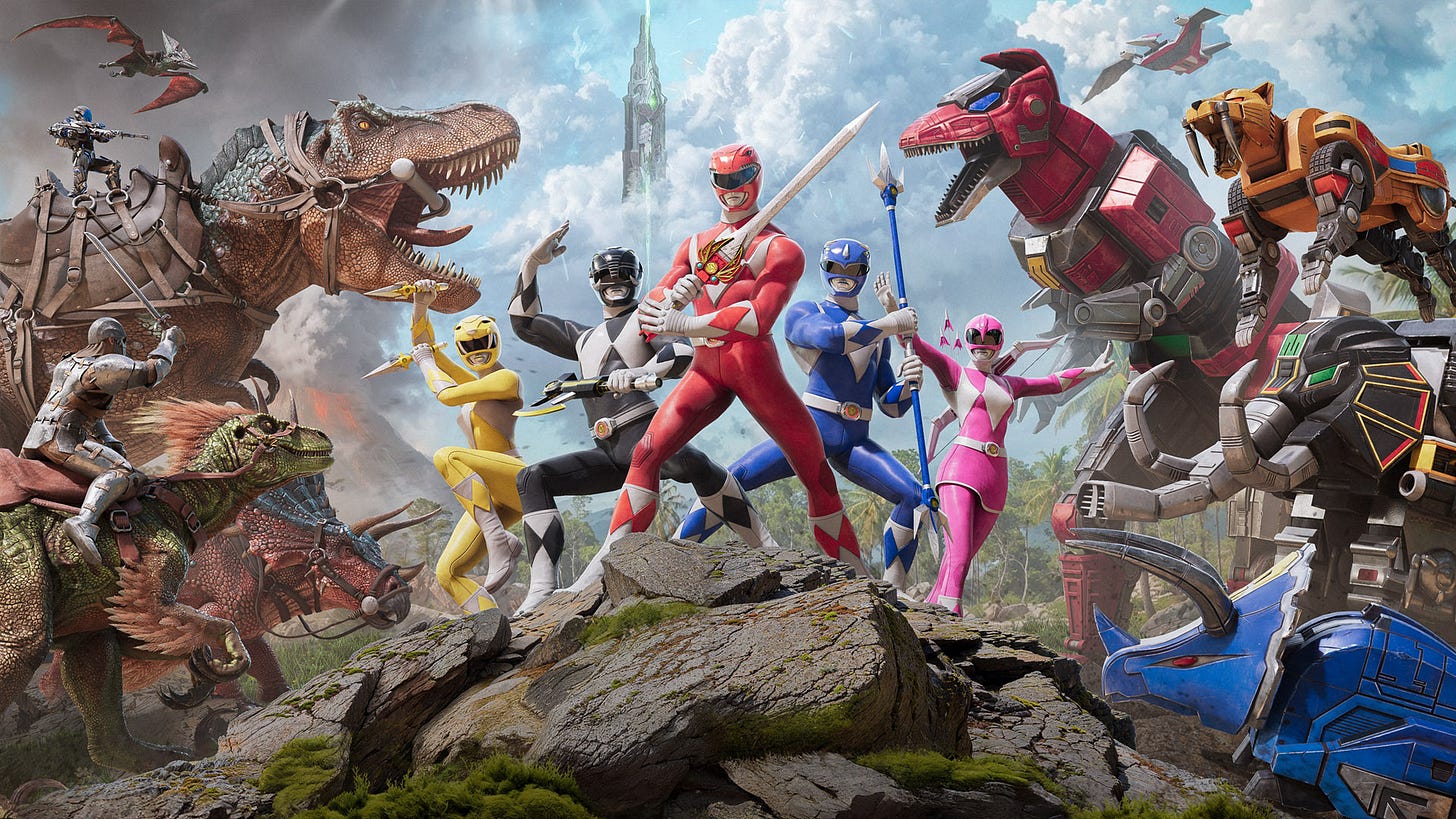
Even split three ways - LNW, CurseForge/Overwolf and Hasbro (which owns the Power Rangers IP and is another LNW investor) likely split the proceeds by some opaque formula - that must be more player-driven cash than LNW has generated from all of its UEFN islands put together. The timing can’t be a coincidence either: LNW announces an additional $2.25 million in funding, including from Overwolf and Hasbro, a month after LNW releases a hit Power Rangers mod on CurseForge?
LNW released a follow-on mod this February: Mighty Morphin Power Rangers Wave 2. That mod also costs $10 and is available on the same platforms. It’s currently sitting at 2.15 million downloads. That another $21+ million.
There’s virtually no chance that UEFN has generated anything close to that much revenue for LNW to date.
A month ago, the studio released another premium mod pack - this time with a new IP partner: ARK x Teenage Mutant Ninja Turtles. I guess the word is getting around. That mod has >300,000 downloads to date.
Say it with me: “Cowabunga!”
Premium CurseForge mods have be the smartest pivot or side bet made by LNW. My prediction? We’ll see more premium mod packs for ARK in 2026. The risk: ARK’s player base is slowly dwindling, at least according to SteamDB. My second prediction? LNW will release a mod pack (with well-known IP featured) for a different popular game supported by Overwolf’s “platform economy” in 2026.
Taking a step back, what else might we take away from this window into UGC-based gaming?
For my money, three points deserve to be underscored:
Mostly due to the demographics of who plays UEFN (and Roblox) relative to titles like ARK: Survival Ascended, UGC creators and studios that want to make money in 2026 should look much more seriously at games and platforms in the latter group.
Co-dev projects involving popular IP are more likely to fly than original IP. (We didn’t cover it here, but a co-dev’d UEFN island that LNW made with Bandai Namco, GUNDAM: REQUIEM FOR VENGEANCE RED VS BLUE, may have been LNW’s most popular UEFN island ever…although that island is also no longer playable.)
Reduced risks go hand-in-hand with reduced rewards. UCG platform economies may a have built-in audience and built-in distribution, discovery, and payment systems, but their operators also have revenue sharing arrangements, and other structures in place that are sharply biased toward their own ends. Pair that with a need to license known IP, which doesn’t tend to come cheap, and the ability for UGC creators and studios to maintain stable flight becomes extremely iffy. (LNW has mitigated this threat by converting IP rights holders into investors.)
For Seropian, low-cost learning and the application of AI appear to be key ingredients to his UGC success formula moving forward.
In the podcast, he told Posner that “people pick up new skills, learn from each other, share, and teach each other through video on a platform like YouTube. And I think we’re going to see something even more powerful with AI, where learning can become even more self-directed and accelerated. So it’s pretty exciting.”
“I love to make things, you know. I love to craft and the creative process and, you know, conjuring something up out of nothing. For me, music was super appealing for that reason. I grew up taking piano lessons. I played a lot of guitar. I’m not a fantastic musician, but the craft of creating music is really…I really enjoy it. And it’s not all that different, for me, than programming or, you know, woodworking, which is my other hobby, or cooking, which is another hobby of mine, where you you assemble things, you know, with a particular idea in mind.”
Like Sandi, LNW runs a Discord server that has become a key communications hub.
‘We operate a community, Discord, where we’re streaming, we’re doing game, you know, game events and just trying to build a relationship with our players,” Seropian told Posner. “That’s the thing that’s really important to what we’re doing as well, is having a place for our audience to come and connect with each other, connect with us.”
Connect. Test. Learn. Iterate. Repeat.
“You know, every generation, what’s cool to that generation is confusing to the older generation. And what’s good to the older generation is crap to the new generation, right? That’s a societal thing. That’s a truth of human evolution.”
I’m also a father of three. It was Father’s Day this weekend. And, you know, there’s just a lot of odd parallels between raising kids and starting companies. - Alex Seropian
Alex Seropian knows a thing or two about raising kids and starting companies. As Seropian outlined in a Player Driven podcast episode released in July, he co-founded the iconic video game studio Bungie in the early 1990s. Bungie developed the genre-defining first-person shooter Halo: Combat Evolved, among other titles, which sold millions of copies and was pivotal in getting Microsoft’s new Xbox console platform off the ground.
“We had been doing multiplayer games for for a long time,” Seropian told Player Driven host Greg Posner. “It definitely was in the DNA of the studio, back to, you know, we had this game Minotaur…[T]he scale of how everything worked out [with Halo] was way beyond any expectations.”
Seropian left Bungie in the early 2000s and founded Wideload Games shortly thereafter. Disney acquired that studio, which championed small teams and narrow scope projects, in 2009. Seropian then ran Disney Interactive Studios for many years. In 2012, he left Disney to establish Industrial Toys, which made mobile shooters. That studio was bought by Electronic Arts (EA) in 2018. EA shuttered Industrial Toys in 2023, which is when Seropian and five others co-founded Look North World (LNW).

LNW is a distributed company based in Los Angeles, CA. Part of what distinguishes the studio’s pedigree is that, to date, it has only made content for platforms with mature UGC (user-generated content) ecosystems and large player/user bases. LNW’s initial focus was making islands for Epic Games’ Fortnite UEFN.
Buoyed by an initial seed funding round of $2.25 million, LNW doubled its resource pool last July. (Additional details are here; second round investors included Hibbard Road Partners, London Venture Partners, Hasbro, Bandai Namco, Overwolf, Crush Ventures, and PixCapital.)
Seropian appears to have enjoyed more than raising his fourth studio “baby” in 2025. Near the end of the podcast, Posner asked him if he plays games with his kids, and Seropian’s face lit up.
“[W]e play lots of games,” he said. “Many of them are sort of like IRL physical games. Like, we’ve got a long running Euchre game going. Also, we play this card game called Wizard…It’s like a deck of real playing cards with a few extra cards in it, which is a lot of fun. We’ve done a couple of D&D campaigns. My son, who’s in the middle, is a Valorant player.”

Posner also asked Seropian if he had anything special for Father’s Day dinner. Seropian’s Armenian roots shone through in the response.
“Oh, we had a shish kebab feast yesterday with everything. You know, lula kebab, chicken kebab, you know, pilaf, grilled vegetables, hummus, tzatziki. It was off the charts.”
As we’ll explore below, Seropian and company are working to find a formula that’ll put LNW on a glide path to sustainable flight in the brave new ether of UGC-based gaming. The studio has crawled, wobbled, stumbled, fallen, gotten up, and taken its first steps forward over the past 2+ years. An “off the charts” success is hasn’t been, but UGC gaming success stories are as rare as viral influencer and YouTuber sensations. There’s a lot of effort, timing, and luck involved.
Will LNW find its footing, start running, and take flight in 2026+, or is it on an Icarian mission? Nobody knows. Seropian appears determined to identify a formula and process that works, though, and he’s as prepared as anyone to weather the storms of UGC-based studio flight and come out the other side intact - and, hopefully, smiling.
Fire, Aim, Ready?
We have a pretty diverse group of creators. Different ages, genders, points of view, walks of life…We can operate at kind of like a publisher scale because these games are so small. Like I said, we shipped, I think, over 20 games last year. So we can try a lot of things and support a lot of folks being creative in the studio. - Alex Seropian
Outlaw Corral and Carrera Coast were among LNW’s first UEFN islands. According to Fortnite.gg, a fan-run site that appears to estimate a range of Fortnite- and UEFN-related metrics by pulling data from an API that Epic Games provides, both these LNW islands are now defunct. In fact, several of the 16 games listed on LNW’s site are nonplayable UEFN islands. Presumably, these creations failed to attract and maintain enough player interest to warrant ongoing support.
This is par for the course in UGC. Like success in the adjacent media influencer market, in UGC-based gaming market success is, in no small measure, about being able to:
develop a vast number of “educated guesses” about what the target audience will respond to
throw that content up against the user base “wall” to see what sticks
learn from what stuck and what didn’t
and rapidly generate more educated guesses to push up the “stick rate.”
UCG game development processes don’t appear to differ fundamentally from traditional game development processes. The biggest difference, perhaps, is that the scale of each educated guess is far, far smaller and the volume of these guesses is much, much larger in UGC. It’s like a permanent game jam with real-world stakes (LNW appears to have about a dozen employees today). It must be fun, exhausting, and rife with misfires.
“We started right when UEFN came out,” Seropian told Posner. “Our assumption of a player’s expectation on the platform was wrong by, I don’t know, two or two or three viewpoints…The thing that you identified, just as an observer right off the bat, genius, [is that] everybody on here is playing Battle Royale.”
“In the beginning, you know, maybe you want to, like, not take too many steps away from the core experience.”
Translation: Outlaw Corral and Carrera Coast were clear misses. Seropian was simultaneously learning UEFN’s creative ropes along with his creators.
“I’m going to work on things where I’m going to learn something,” Seropian continued. “I’m going to get better at a particular element of the craft. And that’s what I personally will invest my time creating.”
Industrial Toys’ first game, Midnight Star, used Unreal Engine 3. It’s likely that Seropian came to LNW with a solid grasp of Unreal Engine dev pipelines, project management skills, etc. Behind the scenes, he’s not only guiding LNW’s creators but getting under the hood to squeeze more juice out of Unreal Engine and UEFN’s toolset. His parenting skills have likely come into play when conveying these lessons to his diverse creative team.
Despite numerous UEFN island flops, Seropian remains bullish on UGC-based gaming.
“I really think this is a thing, another evolution, and, this is what we call it, like, the platform economy, where a lot of creativity is happening inside these other games,” he reflected. “I think it’s gonna result in a lot of new play modalities that we haven’t even discovered yet.”
“I’ll talk about Fortnite because we’re in that ecosystem a lot. If you look at what’s happening there with Disney coming in with Star Wars, and all the other IP and content, that’s all entirely interoperable.”
“Could you even have imagined as a kid that, ‘Oh, there’ll be this place online that we can hang out and Spider-Man’s going to be there. It looks like Batman. And Luke. And you can you can fly an X-Wing.’ You could do all this stuff, right? And you know that would be like the plot of Lawnmower Man or or Ready Player One.”
“[I]t’s, you know, now the metaverse. We don’t call it the metaverse because…I don’t know why that word’s got so much stink on it. But that’s kind of where what’s happening. That’s kind of exciting.”
One of the first pivots or side bets Seropian and company appear to have made was co-creating with external UEFN talent. LNW established a Creator Label and touted it as one of the studio’s “most exciting initiatives” in last July’s announcement detailing its second seed funding round.
According to Fortnite.gg, these Creator Label efforts haven’t borne much fruit either. Last September, to take one example, LNW announced the release of Tower of Heck, a Creator Label island developed by FarBridge. As of year November, the island is no longer playable.
Ditto for another Creator Label island, Patchwork Parkour. It came out in February of this year and Fortnite.gg shows that its player count rapidly fell to zero. Ouch!

The point of reviewing such Fortnite.gg data isn’t to throw shade at Seropian, LNW, or its Creator Label talent. As noted earlier, flops are the norm in Seropian’s “platform economy” market. The point of showing these flops is to set the table for another pivot or side bet Seropian and company placed last year that does appear to have borne juicy fruit (and we’ll circle back to this topic below).
“Innovation is like this word that can mean a lot of things or it can mean nothing,” Seropian told Posner. “But where new ideas tend to come from are places that support experimenting, support learning.”
If you’re Microsoft or if you’re EA or Take-Two, they’re going to get Grand Theft Auto 6 right, you know, and they’re putting a lot of money into it. What that means is the the new stuff….doesn’t fit an existing model. The innovation, you know, it tends to come from places where it’s okay to take risk.
“And these platforms…UEFN is one. I would say Roblox is another.”
Posner turned to the topic of discoverability challenges on these UGC platforms.
“Discoverability of good content has gotten more and more challenging, both for the consumer and the creator,” said Seropian. ‘There’s just more and more and more stuff. If I’m a creator, there’s more opportunity. But it does mean that, you know, that power curve…like the top 1% makes all the money and the bottom 99% makes nothing.”
“That curve gets really challenging from a commercial perspective. It’s way less expensive and easier to get to a point of sale, but you’re competing. Like, you know, like you say, discoverability is the big thing.”
That, and finding an audience that’s willing to pay for content! Last May, LNW appears to have struck a gold vein…but it wasn’t on Fortnite or Roblox.
Spreading the Risk…and the Reward
A larger production would have, like, one of our teams, which is typically five people…And they may be working with a co-dev partner, which may add another, like, you know, three to ten people. So, we we have done projects that are larger in scope. - Alex Seropian
Co-dev partnerships appear to be LNW’s sole player-driven revenue bright spot to date. Specifically, co-dev projects that combine well-known IP with premium mods. Even more specifically, LNW’s top commercial success, by far, appears to have been CusrseForge mods for Studio Wildcard’s ARK: Survival Ascended.
Readers of the Player Driven’s Substack will be forgiven if they just got whiplashed: yes, this is the same scenario that we detailed two weeks ago in the context of Francisco “Sandi” Montaño’s smash hit ARK mods.
We previously noted that Overwolf, which owns and operates CurseForge, is an LNW investor. The same funding announcement from last July also stated that LNW’s ARK x POWER RANGERS Premium Mod had proven “incredibly successful” and had topped 800,000 downloads. That mod, which includes skins, weapons, and emotes, costs $10. It’s available to ARK: Survival Ascended players on PCs, PlayStation 5 and Xbox Series X/S consoles. As of late November of this year, that mod’s download tally was >4.1 million. Assuming no freebies or discounts, that’s $41 million.
“Go, Go, Power Rangers!”

Even split three ways - LNW, CurseForge/Overwolf and Hasbro (which owns the Power Rangers IP and is another LNW investor) likely split the proceeds by some opaque formula - that must be more player-driven cash than LNW has generated from all of its UEFN islands put together. The timing can’t be a coincidence either: LNW announces an additional $2.25 million in funding, including from Overwolf and Hasbro, a month after LNW releases a hit Power Rangers mod on CurseForge?
LNW released a follow-on mod this February: Mighty Morphin Power Rangers Wave 2. That mod also costs $10 and is available on the same platforms. It’s currently sitting at 2.15 million downloads. That another $21+ million.
There’s virtually no chance that UEFN has generated anything close to that much revenue for LNW to date.
A month ago, the studio released another premium mod pack - this time with a new IP partner: ARK x Teenage Mutant Ninja Turtles. I guess the word is getting around. That mod has >300,000 downloads to date.
Say it with me: “Cowabunga!”
Premium CurseForge mods have be the smartest pivot or side bet made by LNW. My prediction? We’ll see more premium mod packs for ARK in 2026. The risk: ARK’s player base is slowly dwindling, at least according to SteamDB. My second prediction? LNW will release a mod pack (with well-known IP featured) for a different popular game supported by Overwolf’s “platform economy” in 2026.

Taking a step back, what else might we take away from this window into UGC-based gaming?
For my money, three points deserve to be underscored:
Mostly due to the demographics of who plays UEFN (and Roblox) relative to titles like ARK: Survival Ascended, UGC creators and studios that want to make money in 2026 should look much more seriously at games and platforms in the latter group.
Co-dev projects involving popular IP are more likely to fly than original IP. (We didn’t cover it here, but a co-dev’d UEFN island that LNW made with Bandai Namco, GUNDAM: REQUIEM FOR VENGEANCE RED VS BLUE, may have been LNW’s most popular UEFN island ever…although that island is also no longer playable.)
Reduced risks go hand-in-hand with reduced rewards. UCG platform economies may a have built-in audience and built-in distribution, discovery, and payment systems, but their operators also have revenue sharing arrangements, and other structures in place that are sharply biased toward their own ends. Pair that with a need to license known IP, which doesn’t tend to come cheap, and the ability for UGC creators and studios to maintain stable flight becomes extremely iffy. (LNW has mitigated this threat by converting IP rights holders into investors.)
For Seropian, low-cost learning and the application of AI appear to be key ingredients to his UGC success formula moving forward.
In the podcast, he told Posner that “people pick up new skills, learn from each other, share, and teach each other through video on a platform like YouTube. And I think we’re going to see something even more powerful with AI, where learning can become even more self-directed and accelerated. So it’s pretty exciting.”
“I love to make things, you know. I love to craft and the creative process and, you know, conjuring something up out of nothing. For me, music was super appealing for that reason. I grew up taking piano lessons. I played a lot of guitar. I’m not a fantastic musician, but the craft of creating music is really…I really enjoy it. And it’s not all that different, for me, than programming or, you know, woodworking, which is my other hobby, or cooking, which is another hobby of mine, where you you assemble things, you know, with a particular idea in mind.”
Like Sandi, LNW runs a Discord server that has become a key communications hub.
‘We operate a community, Discord, where we’re streaming, we’re doing game, you know, game events and just trying to build a relationship with our players,” Seropian told Posner. “That’s the thing that’s really important to what we’re doing as well, is having a place for our audience to come and connect with each other, connect with us.”
Connect. Test. Learn. Iterate. Repeat.
“You know, every generation, what’s cool to that generation is confusing to the older generation. And what’s good to the older generation is crap to the new generation, right? That’s a societal thing. That’s a truth of human evolution.”
I’m also a father of three. It was Father’s Day this weekend. And, you know, there’s just a lot of odd parallels between raising kids and starting companies. - Alex Seropian
Alex Seropian knows a thing or two about raising kids and starting companies. As Seropian outlined in a Player Driven podcast episode released in July, he co-founded the iconic video game studio Bungie in the early 1990s. Bungie developed the genre-defining first-person shooter Halo: Combat Evolved, among other titles, which sold millions of copies and was pivotal in getting Microsoft’s new Xbox console platform off the ground.
“We had been doing multiplayer games for for a long time,” Seropian told Player Driven host Greg Posner. “It definitely was in the DNA of the studio, back to, you know, we had this game Minotaur…[T]he scale of how everything worked out [with Halo] was way beyond any expectations.”
Seropian left Bungie in the early 2000s and founded Wideload Games shortly thereafter. Disney acquired that studio, which championed small teams and narrow scope projects, in 2009. Seropian then ran Disney Interactive Studios for many years. In 2012, he left Disney to establish Industrial Toys, which made mobile shooters. That studio was bought by Electronic Arts (EA) in 2018. EA shuttered Industrial Toys in 2023, which is when Seropian and five others co-founded Look North World (LNW).

LNW is a distributed company based in Los Angeles, CA. Part of what distinguishes the studio’s pedigree is that, to date, it has only made content for platforms with mature UGC (user-generated content) ecosystems and large player/user bases. LNW’s initial focus was making islands for Epic Games’ Fortnite UEFN.
Buoyed by an initial seed funding round of $2.25 million, LNW doubled its resource pool last July. (Additional details are here; second round investors included Hibbard Road Partners, London Venture Partners, Hasbro, Bandai Namco, Overwolf, Crush Ventures, and PixCapital.)
Seropian appears to have enjoyed more than raising his fourth studio “baby” in 2025. Near the end of the podcast, Posner asked him if he plays games with his kids, and Seropian’s face lit up.
“[W]e play lots of games,” he said. “Many of them are sort of like IRL physical games. Like, we’ve got a long running Euchre game going. Also, we play this card game called Wizard…It’s like a deck of real playing cards with a few extra cards in it, which is a lot of fun. We’ve done a couple of D&D campaigns. My son, who’s in the middle, is a Valorant player.”

Posner also asked Seropian if he had anything special for Father’s Day dinner. Seropian’s Armenian roots shone through in the response.
“Oh, we had a shish kebab feast yesterday with everything. You know, lula kebab, chicken kebab, you know, pilaf, grilled vegetables, hummus, tzatziki. It was off the charts.”
As we’ll explore below, Seropian and company are working to find a formula that’ll put LNW on a glide path to sustainable flight in the brave new ether of UGC-based gaming. The studio has crawled, wobbled, stumbled, fallen, gotten up, and taken its first steps forward over the past 2+ years. An “off the charts” success is hasn’t been, but UGC gaming success stories are as rare as viral influencer and YouTuber sensations. There’s a lot of effort, timing, and luck involved.
Will LNW find its footing, start running, and take flight in 2026+, or is it on an Icarian mission? Nobody knows. Seropian appears determined to identify a formula and process that works, though, and he’s as prepared as anyone to weather the storms of UGC-based studio flight and come out the other side intact - and, hopefully, smiling.
Fire, Aim, Ready?
We have a pretty diverse group of creators. Different ages, genders, points of view, walks of life…We can operate at kind of like a publisher scale because these games are so small. Like I said, we shipped, I think, over 20 games last year. So we can try a lot of things and support a lot of folks being creative in the studio. - Alex Seropian
Outlaw Corral and Carrera Coast were among LNW’s first UEFN islands. According to Fortnite.gg, a fan-run site that appears to estimate a range of Fortnite- and UEFN-related metrics by pulling data from an API that Epic Games provides, both these LNW islands are now defunct. In fact, several of the 16 games listed on LNW’s site are nonplayable UEFN islands. Presumably, these creations failed to attract and maintain enough player interest to warrant ongoing support.
This is par for the course in UGC. Like success in the adjacent media influencer market, in UGC-based gaming market success is, in no small measure, about being able to:
develop a vast number of “educated guesses” about what the target audience will respond to
throw that content up against the user base “wall” to see what sticks
learn from what stuck and what didn’t
and rapidly generate more educated guesses to push up the “stick rate.”
UCG game development processes don’t appear to differ fundamentally from traditional game development processes. The biggest difference, perhaps, is that the scale of each educated guess is far, far smaller and the volume of these guesses is much, much larger in UGC. It’s like a permanent game jam with real-world stakes (LNW appears to have about a dozen employees today). It must be fun, exhausting, and rife with misfires.
“We started right when UEFN came out,” Seropian told Posner. “Our assumption of a player’s expectation on the platform was wrong by, I don’t know, two or two or three viewpoints…The thing that you identified, just as an observer right off the bat, genius, [is that] everybody on here is playing Battle Royale.”
“In the beginning, you know, maybe you want to, like, not take too many steps away from the core experience.”
Translation: Outlaw Corral and Carrera Coast were clear misses. Seropian was simultaneously learning UEFN’s creative ropes along with his creators.
“I’m going to work on things where I’m going to learn something,” Seropian continued. “I’m going to get better at a particular element of the craft. And that’s what I personally will invest my time creating.”
Industrial Toys’ first game, Midnight Star, used Unreal Engine 3. It’s likely that Seropian came to LNW with a solid grasp of Unreal Engine dev pipelines, project management skills, etc. Behind the scenes, he’s not only guiding LNW’s creators but getting under the hood to squeeze more juice out of Unreal Engine and UEFN’s toolset. His parenting skills have likely come into play when conveying these lessons to his diverse creative team.
Despite numerous UEFN island flops, Seropian remains bullish on UGC-based gaming.
“I really think this is a thing, another evolution, and, this is what we call it, like, the platform economy, where a lot of creativity is happening inside these other games,” he reflected. “I think it’s gonna result in a lot of new play modalities that we haven’t even discovered yet.”
“I’ll talk about Fortnite because we’re in that ecosystem a lot. If you look at what’s happening there with Disney coming in with Star Wars, and all the other IP and content, that’s all entirely interoperable.”
“Could you even have imagined as a kid that, ‘Oh, there’ll be this place online that we can hang out and Spider-Man’s going to be there. It looks like Batman. And Luke. And you can you can fly an X-Wing.’ You could do all this stuff, right? And you know that would be like the plot of Lawnmower Man or or Ready Player One.”
“[I]t’s, you know, now the metaverse. We don’t call it the metaverse because…I don’t know why that word’s got so much stink on it. But that’s kind of where what’s happening. That’s kind of exciting.”
One of the first pivots or side bets Seropian and company appear to have made was co-creating with external UEFN talent. LNW established a Creator Label and touted it as one of the studio’s “most exciting initiatives” in last July’s announcement detailing its second seed funding round.
According to Fortnite.gg, these Creator Label efforts haven’t borne much fruit either. Last September, to take one example, LNW announced the release of Tower of Heck, a Creator Label island developed by FarBridge. As of year November, the island is no longer playable.
Ditto for another Creator Label island, Patchwork Parkour. It came out in February of this year and Fortnite.gg shows that its player count rapidly fell to zero. Ouch!

The point of reviewing such Fortnite.gg data isn’t to throw shade at Seropian, LNW, or its Creator Label talent. As noted earlier, flops are the norm in Seropian’s “platform economy” market. The point of showing these flops is to set the table for another pivot or side bet Seropian and company placed last year that does appear to have borne juicy fruit (and we’ll circle back to this topic below).
“Innovation is like this word that can mean a lot of things or it can mean nothing,” Seropian told Posner. “But where new ideas tend to come from are places that support experimenting, support learning.”
If you’re Microsoft or if you’re EA or Take-Two, they’re going to get Grand Theft Auto 6 right, you know, and they’re putting a lot of money into it. What that means is the the new stuff….doesn’t fit an existing model. The innovation, you know, it tends to come from places where it’s okay to take risk.
“And these platforms…UEFN is one. I would say Roblox is another.”
Posner turned to the topic of discoverability challenges on these UGC platforms.
“Discoverability of good content has gotten more and more challenging, both for the consumer and the creator,” said Seropian. ‘There’s just more and more and more stuff. If I’m a creator, there’s more opportunity. But it does mean that, you know, that power curve…like the top 1% makes all the money and the bottom 99% makes nothing.”
“That curve gets really challenging from a commercial perspective. It’s way less expensive and easier to get to a point of sale, but you’re competing. Like, you know, like you say, discoverability is the big thing.”
That, and finding an audience that’s willing to pay for content! Last May, LNW appears to have struck a gold vein…but it wasn’t on Fortnite or Roblox.
Spreading the Risk…and the Reward
A larger production would have, like, one of our teams, which is typically five people…And they may be working with a co-dev partner, which may add another, like, you know, three to ten people. So, we we have done projects that are larger in scope. - Alex Seropian
Co-dev partnerships appear to be LNW’s sole player-driven revenue bright spot to date. Specifically, co-dev projects that combine well-known IP with premium mods. Even more specifically, LNW’s top commercial success, by far, appears to have been CusrseForge mods for Studio Wildcard’s ARK: Survival Ascended.
Readers of the Player Driven’s Substack will be forgiven if they just got whiplashed: yes, this is the same scenario that we detailed two weeks ago in the context of Francisco “Sandi” Montaño’s smash hit ARK mods.
We previously noted that Overwolf, which owns and operates CurseForge, is an LNW investor. The same funding announcement from last July also stated that LNW’s ARK x POWER RANGERS Premium Mod had proven “incredibly successful” and had topped 800,000 downloads. That mod, which includes skins, weapons, and emotes, costs $10. It’s available to ARK: Survival Ascended players on PCs, PlayStation 5 and Xbox Series X/S consoles. As of late November of this year, that mod’s download tally was >4.1 million. Assuming no freebies or discounts, that’s $41 million.
“Go, Go, Power Rangers!”

Even split three ways - LNW, CurseForge/Overwolf and Hasbro (which owns the Power Rangers IP and is another LNW investor) likely split the proceeds by some opaque formula - that must be more player-driven cash than LNW has generated from all of its UEFN islands put together. The timing can’t be a coincidence either: LNW announces an additional $2.25 million in funding, including from Overwolf and Hasbro, a month after LNW releases a hit Power Rangers mod on CurseForge?
LNW released a follow-on mod this February: Mighty Morphin Power Rangers Wave 2. That mod also costs $10 and is available on the same platforms. It’s currently sitting at 2.15 million downloads. That another $21+ million.
There’s virtually no chance that UEFN has generated anything close to that much revenue for LNW to date.
A month ago, the studio released another premium mod pack - this time with a new IP partner: ARK x Teenage Mutant Ninja Turtles. I guess the word is getting around. That mod has >300,000 downloads to date.
Say it with me: “Cowabunga!”
Premium CurseForge mods have be the smartest pivot or side bet made by LNW. My prediction? We’ll see more premium mod packs for ARK in 2026. The risk: ARK’s player base is slowly dwindling, at least according to SteamDB. My second prediction? LNW will release a mod pack (with well-known IP featured) for a different popular game supported by Overwolf’s “platform economy” in 2026.

Taking a step back, what else might we take away from this window into UGC-based gaming?
For my money, three points deserve to be underscored:
Mostly due to the demographics of who plays UEFN (and Roblox) relative to titles like ARK: Survival Ascended, UGC creators and studios that want to make money in 2026 should look much more seriously at games and platforms in the latter group.
Co-dev projects involving popular IP are more likely to fly than original IP. (We didn’t cover it here, but a co-dev’d UEFN island that LNW made with Bandai Namco, GUNDAM: REQUIEM FOR VENGEANCE RED VS BLUE, may have been LNW’s most popular UEFN island ever…although that island is also no longer playable.)
Reduced risks go hand-in-hand with reduced rewards. UCG platform economies may a have built-in audience and built-in distribution, discovery, and payment systems, but their operators also have revenue sharing arrangements, and other structures in place that are sharply biased toward their own ends. Pair that with a need to license known IP, which doesn’t tend to come cheap, and the ability for UGC creators and studios to maintain stable flight becomes extremely iffy. (LNW has mitigated this threat by converting IP rights holders into investors.)
For Seropian, low-cost learning and the application of AI appear to be key ingredients to his UGC success formula moving forward.
In the podcast, he told Posner that “people pick up new skills, learn from each other, share, and teach each other through video on a platform like YouTube. And I think we’re going to see something even more powerful with AI, where learning can become even more self-directed and accelerated. So it’s pretty exciting.”
“I love to make things, you know. I love to craft and the creative process and, you know, conjuring something up out of nothing. For me, music was super appealing for that reason. I grew up taking piano lessons. I played a lot of guitar. I’m not a fantastic musician, but the craft of creating music is really…I really enjoy it. And it’s not all that different, for me, than programming or, you know, woodworking, which is my other hobby, or cooking, which is another hobby of mine, where you you assemble things, you know, with a particular idea in mind.”
Like Sandi, LNW runs a Discord server that has become a key communications hub.
‘We operate a community, Discord, where we’re streaming, we’re doing game, you know, game events and just trying to build a relationship with our players,” Seropian told Posner. “That’s the thing that’s really important to what we’re doing as well, is having a place for our audience to come and connect with each other, connect with us.”
Connect. Test. Learn. Iterate. Repeat.
“You know, every generation, what’s cool to that generation is confusing to the older generation. And what’s good to the older generation is crap to the new generation, right? That’s a societal thing. That’s a truth of human evolution.”
Share
Copy link
Share
Copy link
Share
Copy link
Related
Subscribe for player.driven updates
© Player Driven
2026