Blogs
•
February 26, 2026
•
Lewis Ward

ArenaNet’s Crystin Cox, a veteran Live Ops video game designer, director and publisher, warns that Games-as-a-Service overthinking can spell doom
I’ve always made Live Ops games. You know, I came from a background actually in theater and film. I was drawn pretty quickly into live nature of Live Ops. I kind of love the always-on element of it, and the fact that there’s a lot more direct interaction between the player and the developer.—Crystin Cox
Based in Bellevue, Washington, ArenaNet is best known for developing and publishing Guild Wars and Guild Wars 2, two long-running, critically acclaimed, PC-based fantasy MMORPGs. The company was founded in 2000 by ex-Blizzard vets and, since 2002, it has been a subsidiary of NCSOFT.
“I’m the head of publishing for ArenaNet,” Crystin Cox told me during our discussion in late January. “ArenaNet does their own publishing. It is a part of our development studio, the publishing team, and I run that.”
It wasn’t always so. Cox cut her teeth designing and directing what are today often referred to as Live Ops games. According to Cox, a live game is one that offers a “connected, persistent experience,” and the ops (operations) piece is “about a continuous investment process that evolves over time.”
“When I was getting started at the turn of the century,” she told me, “you would say ‘MMO’s’ or ‘virtual worlds’ or ‘MUDs.’ The terminology has changed. I was really interested in that…[direct player-studio] interaction” that was a precursor for today’s Live Ops games, which have a massive profile on video gaming’s landscape.
In the early- to mid-2000s, Cox helped Nexon design the global version of MapleStory. (Fans of Player Driven may recall that this game, and its player community, was pivotal in terms of putting a former guest, Netflix Games’ Christina Camilleri on her career path.)
Cox eventually moved on to ArenaNet, where she helped design Guild Wars 2 prior to its 2012 launch. She remained there through two huge post-launch updates and was promoted to Director in the late 2010s.
In this timeframe, Cox recalled, “I spent a lot of time focused on design and game direction, and sort of driving the systematic part of those games.”
From there she moved to Microsoft, where, among other roles, she became Director of Live Operations for Xbox Game Studios (XGS) Publishing.
Cox made the move because she was “looking for a broader view of things. I’m pretty passionate about...the business side. I’ve spoken a lot about ethical monetization, and monetization strategy and design, and I was pretty passionate about that, and wanted to focus more on it.”
Cox circled back to ArenaNet in early 2025, and she has remained on the publishing/operational side of the business there.
“I’ve sort of moved fully over,” she said. “I don’t really do hands on development anymore.”
Cox has experienced and learned much in her remarkable career in Live Ops gaming, including a disturbing pattern.
“A lot of people,” she said, approach Live Ops “from the point of view of thinking about Games-as-a-Service [GaaS]. And that ends up translating into thinking about what you need to be true, as opposed to what players want and need, because Games-as-a-Service...is ultimately a business strategy.”
“It’s a decision on how you’re going to deliver the game to the player. It’s not really anything about what the game is, or why players might want it.”
Point taken. Simply because something is delivered as a service doesn’t convey anything about why anyone should adopt it–let alone pay for it.
“Back when I was doing economy and monetization design, I would often,” Cox recalled, “talk to teams, and then, later, even when I was talking to a broad number of teams [at XGS Publishing] and we would talk about monetization design, I would be, like, ‘Okay, so it’s important to know what your needs are as a developer. You do need to know that. You should know what your run rate is and how much revenue you need to generate to keep the studio open and all those things.’” Simply keeping tabs on such business-focused metrics isn’t enough, however.
“You see a lot of that still happen,” she continued. “We saw even some really big examples of it. And a lot of teams get really burned out on it because there was this push from one side [of the business] that would say, ‘We need this to be true, we want to have a big successful Live Ops game. We want to be in this space. We want players to come and spend all their time with us.’”
“There wasn’t as much thinking…or there was too much pressure to allow for that thinking to happen on the design side to say, ‘What do players want?’”
The former approach can spell disaster, in Cox’s view. Developers don’t only risk burnout when this happens–they can lose their jobs and entire studios can implode.
Cox didn’t say it, but it’s possible that this kind of overemphasis on GaaS-focused metrics had something to do with, to take a fairly recent example, the $200+ million flameout of Sony’s Firewalk Studios and its flagship title, Concord, in 2024. A smaller, brand new example may be the icy cold reception that Wildlight Entertainment’s Highguard received late last month.
“It’s very simple product development questions,” Cox told me in our late January discussion. “Like, ‘What is missing in the market? Where are unmet needs?’ Like, ‘What are problems that we could solve for players? What do they want to do?’ They get kind of overridden when we put too much pressure on those business strategy models because those can’t really answer those questions. They could just say, ‘Well, what we need them to do is X.’”
“Then it’s human nature. It’s human nature to go, ‘I’m getting a ton of pressure that we need people to do X. And so, I just need to figure out how that is true,’ right? Like, ‘I just need to either justify that will be true, or figure out a way to try to force it to be true.’”
No bueno!
“That’s really hard, especially in the entertainment space where there’s a lot of choice,” Cox said. “You don’t have a lot of leverage with players. They get to choose whether they are having fun with you or not, and then they’ll come or they’ll go. So, you really need to be sensitive to what they want.”
Cox didn’t say this either, but she implied the Live Ops games that have found an audience, and a distinct voice, and, indeed, have grown to the point that they’ve taken over much the gaming landscape in the past 15 years—think Fortnite, Dungeon & Fighter Online, League of Legends, Pokémon GO, Crossfire, Counter-Strike 2, Call of Duty, Roblox, and a raft of smaller titles, including ArenaNet’s two MMORPGs and even MapleStory—have done so, to no small extent, because they’ve done a relatively good job identifying and serving the needs of their player bases as opposed to sending GaaS-focused metrics up the internal food chains to their studio’s and publisher’s executive/investor teams who cannot themselves sustain a video game’s success.
One of these approaches tends to dominate, Cox strongly implied, and she’s very clear which side of that fence she comes down on.
Read on, if you’d like Cox’s insights about:
What goes into a basic Live Ops game process
How player psychology can impact Live Ops game processes and
How video game design, psychology, and Live Ops may be fitted together to form a coherent whole.
Don't forget to sign up for our newsletter!
A Live Ops Double-click
Because Live Ops games care so much about engagement and, when you’re designing them, you’re thinking so much about the way that players are going to interact with your game over a long period of time, they have this big benefit that accumulates. They sort of snowball. We often say in Live Ops that the day you launch your game is the worst version of your game you’ll ever have because it’s the lowest number of features and the least amount of iteration you’ve done with live players. Once you start having that, and you start building up and building up and building up, the game gets better and better and better and better, and learns to serve its community more and more and more and more.—Crystin Cox
I initially reached out to Crystin Cox, ArenaNet’s Head of Publishing, because of a talk she’d given at GDC 2020–that’s the year the physical conference was cancelled due to the COVID-19 pandemic–in which she drew a distinction between studio teams that favor a GaaS orientation and those with a Live Ops orientation.
While at XGS Publishing in 2020, Crystin Cox gave an excellent virtual talk at that year’s Game Developers Conference that explored the dynamic between GaaS and Live Ops; if you have a subscription to GDC Vault, a playback of the outstanding session is here.
One of my first questions to Cox was whether she’d changed her mind about the basic premise of her 2020 talk.
“In some ways, I’d probably double down on it,” she told me.
“A lot of Live Ops games tend to satisfy player desires that are really broad,” she continued, thinking about why the profile of Live Ops games have continued to rise in the gaming industry.
“Some of it is, like, a survivorship bias situation, but some of it is just a market reality.”
Survivorship bias is a term that psychologists use to describe a logical error in which the analysis of a phenomenon is overly focused on the successful (surviving) examples rather than the failed examples of something, which can lead to skewed, inaccurate readings of the tea leaves.
“It’s sort of like saying, ‘Why do mobile games make up, you know, 60-70% of the [video game] business?’” Cox explained. “And it’s like, ‘Well, they appeal to a super broad audience,’ versus if you want to ask the average person...anywhere in the world, and you’re like, ‘Play this very complex simulation game with deep immersion with the 18-button controller.’ That might be really hard [for the average person to play] versus a very simple touchscreen controller with a match three-game” like Dream Games’ Royal Match on it.
“So, there’s a market reality, to some extent, for some Live Ops stuff, where they tend to service a really broad market and they tend to be very value driven. There’s a lot of value...captured in making a Live Ops game, where there’s a lot of flexibility in the way that players can spend, and you get a lot of hours for the amount of money that you put in. I’m giving you a very ‘businessy’ answer first!”
Cox began switching to the design side of the fence, but I interrupted and noted that some Live Ops games, including Activision’s Call of Duty franchise, aren’t exactly cheap.
“Even if you do pay for Call of Duty, you pay 60 bucks or 70 bucks, then you get a lot out of that,” she countered. “You get a ton of value out of that. And so that ends up appealing...to younger audiences, [it] appeals to audiences that want to get really high value.”
“And they don’t have as much money that they’re gonna spend in the course of a year on a game. So, I think that you get that kind of market appeal that exists in Live Ops.”
“If I go to play a great game that’s been operating for over ten years, like, let’s say…I’ve never played [Digital Extremes’] Warframe before, and I start to play it today. That game is amazing! It has, you know, thousands and thousands of hours of content and it’s got all these features and it’s really polished and refined.”
“There’s much more of a gamble if I go to play something that’s just come out, and I don’t know it’s going to be there in two years, and it isn’t as polished and it isn’t as iterated.”
We’re back to Cox’s “growing snowball” explanation of why some Live Ops games keep picking up more and more momentum and scale.
For the record, Cox saw the market in this light back in 2020.
In her GDC talk that year, “Beyond Games as a Service with Live Ops,” she explained how an iterative approach that was used by ArenaNet’s design, development, and production teams in the wake of Guild Wars 2’s launch was vital in terms of that game finding its initial audience and feeding it more of what it was after, even as the team worked to polish and refine the existing content.
Cox stressed in her 2020 talk that the Live Ops pipelines used in that window were, importantly, designed and built in the preproduction and production phases, as the figure below illustrates.
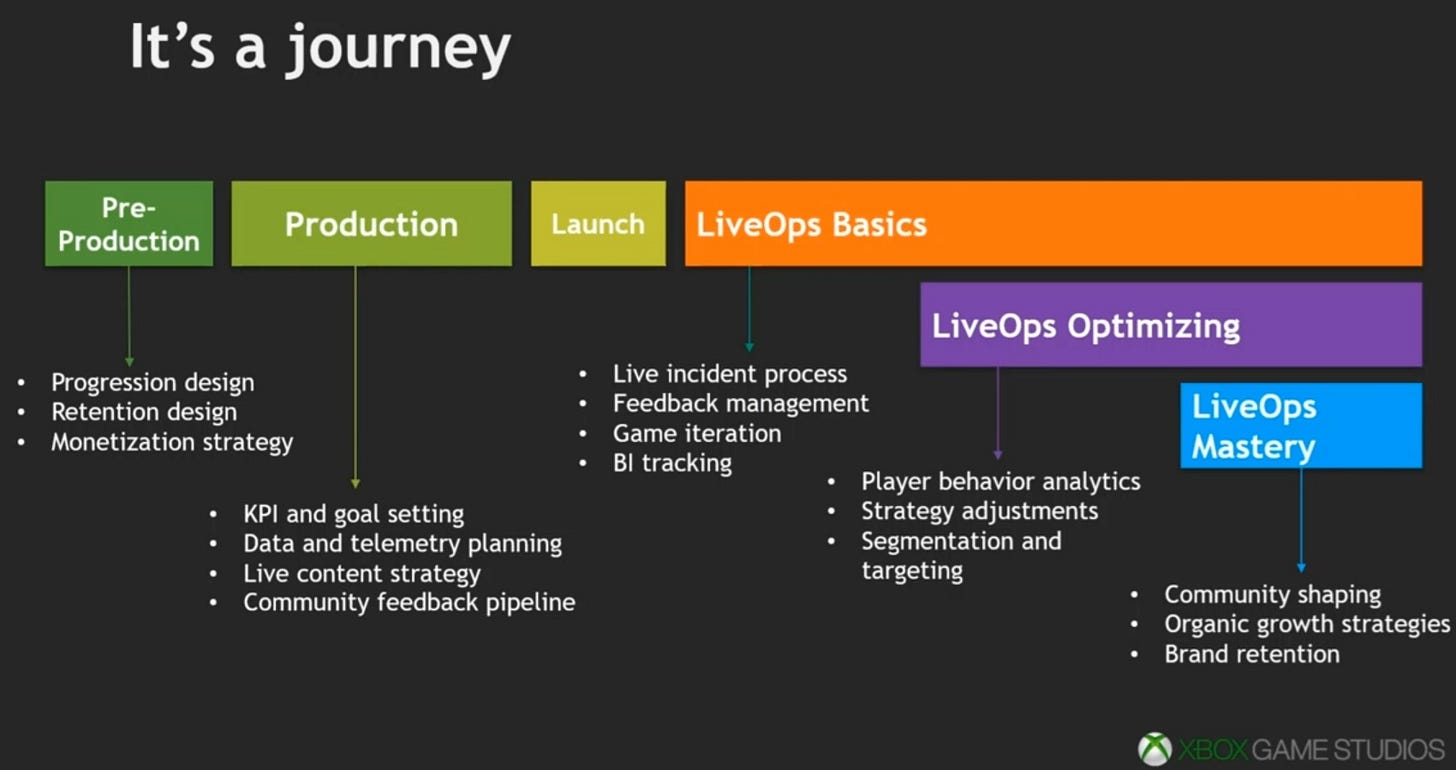
Crystin Cox’s GDC 2020 session included the above process view of Live Ops game development and, among other things, it was used to contextualize how ArenaNet’s Guild Wars 2 team applied an iterative Live Ops process post-launch, in three stages, to get the game and its player community off the ground in one piece.
In the Live Ops basics phase following launch, Cox outlined in her virtual talk at GDC 2020, the main goal is to improve performance rapidly in a lot of modest, but critical, ways. It’s not about launching new DLC. Broken out, the subgoals are to (1) fix bugs, (2) collect early player feedback, (3) use this feedback to prioritize and iterate on player experience enhancements, and, yes, (4) start tracking Business Intelligence (read: GaaS-oriented) game performance metrics.
In Guild Wars 2’s case, Cox relayed in the talk, it was soon clear that what players were doing and what ArenaNet’s team expected them to do were two very different things.
Early Guild Wars 2 players began squadding up over chat and going on “champ trains.” These groups of 50-100 players roamed the game’s massive maps, completely swarming and devastating its carefully balanced NPC bosses, which ArenaNet’s team had assumed would be attacked in small groups or even in solo missions.
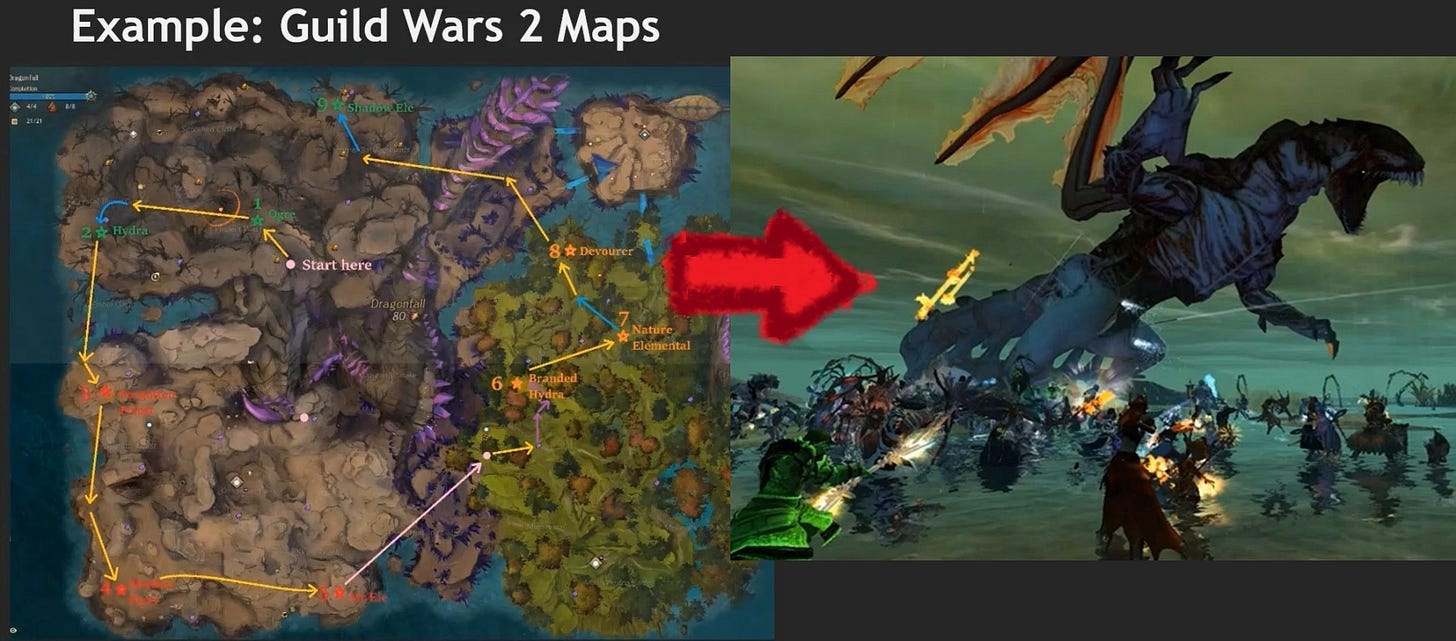
Crystin Cox’s GDC 2020 session outlined how early Guild Wars 2 players surprised ArenaNet’s development team by coordinating large-scale, multi-hour “champ trains” that travelled in a huge loops, systematically dispatching all the NPC bosses the game world offered.
At first, Cox explained, team ArenaNet attempted to stop these trains. They disincentivized these player zergs.
Then they listened more closely to player’s feedback. Riding on a champ train, it turned out, was really fun.
ArenaNet pivoted.
This pivot, Cox stressed, wouldn’t have been possible unless the game was designed and built to allow for that flexibility in the prelaunch period.
ArenaNet was able to get out of the way of this emergent player behavior. The Guild Wars 2 team climbed on the champ train and tooted the whistle. It wasn’t easy, and the iterative process ran into many hiccups, but the fantasy MMORPG’s open world was soon offering boss battles that could only be won by 80-100 player squads.
Cox’s point was that this was a good example of what she meant by an iterative, basic, Live Ops process in action. The focus was on delivering fun for players. Yes, BI and GaaS metrics were also on the train–and were huddled up in the caboose.
In our late January 2026 conversation, I recalled this story and asked Cox if my summary was accurate, and how she suggested that I interpret its meaning more broadly.
“It’s very common for people to imagine what they need to be true,” Cox said. “What would be really beneficial for them to be true? And then go find data and evidence to support that truth instead of really stopping and thinking, ‘What will players really want?’ from the player’s perspective. ‘What feeds their desires? What feeds their motivations? Why would they do this thing?’”
If a studio overemphasizes the GaaS- and revenue-focused side of things, she said, then it can be “really easy to get caught into the mindset of ‘What do I want players to do?’ versus ‘What do players want to do, and what do they need to do?’”
It’s a surprising perspective. Cox, after all, has shifted from the development side of the house to the business side over the course of her career. Shouldn’t she be tacking the other way?
“It’s like bad science,” I blurted out. “A bad scientific process. It’s backwards…”
“It is,” Cox confirmed. “I have talked a lot with teams too, even, like, trying to explain even at a basic level, like, the replication crisis and, like, what p-hacking is, because it’s very prevalent in the way that game developers look at data.”
Replication crisis is a term that’s floated around in academia for years that describes an increasing prevalence of scientific research that can’t be replicated easily because, it appears, those conducing the research, and writing up the results, have a deep-seated need to hit a statistical significance threshold (p<0.05). They wind up, consequently, massaging their data sets and tweaking their methodologies in questionable ways to get below that magic number.
“Game developers look at a lot of data,” Cox continued, “but a lot of them do not have that kind of discipline, when they look at data, that comes with scientific rigor.”
Especially in contexts in which GaaS-oriented pressures are strong, she implied, this approach can produce bad science, which can result in Live Ops game roadkill.
So, what should studios focus on instead?
Live Ops Filtered Through a Player Psychology Sieve
When you’re designing games that you mean people to play for thousands of hours, you’ve got to hit on some of those intrinsic motivators because you’ll hit these hard limits on the extrinsic motivators. That’s not to say you shouldn’t put any extrinsic motivators into your game. They absolutely come into play in everything that you do, but your intrinsic motivators are the things that are actually going to drive long-term engagement because they have to: You’re going to run out of steam on your extrinsic motivators really fast.—Crystin Cox
In her virtual talk at GDC 2020, Cox said that her experiences with Guild Wars 2 and MapleStory led her to conclude that these games’ long-time players “were more motivated by relatedness to other players…” than most other things captured through telemetry.
In Guild Wars 2, she clarified, the behavioral data showed the game’s “townies”–a subset of players who regularly chatted with others in the MMO’s urban watering holes–had far higher long-term retention rates and close to 3x the ARPU (average revenue per user) of the typical Guild Wars 2 player.
Ah-ha! A leading GaaS metric there!
In our discussion, I asked Cox what she’d meant by relatedness in 2020, and what she’d meant when she said engagement with Live Ops games is “more likely to come from the actions that feed whatever the game’s intrinsic motivator is, not necessarily the actions that feed really easy to measure and optimize loops.”
Cox pondered my question.
“So, intrinsic motivators are a thing,” she began, uneasily. “And this is a model of human behavior. So, just to be clear about that, there is no universal truth necessarily when it comes to psychology, right? But it is a model of human behavior, that has become pretty prevalent, that there are motivators that we all have, that drive us to do things that are not from external forces.”

“In behavioral psychology, you might think about things...and you see this come up in economics as well, [with] carrots and sticks. We can incentivize things by giving rewards. We can de-incentivize things by punishment.”
“There’s some strong evidence that those [externally-generated rewards] have very hard cap limits on the way that they actually motivate human behavior. And that there are these other [internal] things that drive people to do things. There’s a model that Self-Determination Theory uses that, sort of, buckets all this stuff into three big intrinsic motivators. And it’s autonomy, relatedness, and...mastery” or competence.
A primer on Self-Determination Theory (SDT), which began percolating in the field of psychology back in the 1980s, is here.
SDT is “a good model for Live Ops,” Cox continued, “because a lot of Live Ops games are games where people spend a lot of time, and they interact with other people. There’s more social structure inside of them. So, we behave a little bit more like you would do in some other complex situations in life” outside of a video game environment.
According to Cox, these internally-driven “intrinsic motivators come into play heavily [in Live Ops games], whereas if you’re playing a match three game, for instance…I don’t mean to…[disparage them but] you’re not necessarily looking to be motivated intrinsically, you’re looking for a more short-term satisfaction, and it [such games] can trigger some competency hits, and things like that. But in Live Ops games, you end up dealing with this on a much, much stronger basis.”
“There is an element” Cox added, “of creativity that gets evoked, where creativity is one of the big factors that gets really hurt by extrinsic motivation. When we get under a lot of pressure with extrinsic motivators, we tend to lock down, go into quick thinking heuristics mode, and we stop activating the higher levels of our thinking. And you lose some of that creativity when you do that, [and] it makes it harder to achieve complex tasks sometimes.”
There is much packed into her statements. We won’t unpack much of what she said in the interest of brevity here, but a key takeaway is that Cox implied she, and many other game designers, directors, production and probably even publishing managers, have bought into what SDT is selling. SDT offers these studio execs, and their teams, a common psychological framework that can be used to interpret what’s motivating players to do things and, importantly, offers pointers that designers and the production team can use to create or iterate on content and experiences that should enhance player satisfaction and retention.
Those are two other GaaS-oriented KPIs.
The GaaS metrics are there. The process of improving them, though, runs through the station of player psychology, and it’s really important to conduct objective science in that station.
Cox said that SDT has “an outsized footprint, I think, in game design, for two reasons. One is that it is a good fit. It’s a model that’s specifically focused on motivation, and we deal with a lot of motivation…You could boil down a lot of design work to, ‘Get players to do things,’ right?”
“So, we end up touching it [SDT] a lot. You’re going to see it a lot more from people who work in parts of games that are less directed.”
“There are games where [a player thinks], ‘I’m primarily engaging with it because I want to experience this story, this narrative, this experience. I want to have an experiential, you know, engagement that is really...I want to see the developer’s point of view.’ Like, ‘I’m here because I’m super curious what Sam Lake and the team that he’s assembled is going to put together for Alan Wake.’ I’m not like, ‘I want to control Alan Wake and make all these decisions about what he does. I want to see the experience that they’ve created for me.’”
That, Cox continued, is different from the “Live Ops games [that] don’t focus on that as much. They’re much more sandboxy. They’re much more open. Like, ‘What does the player want to? How can they build things? How can they be creative? How can they engage in these larger systems?’ You’re going to see SDT come up more for systems designers and people who work in that side of the field than you might see [for] narrative designers who are really interested in crafting specific, directed experiences, [and who] are going to think about different psychology models.”
“The other reason,” according to Cox, “is I can’t not mention Scott Rigby. Scott Rigby is a psychologist who was part of authoring a lot of the original SDT framework papers, and then went on to found, or helped found a research...consultancy called Immersyve.”
The Immersyve website is here.
Rigby “got interested in video games, so much so that he made a firm to engage with video games,” Cox continued. That “had a lot to do with...helping that model become more prevalent” specifically in the context of Live Ops video games since the 2000s.
Game Design + SDT + Live Ops = $$$?
It’s a creative endeavor. Somewhere at the heart of every game, at the beginning of every game is its soul, its heart. And a thing that happens, an idea that gets expressed, a vision that gets communicated, that [thing] makes a group of people go, “Yes! We want to go spend years of our lives solving really complicated problems to try to make that thing happen.”—Crystin Cox
Player psychology does not alone make a game.
Neither do Live Ops processes in a vacuum.
These elements must come together with a game design and a game production process before games can be experienced by audiences.
Knowing that ArenaNet’s Crystin Cox had video game design experience, I threw something of a curveball at her toward the end of our call.
Stone Librande, who’s currently a Senior Designer at Riot Games, is a longtime tabletop and video game designer (who’s scheduled to run, with help, a workshop on game design at GDC 2026—and I intend to be there!). Librande has a well-known model of game design that I won’t describe here, again in the interest of brevity, but it’s covered in a slide deck, “Designing Games for Game Designers” that’s freely available on his website if you’re interested.
I asked Cox if she was aware of Librande’s game design model and, while giving her the option to choose a different model of her choice (I’m a fan of autonomy!), asked her how SDT has slotted into her game design processes.
Cox pondered the question for a long beat.
“I love his [Librande’s] model,” Cox finally said. “I think it’s great. I think it’s a really good way of understanding what’s a super complex thing…I think it’s wonderful, and honestly, I wish more younger designers sort of just grabbed it, and used it, because I love process.”
Librande’s model contains six basic elements: the start state, the goal/end state, the opposition that the player(s) must face and overcome to reach the goal/endgame, the decisions in the core gameplay loop that the game system forces players to make, the ruleset, and the user interface. All of these elements matter greatly, according to Librande. If any one of them are misaligned with the others, the whole system can fall apart at the design stage.
Inspiration for a game can emerge from any of these elements, moreover, or from something else entirely. Part of my question to Cox involved where she tended to start with her game design process.
“Something that is nice about the model [that Librande uses] is that it doesn’t have to go in that order,” meaning the six elements I described, Cox told me. “And that’s good because it [design inspiration] doesn’t necessarily go in that order.”
“Every game I’ve ever worked on, and everything I’ve ever designed has had a different answer” to the starting point question. “When it comes to designing, there’s a lot of stuff that we do, especially in Live Ops games, that centers around trying to create repeatable processes and engines in order to drive content and get players engaged.”
“That stuff is useful because humans are messy and hard, and you need scaffolding to build on.”

“My advice to dev teams is always to follow that,” referring to the soul, heart, and inspiration for their game. “Like, ‘Don’t lose that. That’s so important. Like, make that happen.’”
“A lot of times it is one of those parts that [you cited from Librande’s model that] is the thing.”
“I wasn’t here for this, but there’s all these, like, apocryphal stories about Guild Wars one, and the way it was put together...The thing that drove them in order to say ‘We’ve got to do this’ was largely, from a gameplay perspective, was largely this idea about this core mechanic. It was a combination of a core mechanic and decision matrix.”
“They were like, ‘What if you basically had something like Magic [the Gathering] where you have to build a deck with these limited resources, and that defined the way that you interacted with the world. And that was the thing that was interesting, that sparked everybody and [they] said ‘Let’s go do it.’ Then, from around there, you’re like, ‘Okay, we have this, like, cool little heart. How do we then define all this other stuff, so it’s in conversation with, and hopefully it is congruent with, this thing that is the soul of the game?’ And I think you can’t really lose sight of that” as a design team.
“Where SDT comes in for me,” Cox continued, “is generally when we start talking about...the player. Anytime the player comes in, and we have to contend with them…we have to start saying, ‘Great, why would they want to do this?’”
“We have this idea, even [going back to] the example I gave about Guild Wars one, ‘Okay, wouldn’t it be cool if you were in a big, beautiful RPG world, but you were making these really strategic decisions that then translated into real-time tactical decisions based on skills? Why? Why would that be cool?’”
“And it turns out, and this drove a ton of the development of Guild Wars one, [that] that’s cool because of strategic autonomy. And because it actually feeds into my [they player’s] identity to say, ‘I constructed this group of skills, this is, like, part of who I am, is this engine that I built out of my limited resources in order to go interact with the world.’”
“That drove all kinds of things [in Guild Wars] of, like, the way we think about professions, in the way that we thought about trading those skill decks between players and things. Because that’s why players want to do it.”
It was another great nugget of insight about a classic–and successful–Live Ops game.
Cox’s point was that this MMO was built around a distinctive core mechanic and decision matrix vision–the fourth element in Librande’s model of design–and then the player psychology piece of it was leveraged to help inform the why questions that inevitably cropped up as all of the other five elements were fleshed out in turn.
Ultimately, all these pieces must fit together, and run harmoniously, inside a (iterative) Live Ops game process for it to have a shot at finding its audience and financial succeeding. A lot of moving parts that need to fit together just right. No wonder why so many Live Ops game projects fail. It’s the Olympics of design and production.
“Yeah,” said Cox as we hung up. “Coherency is a big deal. And it’s hard.”
GaaS-oriented metrics must take a back seat to all of it.
It’s not that BI and related KPI’s don’t matter. They do, just as extrinsic motivators exist in video games, and they matter. Perhaps a good way of thinking about it is that GaaS-focused metrics are a lagging indicator of a far more important leading indicator: are your players having fun? If they are, you’ve got a player-driven experience.
Share
Copy link