Profiling the Pariah Teenage Guild Leader

Profiling the Pariah Teenage Guild Leader

Blogs

January 13, 2026

Lewis Ward

Profiling the Pariah Teenage Guild Leader

Blogs

January 13, 2026

A cautionary tale for social economy designers and participants: don't let your "foxes" run the "henhouse"


What would a person who doesn’t care how they’re perceived do in this game? That made the game a lot more fun, at least to me...because then I wasn’t constrained anymore. So I turned the guild into a business, and I thought, “How am I going to make this guild make money in a way where they [the guild’s members] don’t actually care what other people think?” - Andrew Wagner

First, welcome! If you enjoy this read, I hope you’ll come back, check out more of our (forthcoming) content, smash the subscribe button, and share the word.

A note about me before getting into the meat of this inaugural Player Driven post on Substack. I’ve gotten to know Greg Posner, the wizard behind the curtain of the Player Driven podcast, over the past couple of years and it’s been a blast. We met at GDC (Game Developer Conference) in early 2024, where I was moderating a panel discussion and he was working at Helpshift (and already podcasting there). Note: We’re both active on LinkedIn, so if you’d like more context or to connect, look us up.

Greg and I hit it off, kept in contact, and I did my first guest stint on Player Driven in late 2024. Fast forward to late 2025, by which point I’d transmuted from an occasional guest to occasional guest co-host! That’s the Easter egg hidden in this post: how I commandeered Greg’s “baby” to have an interesting discussion with someone, namely, Andrew Wagner, who dove off the deep end into an obscure MMORPG at a tender age, and how that experience:

  1. shaped the man he’s become

  2. contributed to the downfall of the MMORPG he eventually “beat” and

  3. illustrated how inadequate governance of social economies can endanger them in a virtual and irl market context alike.

If you want a full Monty experience, the hourlong podcast is here (and it’s likely on your favorite podcast platform); we published it in late July.

What follows is not a recap of the associated episode, “The Economics of Gaming: How One Player Broke an MMO and Launched a Career.” Instead, I’ll double click on three topics that came up in the episode below. I wanted to expand on them because I found the exchanges particularly fascinating and resonant. I hope you will too.

Wagner is a formally trained economist who has run his own investment firm for many years. When he says there are clear parallels between how Eternal Lands operated when he played it obsessively in the 2000s and real world economic (and social) principles that impact our daily lives today, we should take this idea seriously. These connection points were a big piece of what blew my mind as I read his 2020 book, The Economics of Online Gaming, and prompted me to see if Greg would have Andrew on as a guest.

I’ve researched and analyzed video games and XR tech and related market trends for the past 15 years. Andrew’s book did an excellent job linking real world economic principles and phenomena to the design principles and processes that he experienced, often subconsciously, as a teen in Eternal Lands (a RuneScape-type video game that’s actually still playable here). One one level, the latter may be viewed as a greatly simplified microcosm of the former.

This may sound like an esoteric topic, but hundreds of millions of people today will experience a virtual social economy inside a video game they play. They may not think of it in those terms but it’s a fair way of describing their behavior. What I’ll try to do below, and what I intend to illuminate in most of my subsequent Substack posts, are linkages (as well as the gaps) between how virtual and irl social economies appear to work. This is the twist I plan on putting on a subset of Player Driven episodes moving forward. If this topic sounds interesting, again, smash that subscribe button and share the word!

Enough preamble. Let’s jump into the first installment.

1. Reputational Capital

I was part of another guild before I created my own guild, and that guild was called RIVA. And they used a very similar strategy where they just produced a lot of stuff, but they didn’t want people to hate them, so they kept prices at basically the market level so that all the other players selling stuff would think they’re good, nice, honorable players. And then when I had my guild, which was named RICH, which is just the best name for a villain you could possibly think of, we didn’t care really care about reputational capital. We just cared about money because we called ourselves RICH. That changed the dynamic of the game. If everything was based on price, the reputation didn’t really matter. The buyers would go to whoever was selling the for the cheapest. If they cared about other things like quality and service and all that, reputation would matter a lot more. - Andrew Wagner

The preceding excerpt includes an example of a term that economists like Wagner use to describe how market-based supply, demand, and pricing systems work. His point, which was also made in his book, is that the producer guilds in Eternal Lands - the virtual equivalent of irl manufacturing companies - grew to have good or bad reputations over time, and that those reputations impacted “business” performance.

Spoiler alert: plot twists from Wagner’s book will be aired below!

A guild’s reputation impacted how other guilds, as well as players outside these guilds (the equivalent of consumers in an irl context), viewed and treated these organizations, with public message boards being the primary in-game channel of transmitting reputational info.

Wagner’s “innovation” in Eternal Lands’ producer ecosystem was to use RICH’s members (the equivalent of employees) in a way that allowed RICH to undercut every other producer guild on price. That pissed off a lot of other guild leaders, their members, and some rank-and-file players who weren’t in a guild. It was broadly viewed as unfair behavior. RICH’s reputation suffered - but sales also went up. Eventually, Wagner’s guild drove several producer guilds out of the market entirely.

The game’s primary developer, a guy who went by the name Entropy, let RICH behave as Wagner preferred. Entropy was in the position of a market regulator.

“I think he [Entropy] liked the way that this drama brought attention to the game, and it actually made people play more than if there was nothing happening,” explained Wagner.

RICH and Wagner became Eternal Lands’ “black hat” pariahs. Wagner and company leaned into it. It was a game, so what did it matter if his guild played the villain? In retrospect, from an economic angle, Wagner’s broader point was that reputational capital didn’t really matter in the context of Eternal Lands’ in-game marketplace because (1) the guild sold sold pure commodities and (2) they sold their wares at a price that no other producer guild could match. In such a context, that’s precisely what the laws of supply and demand predict will happen: less efficient companies will bleed market share and eventually fall by the wayside.

“If you think about that [reputational capital] in the real world, it’s kind of a sliding scale,” said Wagner in our podcast discussion. “The more somebody needs the product, the less it matters who sells it, which is why you get companies like Comcast that have a really bad reputation, but people still use it, because they have to.”

“It’s also related to the size of the business. If there’s a small restaurant that has a bad reputation, it’s probably going to go out of business. But if it’s a really big company, they can take a hit to their reputation. So, something like Tesla, where it’s taken a reputational hit, it’s still a really big business. The business is harmed, but they’re not going out of business the way a small company would.”

2. Market Power and Regulatory Capture

I told him [Entropy] what I was going to do. And I told him what was going to happen when I did it. And I told him how to prevent it. And he didn’t. - Andrew Wagner

As RICH moved up the supplier market share ladder, Wagner plotted his next move: becoming a monopolist. We may assume all monopolies are bad news for a market-based social economy, but Wagner distinguished between two kinds of monopolies. The first is a natural monopoly, which is the type, in retrospect, that he maintains RICH became. He compared it to a utility company. In effect, your local community would work less efficiently if it had two separate power grids, two sewer systems, etc.

“If it’s a monopoly that’s created just by having the lowest cost then, generally, consumers can actually somewhat benefit from that,” said Wagner. “They might see lower quality products, but if what they care about the most is price, then consumers are being best served by that type of monopoly.”

“Of course, that’s not great for anybody trying to compete with their business. And that can cause some other issues if somebody that has better quality products wants to compete in this market.”

Wagner didn’t say it, but the other type, by extension, can be described as an unnatural monopoly…as in the price-gouging kind.

“If the monopoly is the only place where people can buy from, then they could really squeeze out their customers,” explained Wagner. “They could capture just a little bit of extra money that they maybe didn’t earn in any way. And some people would say ‘don’t deserve’, but ‘didn’t earn’ is probably a more accurate way of putting it. So that can hurt competitors and it can hurt consumers if you have a monopoly of that type.”

I circled back to Comcast and asked Wagner if he viewed it as a business that operated closer to the latter type.

“The only thing I would have to say about that is when Google Fiber says ‘We’re coming into this neighborhood’…and I know that Google isn’t doing that anymore…but when Google Fiber would say ‘We’re coming into this new neighborhood and we’re going to offer Google Fiber,’ suddenly everyone got really good deals on their internet.”
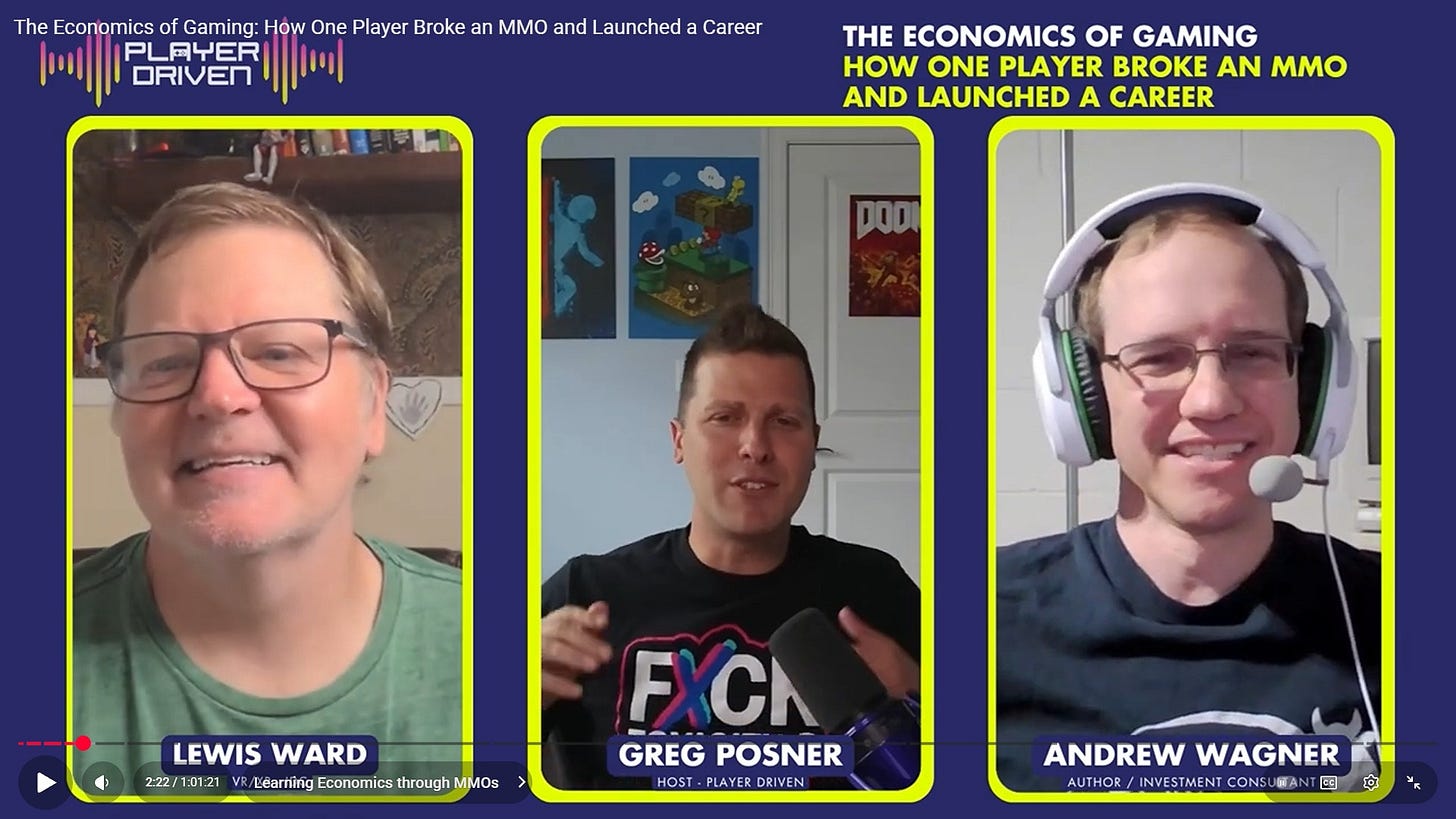
I turned back to the plotline of The Economics of Online Gaming. I noted that RICH’s market power grew to the point that Wagner eventually co-opted somebody on the development team (not Entropy). RICH, already a monopolist in multiple in-game markets, now gained a unique, extra advantage in Eternal Lands that made it virtually unbeatable. I asked Wagner if that broke the concept of a market in half.

“Well, the short answer is, ‘Yes, absolutely,’” he replied. “It absolutely does.”

“This was such a small game and it was really one developer, so he would take people who played the game to help him develop the game, which I thought was really smart because he would get free labor that way. When you have developers who are also playing the game, there’s this temptation to add things that are special benefits just for their own team or their own players. I had this guy in my guild. He was required to leave my guild…because of the reputation that my guild had.”

“So he left and then he sent me a message and he said, ‘Hey, guess what I’m working on?’ It was basically a secret cave that had everything you needed to do to produce. Most of the time you would have to walk, like, halfway across the map, gather materials, carry it back. But this you could do all in one spot. Other developers knew that it was being created too. But what the idea was, I think, and I don’t know all the specifics, but I think the idea was a player should stumble on this secret instead of already knowing about it beforehand. Knowing about it beforehand was really what the advantage was. It was absolutely, entirely, totally unfair. There’s no other way to put it.”

“I actually think I quit the game shortly after that because I felt like I beat the game at that point. That’s the ultimate, you beat the MMO. If you get one of your players on the development team, you have beat the MMO. I don’t think there’s any other way to actually beat an MMO, but that was pretty much what I would say. It does completely destroy competition because...this was a guild that already had a structural advantage from producing. You give that structural advantage another unfair structural advantage, and then the game is basically over. I actually didn’t really use it [the secret cave] that much because the fact that it was created was enough for me to say, ‘I’ve beat the game, I’m done.’”

That’s the ultimate, you beat the MMO. If you get one of your players on the development team, you have beat the MMO.

In his book, he called that kind of activity regulatory capture. An irl example he cited was an ex-Verizon lawyer who was working at the FCC in 2017 and helped to repeal America’s network neutrality laws. In an email exchange leading up to the podcast, Wagner also cited the work of Elon Musk’s DOGE team from early in the second Trump administration as another clearcut case of regulatory capture.

“I wrote my master’s paper on network neutrality, so I should have some thoughts” on how regulatory capture undermines market integrity, Wagner continued. “Effectively, what it means is it creates an inefficiency that shouldn’t exist and then someone profits from that inefficiency. So it’s using the system to create an inefficiency, and then you place someone in that spot, and they profit from it. That’s effectively what regulatory capture is doing.”

“I kind of think of a regulator’s job as to be an impartial referee that ensures everybody’s following the rules. So what happens when one of the players for one of the teams gets to be the referee? You get a situation where they get to choose who the winner is, and they might just choose that their team wins. And that’s effectively what regulatory capture is. And that’s basically what my guild did in the game.”

3. Still Wearing a Black Hat?

“There are people who know me and they know that I’m a very nice person and I only do this kind of thing inside a game. If you play a board game with me, you’re going to have a bad time.” - Andrew Wagner

Last but not least, let’s touch on one of the major differences between a MMORPG and an irl social economy. A video game is, obviously, just a game. Many games allow players to roleplay as villains. EVE Online, a popular space-based MMORPG that’s been around almost as long as Eternal Lands, has a huge, longstanding pirate faction. In GTA V, nearly everyone plays the antihero. There’s nothing wrong with that. Wagner was simply fulfilling this vacant role in Eternal Lands. He embraced the black hat, and loved it.

“I really felt like I was playing a character and I chose to play this character in a certain way,” he explained. “And I know a lot of people who’ve played something like Dungeons & Dragons will know very well that you have a character, and you set this character to behave in a certain way, and that’s how you decide to play the game.”

Wagner also wound up learning a lot, by osmosis, about how that economic and social system worked. Eventually, he mastered the knobs and levers of the game’s social economy…and then subverted them. His guild’s unchecked rise pissed off a lot of fellow guild leaders and many rank-and-file players. Many of them eventually quit the game as a result. The player community began disintegrating not long after he stopped playing and went to college, according to Wagner.

In this sense, one can argue, what RICH did in Eternal Lands undermined the irl business Entropy and his team were running. Yes, it was all fun and games. That is, until the “fun” dried up for too many players not in the RICH guild. That’s where the virtual rubber hit the irl social economy road. You can always quit bad games. There’s a lot of other games out there. It’s far harder to quit irl. The consequences of a subverted market system reverberate indefinitely irl and it’s much trickier to get back to a respawn point.

“I didn’t feel bad about it” at that time, Wagner said. “I was a high school kid and I was exploring the boundaries of what you could do in a game like this. I never thought of it [the secret cave] as and an illegal part of the game, but I have had people say, ‘Hey, did you realize that that’s considered cheating?’”

“When I was making these decisions and I would run it through my head, it was, ‘Okay, this person is the villain. This is how they’ve done things up to this point. How would someone in this mindset make that decision?’ So, I never even really thought about it from the perspective of whether I personally feel bad or not.”

“And I also thought, ‘If this is a problem, then why isn’t the developer fixing it?’ Because I had repeatedly said, ‘This is exactly what’s happening. This is how you can fix it.’ And if they ignore that, then I’m going to keep doing whatever I want. And I don’t care if they don’t like it because they have the ability to fix it at any time.”

“And it’s really funny because they did, eventually, fix it, but far too late. I went back to the game several years later and the mine is still there, but none of the production stuff is in it anymore. So they did fix it, but there aren’t many people playing the game anymore, so it doesn’t really matter.”

“I did at some at some point decide that there were people who weren’t having fun, and I should at least apologize them for taking away their fun.”

Taking away their fun. In both a virtual and irl context, isn’t that one consequence of a social economy that’s gone off the rails? It’s that part of what price-gouging, unnatural monopolies do to their irl customers? Isn’t a common consequence of regulatory capture in any market system that the market subverter absconds with the ‘fun’ of other participants that they ‘didn’t earn’? There’s no free lunch in either context.

At least Wagner eventually felt remorseful and, years later, apologized to some fellow players for his actions.
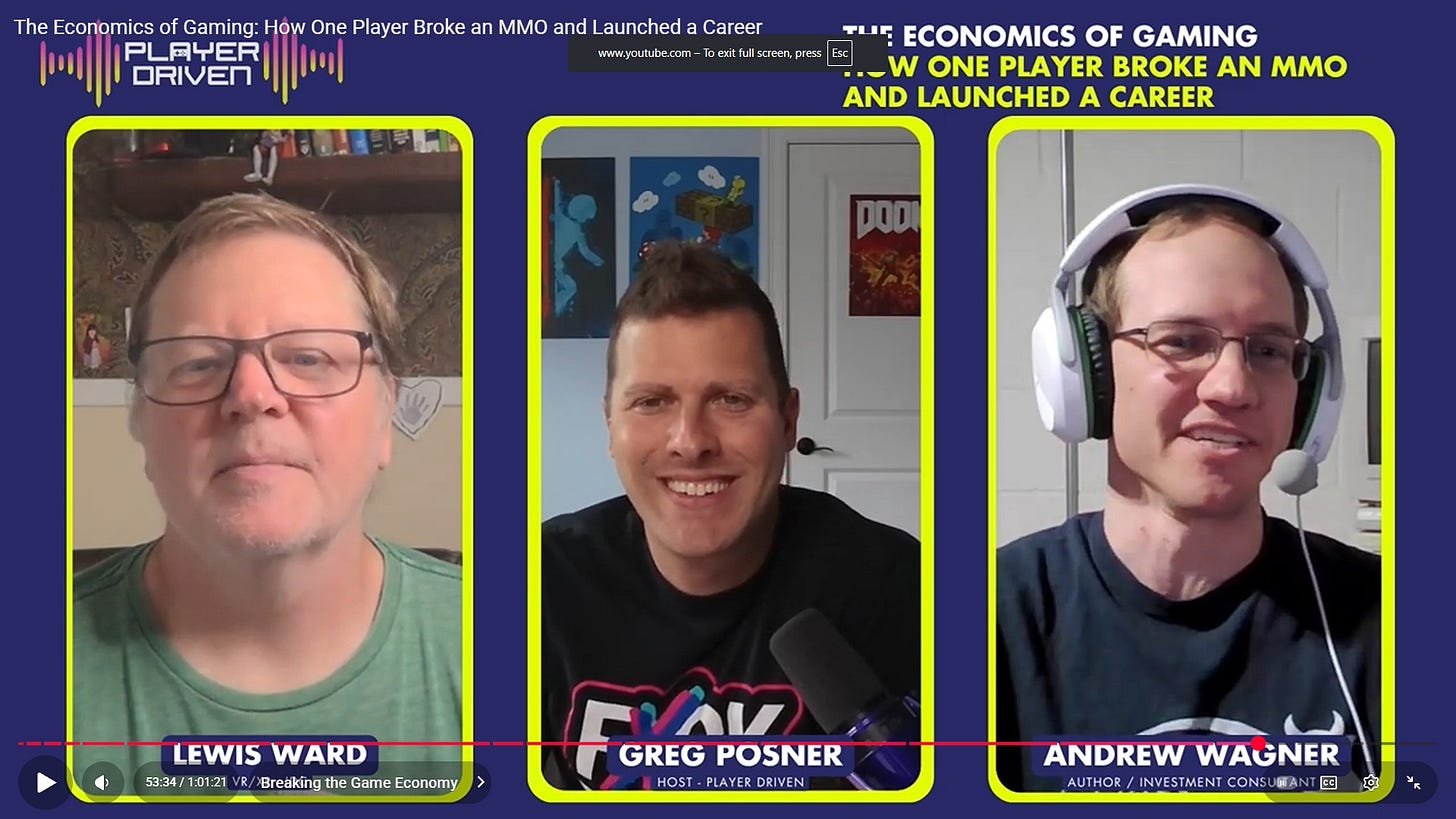
When making investment decisions today, Wagner noted that he leverages two big lessons he learned from playing Eternal Lands.

“There’s kind of two sides of it,” he explained. These are “things that I took from playing this game that I use almost every day. I like to think about where a company fits in its industry and how it competes with other companies. So, for example, do they only care about price? Or is it a combination of the price and the quality of the product they’re selling? Is it how good their service is? And then what’s the market structure like? Is it just a few very large companies? Is it a monopoly? Is a lot of very small businesses? And then how big is the industry? I learned about all of that stuff just from experimenting inside this game.”

“The other side of it is thinking about who the customers are and what impact they have on the business. So, for example, are they providing something that the customers can’t get anywhere else? Do they have to buy it from this particular business or is it easy to replace? Is it something they can easily go somewhere else and buy from somebody else? So, it’s very basic business concepts like that that are incredibly important in the business world.”

I didn’t ask, but I did wonder after the episode was recorded if Wagner is still wearing a kind of irl black hat today. If he’s steering his clients to invest in companies that are on the path to becoming unnatural monopolies, doesn’t that raise the risk that the very inefficiencies he helped foment in Eternal Lands will emerge in America’s social economy writ large?

What would a person who doesn’t care how they’re perceived do in this game? That made the game a lot more fun, at least to me...because then I wasn’t constrained anymore. So I turned the guild into a business, and I thought, “How am I going to make this guild make money in a way where they [the guild’s members] don’t actually care what other people think?” - Andrew Wagner

First, welcome! If you enjoy this read, I hope you’ll come back, check out more of our (forthcoming) content, smash the subscribe button, and share the word.

A note about me before getting into the meat of this inaugural Player Driven post on Substack. I’ve gotten to know Greg Posner, the wizard behind the curtain of the Player Driven podcast, over the past couple of years and it’s been a blast. We met at GDC (Game Developer Conference) in early 2024, where I was moderating a panel discussion and he was working at Helpshift (and already podcasting there). Note: We’re both active on LinkedIn, so if you’d like more context or to connect, look us up.

Greg and I hit it off, kept in contact, and I did my first guest stint on Player Driven in late 2024. Fast forward to late 2025, by which point I’d transmuted from an occasional guest to occasional guest co-host! That’s the Easter egg hidden in this post: how I commandeered Greg’s “baby” to have an interesting discussion with someone, namely, Andrew Wagner, who dove off the deep end into an obscure MMORPG at a tender age, and how that experience:

  1. shaped the man he’s become

  2. contributed to the downfall of the MMORPG he eventually “beat” and

  3. illustrated how inadequate governance of social economies can endanger them in a virtual and irl market context alike.

If you want a full Monty experience, the hourlong podcast is here (and it’s likely on your favorite podcast platform); we published it in late July.

What follows is not a recap of the associated episode, “The Economics of Gaming: How One Player Broke an MMO and Launched a Career.” Instead, I’ll double click on three topics that came up in the episode below. I wanted to expand on them because I found the exchanges particularly fascinating and resonant. I hope you will too.

Wagner is a formally trained economist who has run his own investment firm for many years. When he says there are clear parallels between how Eternal Lands operated when he played it obsessively in the 2000s and real world economic (and social) principles that impact our daily lives today, we should take this idea seriously. These connection points were a big piece of what blew my mind as I read his 2020 book, The Economics of Online Gaming, and prompted me to see if Greg would have Andrew on as a guest.

I’ve researched and analyzed video games and XR tech and related market trends for the past 15 years. Andrew’s book did an excellent job linking real world economic principles and phenomena to the design principles and processes that he experienced, often subconsciously, as a teen in Eternal Lands (a RuneScape-type video game that’s actually still playable here). One one level, the latter may be viewed as a greatly simplified microcosm of the former.

This may sound like an esoteric topic, but hundreds of millions of people today will experience a virtual social economy inside a video game they play. They may not think of it in those terms but it’s a fair way of describing their behavior. What I’ll try to do below, and what I intend to illuminate in most of my subsequent Substack posts, are linkages (as well as the gaps) between how virtual and irl social economies appear to work. This is the twist I plan on putting on a subset of Player Driven episodes moving forward. If this topic sounds interesting, again, smash that subscribe button and share the word!

Enough preamble. Let’s jump into the first installment.

1. Reputational Capital

I was part of another guild before I created my own guild, and that guild was called RIVA. And they used a very similar strategy where they just produced a lot of stuff, but they didn’t want people to hate them, so they kept prices at basically the market level so that all the other players selling stuff would think they’re good, nice, honorable players. And then when I had my guild, which was named RICH, which is just the best name for a villain you could possibly think of, we didn’t care really care about reputational capital. We just cared about money because we called ourselves RICH. That changed the dynamic of the game. If everything was based on price, the reputation didn’t really matter. The buyers would go to whoever was selling the for the cheapest. If they cared about other things like quality and service and all that, reputation would matter a lot more. - Andrew Wagner

The preceding excerpt includes an example of a term that economists like Wagner use to describe how market-based supply, demand, and pricing systems work. His point, which was also made in his book, is that the producer guilds in Eternal Lands - the virtual equivalent of irl manufacturing companies - grew to have good or bad reputations over time, and that those reputations impacted “business” performance.

Spoiler alert: plot twists from Wagner’s book will be aired below!

A guild’s reputation impacted how other guilds, as well as players outside these guilds (the equivalent of consumers in an irl context), viewed and treated these organizations, with public message boards being the primary in-game channel of transmitting reputational info.

Wagner’s “innovation” in Eternal Lands’ producer ecosystem was to use RICH’s members (the equivalent of employees) in a way that allowed RICH to undercut every other producer guild on price. That pissed off a lot of other guild leaders, their members, and some rank-and-file players who weren’t in a guild. It was broadly viewed as unfair behavior. RICH’s reputation suffered - but sales also went up. Eventually, Wagner’s guild drove several producer guilds out of the market entirely.

The game’s primary developer, a guy who went by the name Entropy, let RICH behave as Wagner preferred. Entropy was in the position of a market regulator.

“I think he [Entropy] liked the way that this drama brought attention to the game, and it actually made people play more than if there was nothing happening,” explained Wagner.

RICH and Wagner became Eternal Lands’ “black hat” pariahs. Wagner and company leaned into it. It was a game, so what did it matter if his guild played the villain? In retrospect, from an economic angle, Wagner’s broader point was that reputational capital didn’t really matter in the context of Eternal Lands’ in-game marketplace because (1) the guild sold sold pure commodities and (2) they sold their wares at a price that no other producer guild could match. In such a context, that’s precisely what the laws of supply and demand predict will happen: less efficient companies will bleed market share and eventually fall by the wayside.

“If you think about that [reputational capital] in the real world, it’s kind of a sliding scale,” said Wagner in our podcast discussion. “The more somebody needs the product, the less it matters who sells it, which is why you get companies like Comcast that have a really bad reputation, but people still use it, because they have to.”

“It’s also related to the size of the business. If there’s a small restaurant that has a bad reputation, it’s probably going to go out of business. But if it’s a really big company, they can take a hit to their reputation. So, something like Tesla, where it’s taken a reputational hit, it’s still a really big business. The business is harmed, but they’re not going out of business the way a small company would.”

2. Market Power and Regulatory Capture

I told him [Entropy] what I was going to do. And I told him what was going to happen when I did it. And I told him how to prevent it. And he didn’t. - Andrew Wagner

As RICH moved up the supplier market share ladder, Wagner plotted his next move: becoming a monopolist. We may assume all monopolies are bad news for a market-based social economy, but Wagner distinguished between two kinds of monopolies. The first is a natural monopoly, which is the type, in retrospect, that he maintains RICH became. He compared it to a utility company. In effect, your local community would work less efficiently if it had two separate power grids, two sewer systems, etc.

“If it’s a monopoly that’s created just by having the lowest cost then, generally, consumers can actually somewhat benefit from that,” said Wagner. “They might see lower quality products, but if what they care about the most is price, then consumers are being best served by that type of monopoly.”

“Of course, that’s not great for anybody trying to compete with their business. And that can cause some other issues if somebody that has better quality products wants to compete in this market.”

Wagner didn’t say it, but the other type, by extension, can be described as an unnatural monopoly…as in the price-gouging kind.

“If the monopoly is the only place where people can buy from, then they could really squeeze out their customers,” explained Wagner. “They could capture just a little bit of extra money that they maybe didn’t earn in any way. And some people would say ‘don’t deserve’, but ‘didn’t earn’ is probably a more accurate way of putting it. So that can hurt competitors and it can hurt consumers if you have a monopoly of that type.”

I circled back to Comcast and asked Wagner if he viewed it as a business that operated closer to the latter type.

“The only thing I would have to say about that is when Google Fiber says ‘We’re coming into this neighborhood’…and I know that Google isn’t doing that anymore…but when Google Fiber would say ‘We’re coming into this new neighborhood and we’re going to offer Google Fiber,’ suddenly everyone got really good deals on their internet.”

I turned back to the plotline of The Economics of Online Gaming. I noted that RICH’s market power grew to the point that Wagner eventually co-opted somebody on the development team (not Entropy). RICH, already a monopolist in multiple in-game markets, now gained a unique, extra advantage in Eternal Lands that made it virtually unbeatable. I asked Wagner if that broke the concept of a market in half.

“Well, the short answer is, ‘Yes, absolutely,’” he replied. “It absolutely does.”

“This was such a small game and it was really one developer, so he would take people who played the game to help him develop the game, which I thought was really smart because he would get free labor that way. When you have developers who are also playing the game, there’s this temptation to add things that are special benefits just for their own team or their own players. I had this guy in my guild. He was required to leave my guild…because of the reputation that my guild had.”

“So he left and then he sent me a message and he said, ‘Hey, guess what I’m working on?’ It was basically a secret cave that had everything you needed to do to produce. Most of the time you would have to walk, like, halfway across the map, gather materials, carry it back. But this you could do all in one spot. Other developers knew that it was being created too. But what the idea was, I think, and I don’t know all the specifics, but I think the idea was a player should stumble on this secret instead of already knowing about it beforehand. Knowing about it beforehand was really what the advantage was. It was absolutely, entirely, totally unfair. There’s no other way to put it.”

“I actually think I quit the game shortly after that because I felt like I beat the game at that point. That’s the ultimate, you beat the MMO. If you get one of your players on the development team, you have beat the MMO. I don’t think there’s any other way to actually beat an MMO, but that was pretty much what I would say. It does completely destroy competition because...this was a guild that already had a structural advantage from producing. You give that structural advantage another unfair structural advantage, and then the game is basically over. I actually didn’t really use it [the secret cave] that much because the fact that it was created was enough for me to say, ‘I’ve beat the game, I’m done.’”

That’s the ultimate, you beat the MMO. If you get one of your players on the development team, you have beat the MMO.

In his book, he called that kind of activity regulatory capture. An irl example he cited was an ex-Verizon lawyer who was working at the FCC in 2017 and helped to repeal America’s network neutrality laws. In an email exchange leading up to the podcast, Wagner also cited the work of Elon Musk’s DOGE team from early in the second Trump administration as another clearcut case of regulatory capture.

“I wrote my master’s paper on network neutrality, so I should have some thoughts” on how regulatory capture undermines market integrity, Wagner continued. “Effectively, what it means is it creates an inefficiency that shouldn’t exist and then someone profits from that inefficiency. So it’s using the system to create an inefficiency, and then you place someone in that spot, and they profit from it. That’s effectively what regulatory capture is doing.”

“I kind of think of a regulator’s job as to be an impartial referee that ensures everybody’s following the rules. So what happens when one of the players for one of the teams gets to be the referee? You get a situation where they get to choose who the winner is, and they might just choose that their team wins. And that’s effectively what regulatory capture is. And that’s basically what my guild did in the game.”

3. Still Wearing a Black Hat?

“There are people who know me and they know that I’m a very nice person and I only do this kind of thing inside a game. If you play a board game with me, you’re going to have a bad time.” - Andrew Wagner

Last but not least, let’s touch on one of the major differences between a MMORPG and an irl social economy. A video game is, obviously, just a game. Many games allow players to roleplay as villains. EVE Online, a popular space-based MMORPG that’s been around almost as long as Eternal Lands, has a huge, longstanding pirate faction. In GTA V, nearly everyone plays the antihero. There’s nothing wrong with that. Wagner was simply fulfilling this vacant role in Eternal Lands. He embraced the black hat, and loved it.

“I really felt like I was playing a character and I chose to play this character in a certain way,” he explained. “And I know a lot of people who’ve played something like Dungeons & Dragons will know very well that you have a character, and you set this character to behave in a certain way, and that’s how you decide to play the game.”

Wagner also wound up learning a lot, by osmosis, about how that economic and social system worked. Eventually, he mastered the knobs and levers of the game’s social economy…and then subverted them. His guild’s unchecked rise pissed off a lot of fellow guild leaders and many rank-and-file players. Many of them eventually quit the game as a result. The player community began disintegrating not long after he stopped playing and went to college, according to Wagner.

In this sense, one can argue, what RICH did in Eternal Lands undermined the irl business Entropy and his team were running. Yes, it was all fun and games. That is, until the “fun” dried up for too many players not in the RICH guild. That’s where the virtual rubber hit the irl social economy road. You can always quit bad games. There’s a lot of other games out there. It’s far harder to quit irl. The consequences of a subverted market system reverberate indefinitely irl and it’s much trickier to get back to a respawn point.

“I didn’t feel bad about it” at that time, Wagner said. “I was a high school kid and I was exploring the boundaries of what you could do in a game like this. I never thought of it [the secret cave] as and an illegal part of the game, but I have had people say, ‘Hey, did you realize that that’s considered cheating?’”

“When I was making these decisions and I would run it through my head, it was, ‘Okay, this person is the villain. This is how they’ve done things up to this point. How would someone in this mindset make that decision?’ So, I never even really thought about it from the perspective of whether I personally feel bad or not.”

“And I also thought, ‘If this is a problem, then why isn’t the developer fixing it?’ Because I had repeatedly said, ‘This is exactly what’s happening. This is how you can fix it.’ And if they ignore that, then I’m going to keep doing whatever I want. And I don’t care if they don’t like it because they have the ability to fix it at any time.”

“And it’s really funny because they did, eventually, fix it, but far too late. I went back to the game several years later and the mine is still there, but none of the production stuff is in it anymore. So they did fix it, but there aren’t many people playing the game anymore, so it doesn’t really matter.”

“I did at some at some point decide that there were people who weren’t having fun, and I should at least apologize them for taking away their fun.”

Taking away their fun. In both a virtual and irl context, isn’t that one consequence of a social economy that’s gone off the rails? It’s that part of what price-gouging, unnatural monopolies do to their irl customers? Isn’t a common consequence of regulatory capture in any market system that the market subverter absconds with the ‘fun’ of other participants that they ‘didn’t earn’? There’s no free lunch in either context.

At least Wagner eventually felt remorseful and, years later, apologized to some fellow players for his actions.

When making investment decisions today, Wagner noted that he leverages two big lessons he learned from playing Eternal Lands.

“There’s kind of two sides of it,” he explained. These are “things that I took from playing this game that I use almost every day. I like to think about where a company fits in its industry and how it competes with other companies. So, for example, do they only care about price? Or is it a combination of the price and the quality of the product they’re selling? Is it how good their service is? And then what’s the market structure like? Is it just a few very large companies? Is it a monopoly? Is a lot of very small businesses? And then how big is the industry? I learned about all of that stuff just from experimenting inside this game.”

“The other side of it is thinking about who the customers are and what impact they have on the business. So, for example, are they providing something that the customers can’t get anywhere else? Do they have to buy it from this particular business or is it easy to replace? Is it something they can easily go somewhere else and buy from somebody else? So, it’s very basic business concepts like that that are incredibly important in the business world.”

I didn’t ask, but I did wonder after the episode was recorded if Wagner is still wearing a kind of irl black hat today. If he’s steering his clients to invest in companies that are on the path to becoming unnatural monopolies, doesn’t that raise the risk that the very inefficiencies he helped foment in Eternal Lands will emerge in America’s social economy writ large?


What would a person who doesn’t care how they’re perceived do in this game? That made the game a lot more fun, at least to me...because then I wasn’t constrained anymore. So I turned the guild into a business, and I thought, “How am I going to make this guild make money in a way where they [the guild’s members] don’t actually care what other people think?” - Andrew Wagner

First, welcome! If you enjoy this read, I hope you’ll come back, check out more of our (forthcoming) content, smash the subscribe button, and share the word.

A note about me before getting into the meat of this inaugural Player Driven post on Substack. I’ve gotten to know Greg Posner, the wizard behind the curtain of the Player Driven podcast, over the past couple of years and it’s been a blast. We met at GDC (Game Developer Conference) in early 2024, where I was moderating a panel discussion and he was working at Helpshift (and already podcasting there). Note: We’re both active on LinkedIn, so if you’d like more context or to connect, look us up.

Greg and I hit it off, kept in contact, and I did my first guest stint on Player Driven in late 2024. Fast forward to late 2025, by which point I’d transmuted from an occasional guest to occasional guest co-host! That’s the Easter egg hidden in this post: how I commandeered Greg’s “baby” to have an interesting discussion with someone, namely, Andrew Wagner, who dove off the deep end into an obscure MMORPG at a tender age, and how that experience:

  1. shaped the man he’s become

  2. contributed to the downfall of the MMORPG he eventually “beat” and

  3. illustrated how inadequate governance of social economies can endanger them in a virtual and irl market context alike.

If you want a full Monty experience, the hourlong podcast is here (and it’s likely on your favorite podcast platform); we published it in late July.

What follows is not a recap of the associated episode, “The Economics of Gaming: How One Player Broke an MMO and Launched a Career.” Instead, I’ll double click on three topics that came up in the episode below. I wanted to expand on them because I found the exchanges particularly fascinating and resonant. I hope you will too.

Wagner is a formally trained economist who has run his own investment firm for many years. When he says there are clear parallels between how Eternal Lands operated when he played it obsessively in the 2000s and real world economic (and social) principles that impact our daily lives today, we should take this idea seriously. These connection points were a big piece of what blew my mind as I read his 2020 book, The Economics of Online Gaming, and prompted me to see if Greg would have Andrew on as a guest.

I’ve researched and analyzed video games and XR tech and related market trends for the past 15 years. Andrew’s book did an excellent job linking real world economic principles and phenomena to the design principles and processes that he experienced, often subconsciously, as a teen in Eternal Lands (a RuneScape-type video game that’s actually still playable here). One one level, the latter may be viewed as a greatly simplified microcosm of the former.

This may sound like an esoteric topic, but hundreds of millions of people today will experience a virtual social economy inside a video game they play. They may not think of it in those terms but it’s a fair way of describing their behavior. What I’ll try to do below, and what I intend to illuminate in most of my subsequent Substack posts, are linkages (as well as the gaps) between how virtual and irl social economies appear to work. This is the twist I plan on putting on a subset of Player Driven episodes moving forward. If this topic sounds interesting, again, smash that subscribe button and share the word!

Enough preamble. Let’s jump into the first installment.

1. Reputational Capital

I was part of another guild before I created my own guild, and that guild was called RIVA. And they used a very similar strategy where they just produced a lot of stuff, but they didn’t want people to hate them, so they kept prices at basically the market level so that all the other players selling stuff would think they’re good, nice, honorable players. And then when I had my guild, which was named RICH, which is just the best name for a villain you could possibly think of, we didn’t care really care about reputational capital. We just cared about money because we called ourselves RICH. That changed the dynamic of the game. If everything was based on price, the reputation didn’t really matter. The buyers would go to whoever was selling the for the cheapest. If they cared about other things like quality and service and all that, reputation would matter a lot more. - Andrew Wagner

The preceding excerpt includes an example of a term that economists like Wagner use to describe how market-based supply, demand, and pricing systems work. His point, which was also made in his book, is that the producer guilds in Eternal Lands - the virtual equivalent of irl manufacturing companies - grew to have good or bad reputations over time, and that those reputations impacted “business” performance.

Spoiler alert: plot twists from Wagner’s book will be aired below!

A guild’s reputation impacted how other guilds, as well as players outside these guilds (the equivalent of consumers in an irl context), viewed and treated these organizations, with public message boards being the primary in-game channel of transmitting reputational info.

Wagner’s “innovation” in Eternal Lands’ producer ecosystem was to use RICH’s members (the equivalent of employees) in a way that allowed RICH to undercut every other producer guild on price. That pissed off a lot of other guild leaders, their members, and some rank-and-file players who weren’t in a guild. It was broadly viewed as unfair behavior. RICH’s reputation suffered - but sales also went up. Eventually, Wagner’s guild drove several producer guilds out of the market entirely.

The game’s primary developer, a guy who went by the name Entropy, let RICH behave as Wagner preferred. Entropy was in the position of a market regulator.

“I think he [Entropy] liked the way that this drama brought attention to the game, and it actually made people play more than if there was nothing happening,” explained Wagner.

RICH and Wagner became Eternal Lands’ “black hat” pariahs. Wagner and company leaned into it. It was a game, so what did it matter if his guild played the villain? In retrospect, from an economic angle, Wagner’s broader point was that reputational capital didn’t really matter in the context of Eternal Lands’ in-game marketplace because (1) the guild sold sold pure commodities and (2) they sold their wares at a price that no other producer guild could match. In such a context, that’s precisely what the laws of supply and demand predict will happen: less efficient companies will bleed market share and eventually fall by the wayside.

“If you think about that [reputational capital] in the real world, it’s kind of a sliding scale,” said Wagner in our podcast discussion. “The more somebody needs the product, the less it matters who sells it, which is why you get companies like Comcast that have a really bad reputation, but people still use it, because they have to.”

“It’s also related to the size of the business. If there’s a small restaurant that has a bad reputation, it’s probably going to go out of business. But if it’s a really big company, they can take a hit to their reputation. So, something like Tesla, where it’s taken a reputational hit, it’s still a really big business. The business is harmed, but they’re not going out of business the way a small company would.”

2. Market Power and Regulatory Capture

I told him [Entropy] what I was going to do. And I told him what was going to happen when I did it. And I told him how to prevent it. And he didn’t. - Andrew Wagner

As RICH moved up the supplier market share ladder, Wagner plotted his next move: becoming a monopolist. We may assume all monopolies are bad news for a market-based social economy, but Wagner distinguished between two kinds of monopolies. The first is a natural monopoly, which is the type, in retrospect, that he maintains RICH became. He compared it to a utility company. In effect, your local community would work less efficiently if it had two separate power grids, two sewer systems, etc.

“If it’s a monopoly that’s created just by having the lowest cost then, generally, consumers can actually somewhat benefit from that,” said Wagner. “They might see lower quality products, but if what they care about the most is price, then consumers are being best served by that type of monopoly.”

“Of course, that’s not great for anybody trying to compete with their business. And that can cause some other issues if somebody that has better quality products wants to compete in this market.”

Wagner didn’t say it, but the other type, by extension, can be described as an unnatural monopoly…as in the price-gouging kind.

“If the monopoly is the only place where people can buy from, then they could really squeeze out their customers,” explained Wagner. “They could capture just a little bit of extra money that they maybe didn’t earn in any way. And some people would say ‘don’t deserve’, but ‘didn’t earn’ is probably a more accurate way of putting it. So that can hurt competitors and it can hurt consumers if you have a monopoly of that type.”

I circled back to Comcast and asked Wagner if he viewed it as a business that operated closer to the latter type.

“The only thing I would have to say about that is when Google Fiber says ‘We’re coming into this neighborhood’…and I know that Google isn’t doing that anymore…but when Google Fiber would say ‘We’re coming into this new neighborhood and we’re going to offer Google Fiber,’ suddenly everyone got really good deals on their internet.”

I turned back to the plotline of The Economics of Online Gaming. I noted that RICH’s market power grew to the point that Wagner eventually co-opted somebody on the development team (not Entropy). RICH, already a monopolist in multiple in-game markets, now gained a unique, extra advantage in Eternal Lands that made it virtually unbeatable. I asked Wagner if that broke the concept of a market in half.

“Well, the short answer is, ‘Yes, absolutely,’” he replied. “It absolutely does.”

“This was such a small game and it was really one developer, so he would take people who played the game to help him develop the game, which I thought was really smart because he would get free labor that way. When you have developers who are also playing the game, there’s this temptation to add things that are special benefits just for their own team or their own players. I had this guy in my guild. He was required to leave my guild…because of the reputation that my guild had.”

“So he left and then he sent me a message and he said, ‘Hey, guess what I’m working on?’ It was basically a secret cave that had everything you needed to do to produce. Most of the time you would have to walk, like, halfway across the map, gather materials, carry it back. But this you could do all in one spot. Other developers knew that it was being created too. But what the idea was, I think, and I don’t know all the specifics, but I think the idea was a player should stumble on this secret instead of already knowing about it beforehand. Knowing about it beforehand was really what the advantage was. It was absolutely, entirely, totally unfair. There’s no other way to put it.”

“I actually think I quit the game shortly after that because I felt like I beat the game at that point. That’s the ultimate, you beat the MMO. If you get one of your players on the development team, you have beat the MMO. I don’t think there’s any other way to actually beat an MMO, but that was pretty much what I would say. It does completely destroy competition because...this was a guild that already had a structural advantage from producing. You give that structural advantage another unfair structural advantage, and then the game is basically over. I actually didn’t really use it [the secret cave] that much because the fact that it was created was enough for me to say, ‘I’ve beat the game, I’m done.’”

That’s the ultimate, you beat the MMO. If you get one of your players on the development team, you have beat the MMO.

In his book, he called that kind of activity regulatory capture. An irl example he cited was an ex-Verizon lawyer who was working at the FCC in 2017 and helped to repeal America’s network neutrality laws. In an email exchange leading up to the podcast, Wagner also cited the work of Elon Musk’s DOGE team from early in the second Trump administration as another clearcut case of regulatory capture.

“I wrote my master’s paper on network neutrality, so I should have some thoughts” on how regulatory capture undermines market integrity, Wagner continued. “Effectively, what it means is it creates an inefficiency that shouldn’t exist and then someone profits from that inefficiency. So it’s using the system to create an inefficiency, and then you place someone in that spot, and they profit from it. That’s effectively what regulatory capture is doing.”

“I kind of think of a regulator’s job as to be an impartial referee that ensures everybody’s following the rules. So what happens when one of the players for one of the teams gets to be the referee? You get a situation where they get to choose who the winner is, and they might just choose that their team wins. And that’s effectively what regulatory capture is. And that’s basically what my guild did in the game.”

3. Still Wearing a Black Hat?

“There are people who know me and they know that I’m a very nice person and I only do this kind of thing inside a game. If you play a board game with me, you’re going to have a bad time.” - Andrew Wagner

Last but not least, let’s touch on one of the major differences between a MMORPG and an irl social economy. A video game is, obviously, just a game. Many games allow players to roleplay as villains. EVE Online, a popular space-based MMORPG that’s been around almost as long as Eternal Lands, has a huge, longstanding pirate faction. In GTA V, nearly everyone plays the antihero. There’s nothing wrong with that. Wagner was simply fulfilling this vacant role in Eternal Lands. He embraced the black hat, and loved it.

“I really felt like I was playing a character and I chose to play this character in a certain way,” he explained. “And I know a lot of people who’ve played something like Dungeons & Dragons will know very well that you have a character, and you set this character to behave in a certain way, and that’s how you decide to play the game.”

Wagner also wound up learning a lot, by osmosis, about how that economic and social system worked. Eventually, he mastered the knobs and levers of the game’s social economy…and then subverted them. His guild’s unchecked rise pissed off a lot of fellow guild leaders and many rank-and-file players. Many of them eventually quit the game as a result. The player community began disintegrating not long after he stopped playing and went to college, according to Wagner.

In this sense, one can argue, what RICH did in Eternal Lands undermined the irl business Entropy and his team were running. Yes, it was all fun and games. That is, until the “fun” dried up for too many players not in the RICH guild. That’s where the virtual rubber hit the irl social economy road. You can always quit bad games. There’s a lot of other games out there. It’s far harder to quit irl. The consequences of a subverted market system reverberate indefinitely irl and it’s much trickier to get back to a respawn point.

“I didn’t feel bad about it” at that time, Wagner said. “I was a high school kid and I was exploring the boundaries of what you could do in a game like this. I never thought of it [the secret cave] as and an illegal part of the game, but I have had people say, ‘Hey, did you realize that that’s considered cheating?’”

“When I was making these decisions and I would run it through my head, it was, ‘Okay, this person is the villain. This is how they’ve done things up to this point. How would someone in this mindset make that decision?’ So, I never even really thought about it from the perspective of whether I personally feel bad or not.”

“And I also thought, ‘If this is a problem, then why isn’t the developer fixing it?’ Because I had repeatedly said, ‘This is exactly what’s happening. This is how you can fix it.’ And if they ignore that, then I’m going to keep doing whatever I want. And I don’t care if they don’t like it because they have the ability to fix it at any time.”

“And it’s really funny because they did, eventually, fix it, but far too late. I went back to the game several years later and the mine is still there, but none of the production stuff is in it anymore. So they did fix it, but there aren’t many people playing the game anymore, so it doesn’t really matter.”

“I did at some at some point decide that there were people who weren’t having fun, and I should at least apologize them for taking away their fun.”

Taking away their fun. In both a virtual and irl context, isn’t that one consequence of a social economy that’s gone off the rails? It’s that part of what price-gouging, unnatural monopolies do to their irl customers? Isn’t a common consequence of regulatory capture in any market system that the market subverter absconds with the ‘fun’ of other participants that they ‘didn’t earn’? There’s no free lunch in either context.

At least Wagner eventually felt remorseful and, years later, apologized to some fellow players for his actions.

When making investment decisions today, Wagner noted that he leverages two big lessons he learned from playing Eternal Lands.

“There’s kind of two sides of it,” he explained. These are “things that I took from playing this game that I use almost every day. I like to think about where a company fits in its industry and how it competes with other companies. So, for example, do they only care about price? Or is it a combination of the price and the quality of the product they’re selling? Is it how good their service is? And then what’s the market structure like? Is it just a few very large companies? Is it a monopoly? Is a lot of very small businesses? And then how big is the industry? I learned about all of that stuff just from experimenting inside this game.”

“The other side of it is thinking about who the customers are and what impact they have on the business. So, for example, are they providing something that the customers can’t get anywhere else? Do they have to buy it from this particular business or is it easy to replace? Is it something they can easily go somewhere else and buy from somebody else? So, it’s very basic business concepts like that that are incredibly important in the business world.”

I didn’t ask, but I did wonder after the episode was recorded if Wagner is still wearing a kind of irl black hat today. If he’s steering his clients to invest in companies that are on the path to becoming unnatural monopolies, doesn’t that raise the risk that the very inefficiencies he helped foment in Eternal Lands will emerge in America’s social economy writ large?

Share

LinkedIn

Facebook

Copy link

Share

LinkedIn

Facebook

Copy link

Share

LinkedIn

Facebook

Copy link