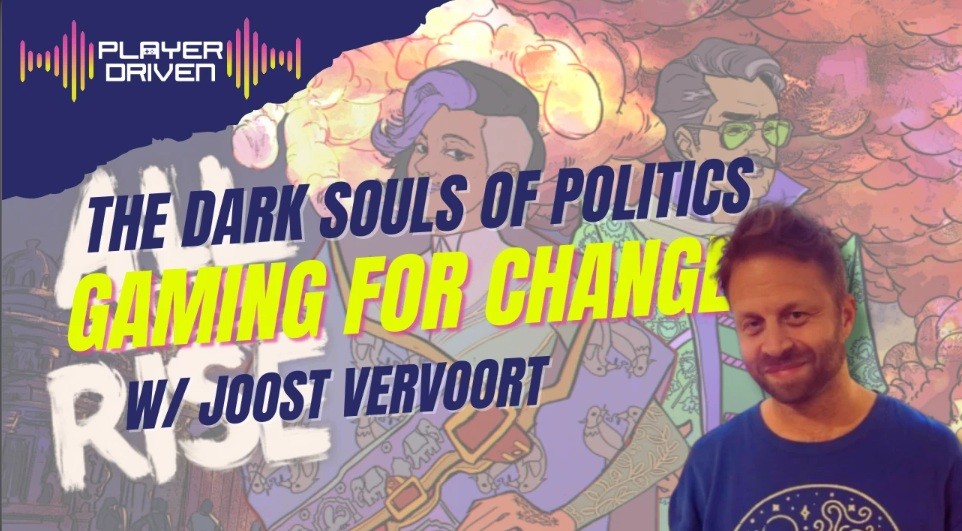
He's helping to shape Speculative Agency's strategic deck-builder, All Will Rise, to be a means toward that end
My background is originally in ecology and sustainability, but I'm at a political science group now and focus much more on societal relationships with the future, and how do we make a better future. For the last, I guess, already at least 10 years, I've been working on working on games, and how games can play a role in that sort of change process.—Dr. Joost Vervoort
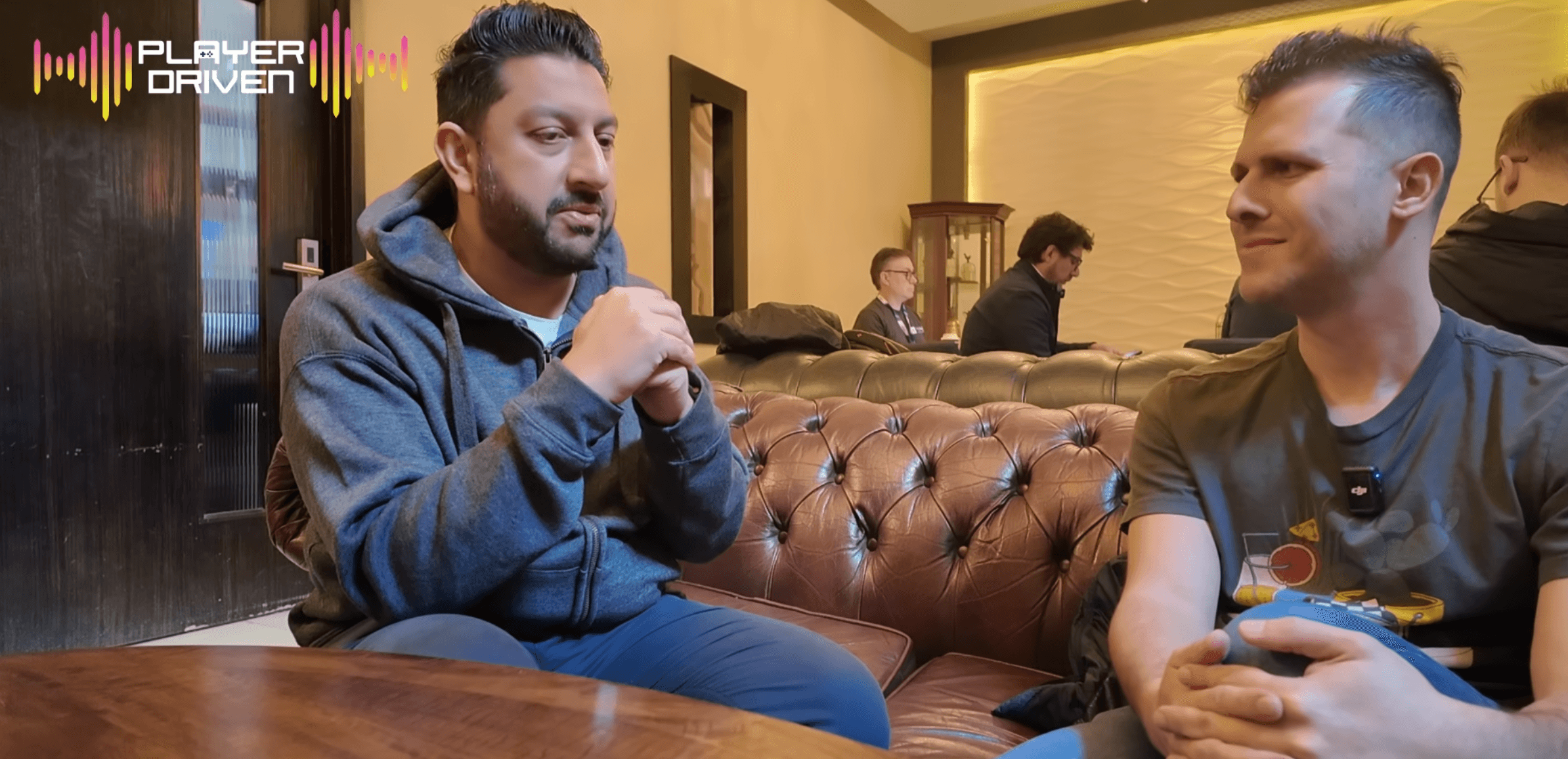
Back in February, Player Driven published a podcast with Dr. Joost (rhymes with toast) Vervoort, associate professor at Utrecht University in the Netherlands. His full title is quite a mouthful: Associate Professor of Transformative Imagination in the Environmental Governance Group at the Copernicus Institute of Sustainable Development. The nutshell version is that Vervoort has toiled at the intersection of progressive political science and video games for over a decade.
Our discussion was necessarily wide-ranging. I and Player Driven’s founder, Greg Posner, peppered Vervoort with questions about his day job, a video game project with which he’s intimately involved, how he found his calling, his favorite game, and more.
We’ll get to all that.
Coincidentally, Vervoort and Posner were at Pocket Gamer Connects (PGC) in London in January, and got to meet irl about a week before the podcast was recorded.
“I had a good time,” at PGC, Vervoort told us at the top of the discussion. “Lots of biz dev kind of folks...There is a very nice pub around the corner, The Jugged Hare, where most people spent quite a bit of time.”
Judging from its website, The Jugged Hare is rather fancy and the food/drink look cracking.
“Because of me we did not get enough time together” at the pub, Posner recalled.
“At Pocket Gamer Connects,” Vervoort continued, “I was on a panel with a bunch of folks talking about how we make games for change, essentially. A really interesting conversation.”
An early question for Vervoort involved his introduction to video games and when he connected gaming and his budding professional interests.
“I've always been interested in games,” Vervoort told Posner and me. “I remember what it was like when my parents got…[a] PC and we were able to play Doom.”
“My mind was just blown. I remember not being able to sleep all night, just seeing labyrinths from Doom...That was my first video game experience.”
“BFG!” I blurted.
Vervoort ignored me. “Scary as hell. I was like, 'Why is there a chainsaw?'”
“BFG!” I repeated.
This time he acknowledged me.
“Exactly. That's formative stuff for me. The other sort of influence next to video games was the power of tabletop role-playing games [TTRPGs]. Just sitting around a table with some friends, playing Vampire: The Masquerade.”
Released in 1991 by White Wolf Publishing, Vampire: The Masquerade has been a top-selling TTRPG ever since, and it’s known for a strong narrative and political backbiting…sometimes literally.
“I actually still play with” this same group of friends, Vervoort added. “We've restarted.”
That TTRPG experience, he recalled, was “more impactful because...the sky is the limit, right? Your imagination is all that holds you back.”
“I was completely blown away by what happens if you just put a few people around the table and start telling these emergent stories. And I think that was maybe the biggest influence on where my own work went.”
I have worked all around the world with policymakers using future scenarios to guide their planning processes. That's kind of like playing a tabletop role playing game, in a way. It's a bit more structured than that, but it's not too far off.
“I was working at the University of Oxford at the time,” Vervoort added. “I worked there for seven years, leading this big global scenarios project.”
“At some point, I was like, ‘This is a little bit limiting in terms of the what can be done in the space of policy.’”
“There's a huge society out there,” he recalled. “People vote, how they think about politics, what the mainstream media is doing...[That] sort of shapes what policymakers can even do, right?”
Sure, it does.
“Lots of people have been working on climate change issues for decades. Suddenly their funding's gone, right? Or their institute's closed…That's because of political shifts that often have very little to do with climate change” as an objective, science-backed fact.
“I got more and more interested in the space of societal imagination, and how that impacts good and bad futures.”
“There are some people on the far right and so on who are very good at this, at this sort of, like, engagement with mainstream mythmaking,” he said. “I think progressive folks have been lagging a little bit in the past, so I've been interested in that.”
“I worked first on games in a sort of policy and serious gaming context but then, over time, and also as I got more funding to do more fun things, I realized that it [policy] is great but that's a little bit like messing around in the margin.”
There's this massive industry out there that is constantly helping people imagine all kinds of things. Sometimes it's very superficial. Sometimes it's deep. But it's a huge imagination factory, right, the games industry? So, what can we do there? That's what brought me to where I am today.
We’ll get more into this fascinating topic in short order, but let’s back up and highlight a few other games that have informed Vervoort’s view of video game industry’s “futures” potential.
“The games that I've really always loved,” Vervoort told us, are titles like “Planescape: Torment, like Disco Elysium. The kind of game that really goes deep into this narrative.”
“The other series that I'm really in love with is the Souls series, Dark Souls and the FromSoftware games.”
“Amazing depth and really resonant games, and just incredible.”
“What I'm playing right now,” Vervoort added, “is Silksong. And that's, of course, a logical evolution coming out of Dark Souls. Silksong has driven me up the wall. Hollow Knight: Silksong is far more difficult than any of the Souls games.”

The original Dark Souls (2011) is an action-RPG that was developed by FromSoftware and published by Namco Bandai; Team Cherry developed Hollow Knight: Silksong and published this search-action/Metroidvania game late last year. Both titles have a reputation for being most unforgiving.
“I have been shocked at how difficult it was in the beginning even though I did play Hollow Knight,” Vervoort explained. “Now I'm like, 'No, it's just getting used to it.' You know, you just have to get it in your fingers, get the muscle memory, and it's it better. But yeah, it's a hard game.”
Vervoort is impressed with what Team Cherry accomplished.
“It's small studio that works for seven years on a game, does barely any marketing. Of course, they had the benefit of Hollow Knight. Then it just breaks all the platforms at release” in terms of sales results.
Vervoort undoubtedly hopes the forthcoming game projects he’s deeply involved with will follow in Hollow Knight: Silksong’s footsteps, at least from a sales angle.
I wouldn’t rule it out: Vervoort has grit and stick-to-itiveness.
“I once finished Dark Souls one on soul level one, which, you know, means no leveling. And it felt like...it was like an extra job, you know? My job was to try to beat Dark Souls without leveling. And I did it!”
Read on for Vervoort’s thoughts on these topics:
All Will Rise, a pro-environment deck-builder to which he’s been a key contributor
How Vervoort’s day job efforts tie into Horizon Europe’s €93.5 billion resource pool
The context in which All Will Rise could seed additional irl progressive political engagement by younger people
Note: The balance of this week’s blog will cover the first bullet point above; we’ll close the loop on the last two next week.
Don’t forget to sign up for our newsletter and share this post if you enjoy it!
All Will Rise
The location of the game shifted from the Netherlands to the south of India because Meghna Jayanth, our narrative director, who has worked on games like 80 Days and Sable and other games...we wanted...her to have an opportunity to write from that location. We also thought that would be super cool to do, and to have a different world, and so on. We decided to make the game more speculative. So, the game is set in a slightly different world from our own, but there's lots of overlap.—Dr. Joost Vervoort
An early question Posner and I put to Utrecht University Associate Professor Joost Vervoort involved All Will Rise, a video game that he and the team at Speculative Agency, the studio behind the title, expect to launch late this year.
Interestingly, the idea for the game came out of an irl court case that involved Vervoort.
The game is “about taking billionaires and corporations to court for destroying the planet,” he explained to me and Posner. “I came up with this idea when I was actually involved in a real preparation of an actual court case against one of the world's biggest pension funds, the Dutch pension fund for civil servants.”
Also known as the ABP, this fund is indeed massive: As of 2025, it had €532 billion ($615 billion) in assets under management.
“It's gigantic,” he continued. And Vervoort owns a tiny piece of it “as a university professor, as part of the pension fund.”
At first, he said, “I was like, 'Cool, you know, I'm getting involved with this action group.' And, actually, they were so much better and so much more professional than I had imagined.”
“I was at their first meeting,” and there were about “100 people starting to organize this lawsuit.”
“I was like, 'What can we do with games to raise awareness and get attention to this?' And then I thought, 'Phoenix Wright: Ace Attorney, like, that's already a very successful court game...People love it, right? Millions of players. It's hilarious. It's absurd. It's over the top. It's wild.'” (And it’s here if you’d like a refresher about this visual novel and adventure game that Capcom first published way back in 2001.)
“I said that in a meeting,” Vervoort continued. “I said, 'You know, there's this game series, Ace Attorney...And there was, like, a 16-year-old kid there from Fridays for Futures who jumped up and shouted, 'Phoenix Wright is amazing!'”
In case you’re unfamiliar with it, Fridays for Future is the youth-led movement that the (then) 15-year-old Greta Thunberg and other young activists started in 2018, when they sat in front of the Swedish parliament for weeks, protesting inaction on the climate crisis.
“And then, everyone” at this meeting, Vervoort added, was “like, 'Okay, these two people know what they're talking about. Maybe we don't, but...he's connecting to the youth somehow.'”
“I sort of pitched that idea. And then Niels [Monshouwer], who is our producer [of All Will Rise], came on board, who’s ex-Guerrilla Games from Amsterdam.”
“A whole lot of amazing people came on board afterwards,” including Narrative Director Meghna Jayanth. “We have this team of wonderful indie folks and, sort of, ex-AAA people.”
“This idea of building a sort of court drama, but based on climate change, shifted over time.”
These changes to the scope and vision were made “to make it less straightforwardly just a game about a societal problem, and to make it more exciting, and interesting as a world.”
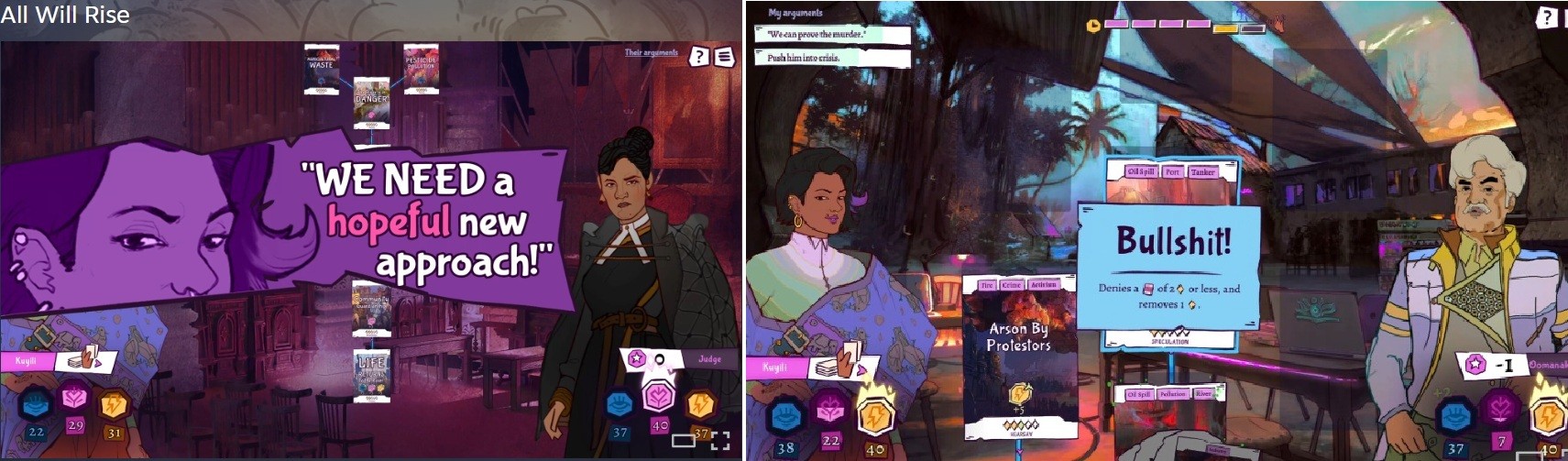
There’s no release date or price, but Speculative Agency’s courtroom deck-builder, All Will Rise, is slated to launch this year; there’s a downloadable demo and it can be wishlisted on Steam.
Vervoort told us that the team at Speculative Agency “decided not to focus on climate change, actually, but to focus on the destruction of a river.”
We interviewed a lot of climate activists and lawyers who said, “Start with concrete cases that are local because people get that much more easily than this big abstract climate change thing.” So, the game starts and focuses on a river being on fire, which is nice and dramatic and happens in real life.
The burning river, he continued, is the “Periyar, in the city of Muziris, a city that does not exist anymore in Kerala, in the south of India, but in our story still does.”
The Core Loop
In terms of gameplay, Vervoort told me and Posner, “your team of people is led by an eco-lawyer, Kuyili.”
Players will unlock new card by following leads in the case, and by sending team members (NPCs; the game is single-player) on missions. Some conversations in the game are strategic card battles, and they culminate in a climatic courtroom contest between Kuyili and Rishabh, a corporate fossil fuel executive.
“We think there's a real dearth of games looking at these topics that are wild and poetic and a bit mystical and mysterious and adventurous and a bit sexy,” said Vervoort. “There's a book called Bad Environmentalism that argues that people should be making...bad environmentalism things, that are sort of naughty, you know, wild and crazy, and not just this sort of goody two-shoes crap. That's the idea.”
Nicole Seymour’s Bad Environmentalism: Irony and Irreverence in the Ecological Age came out in 2018 and it indeed implores readers to shift the pro-environment narrative in from one of doom and gloom to one of irony, irreverence, and justice.
“In terms of gameplay,” Vervoort explained, All Will Rise “is a sort of a strategic role-playing game with deck-builder mechanics.”
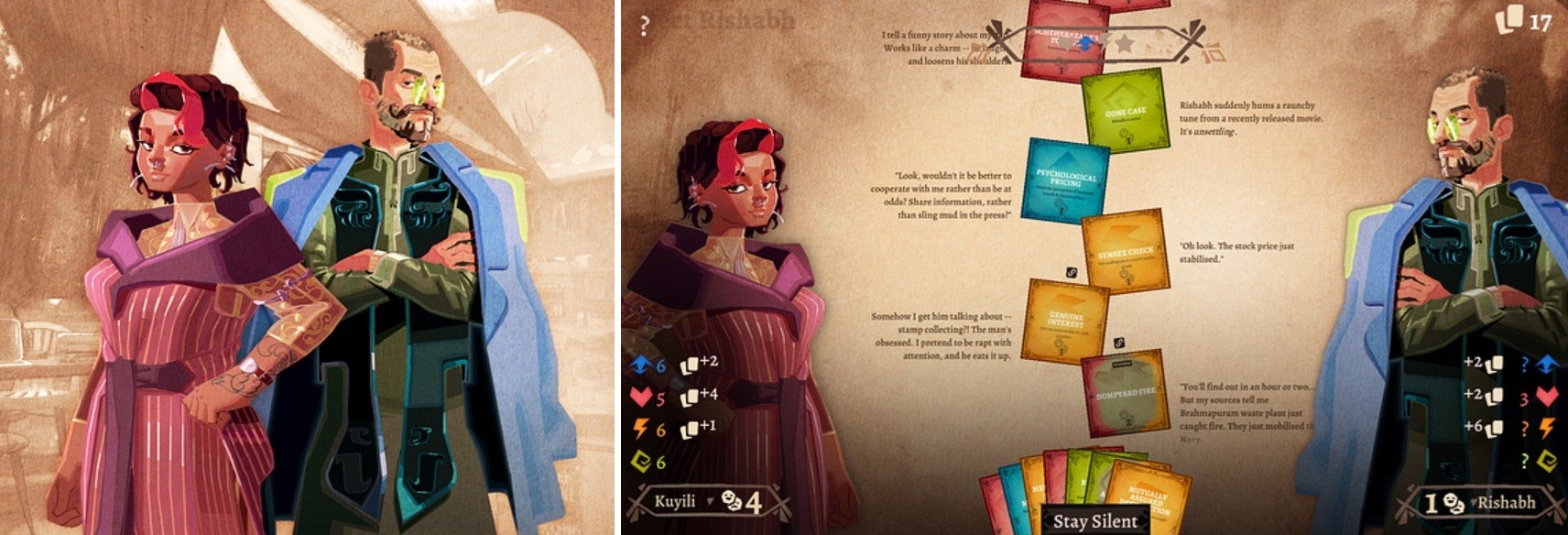
The art may have evolved since this development blog about All Will Rise posted in 2024, but the game’s hero, the environmental lawyer Kuyili, still squares off against Rishabh, a fossil fuel exec, in the final boss battle. Interestingly, the blog notes that a share of the game’s profits will help fund irl pro-environment court cases.
“So, you're talking to someone, you have a whole set of cards that are your repertoire of strategies of how to talk to them, and you're trying to get them to open up, or you're trying to get them on your side, or you're intimidating them….That's one of the core gameplay elements. The other one is to manage your team…You get cards from missions, and from your team, that you then use to unlock more of the evidence in the case.”
At different times in our discussion, Vervoort also compared All Will Rise to Disco Elysium, Norco, Citizen Sleeper, and Persona 5.
Vervoort stressed that the game’s environmental edge isn’t overly sharp.
“I don't think you have to be primarily into this environmental...focus to be interested in the game,” he told us. “We decided pretty early on that we wanted to make it very clear that this is a game about the powerless fighting the powerful, about the billionaires destroying our future. It's not just the environment, right? It's our livelihoods and our way of being.”
“We wanted to get away from this idea that is a climate activism game or something because, that is certainly an audience, but it's not very big.”
In these times when we're way too busy getting crushed by fascism, and all kinds of and AI, and all kinds of stuff, having a slightly wider lens where we say, “No, this is about…justice and power”...That is ultimately what it's really about, right? Climate change and the environment and so on are just a symptom of this wider...you know, predatory capitalism, sort of billionaire elite.
“I think that makes the game much more exciting,” Vervoort said. “It makes the game more angry.”
Grrr.
“What we do hope to do is to make people excited about getting messy with politics and getting messy with societal issues in general, that that is fun, that's interesting.”
Funding the Indie
Beyond the development funds contributed/gathered by the game’s producer, All Will Rise got a financial tailwind via a Kickstarter campaign.
“We are launching a Kickstarter in a few weeks,” Vervoort told me and Posner back in January. “That is partly because we feel like this is a kind of game that really benefits from community support with this kind of topic. We have talked to publishers before but it's a difficult time to get anything funded that even smells of narrative.”
“All Will Rise is not a narrative-only game, by any means,” Vervoort clarified. “It's quite systems heavy, in a way.”
There are a lot of publishers who say, “We are really hesitant with funding games that have a narrative-heavy focus because it's just unpredictable.” And we have also heard from publishers who have been honest, very honest, with us that they found the politics of the game to be scary and threatening. They don't want to be, like, attacked and doxed by, you know, big streamers.
“We've certainly heard some stories about that,” Vervoort added, “where people really were very, you know, very threatened by that. So, that's also something we realized: that the publishers have to play it safe.”
“They cannot afford to be courageous in terms of genre, so we are going for Kickstarter. Part of the game is supported by our producer, who has been able to, sort of, prefinance some of the development. But, yeah, we hope the Kickstarter helps us make the game larger, better, more complete, and so on. So that's happening, and we're very excited about that. We'll see how it goes.”
It went pretty well.
The campaign concluded in late March and wound up raising an additional €60,709 (almost $72,000) from approximately 1,300 backers.
Full disclosure: I bought a copy!
“As a researcher in the world of games and the games industry,” remarked Vervoort, “being fairly new to this space and really walking around in the games industry for the last five years or something only, making All Will Rise, for me, is also like a test case, you know?”
“What is it like to try to make a successful game? What can I learn from that, as a researcher, that other people can benefit from by trying to do it, instead of looking from the sidelines?”
The answers to such questions should be clearer by the end of this year.
Next week, in part two of our profile of Associate Professor Joost Vervoort, we’ll wrap up with more context on his day job and more color about how All Will Rise is designed, in part, to push players to take more irl progressive political actions.