What B2B SaaS Can Learn from Mobile Games About Engagement Systems

What B2B SaaS Can Learn from Mobile Games About Engagement Systems

Blogs

January 12, 2026

Christine Dart

What B2B SaaS Can Learn from Mobile Games About Engagement Systems

Blogs

January 12, 2026

Engagement Under Pressure

Mobile game studios face a level of engagement pressure that most B2B SaaS companies are not designed to experience, and thankfully so. Their players can leave instantly, without friction, explanation, or consequence, often because something momentarily more interesting appeared in an ad on the same screen. There are no contracts, no renewal cycles, and little patience for confusion or bugs. In that environment, engagement is not a metric to be reviewed later. It is a system that must be anticipated in the design cycle and must work continuously, or the business simply does not.

B2B SaaS, by contrast, has long taken engagement and retention seriously, but typically on a much longer clock, often bound by annual contracts. Deliberate onboarding and structured adoption plans create room for education and trust to develop. However, proper execution can be resource-intensive and difficult to keep up with as the product evolves. The opportunity worth examining is what happens when engagement must be earned repeatedly, rapidly, and in smaller moments, rather than treated as something that will take care of itself between major roadmap milestones and QBRs.

Daily Login Rewards and the Power of Habit

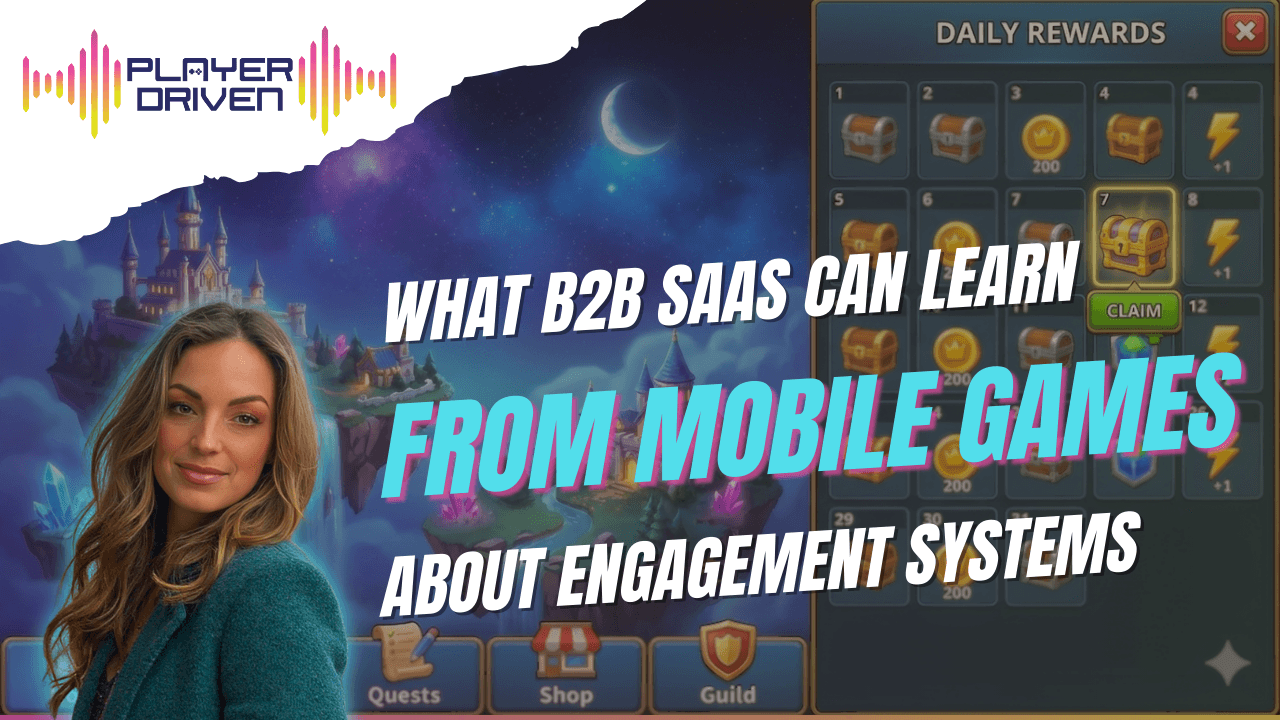
One of the most common examples of mobile game engagement strategy is the use of daily login rewards and time-based incentives. These mechanics are not about generosity so much as they are about habit formation. Players are rewarded simply for showing up, then rewarded again for staying longer, often in ways that compound over time. Miss a day, and the streak resets. Show up consistently, and progress accelerates. It is simple, transparent, and remarkably effective.

What makes this compelling is not just the reward itself, but the signal it sends: your presence matters. Engagement is acknowledged early and often.

Mobile game producers prioritize rewarding early engagement, trusting that increased player longevity will follow.

Limited-Time Events and Honest Urgency

Mobile games make disciplined use of limited-time events, introducing urgency without relying on pressure or manipulation. These events are typically tied to unique prizes, exclusive access, or special deals that will not be available indefinitely. Players are motivated to log in and complete the objectives of the event because the tradeoff is clear: participation leads to progress or advantage, while inaction simply means missing out on something that will not return in the same form. The urgency feels fair because it is explicit, bounded, and directly connected to value.

That framing matters. Urgency in mobile game events is created by being selective about what is time-sensitive and why. The system gives players enough context to decide whether the moment is worth their attention, which preserves trust even when the answer is no.

SaaS brands can struggle with urgency, or in this case the adoption of new features, for the opposite reason. When every feature launch, update, or initiative is positioned as critical, customers can feel overwhelmed rather than motivated, even when the intent is helpful. Mobile games offer a useful counterpoint here: urgency works best when it is limited, optional, and clearly tied to a specific outcome.

In a SaaS context, a parallel might be encouraging live attendance for a webinar focused on best practices for a specific set of newly released features. Rather than framing the session as broadly important, the value could be made more concrete. Use cases and the intended audience should be clear so that customers can decide if it’s important to them. Brands should then consider: How might customers be rewarded for attending live? What advantage do they gain that will not be available if they wait for the recording? And just as importantly, what do they knowingly choose to miss if they decide not to participate?

Teaching Complexity Without Making It Feel Like Learning

Where mobile games offer perhaps the most transferable insight is in how they educate users and drive feature adoption. Games do not require players to read technical documentation, watch lengthy tutorials, or discover mechanics through exploration alone. Instead, education is delivered in small, contextual moments, exactly when it is useful, and rarely all at once.

New mechanics are introduced through lightweight walkthroughs that demonstrate how, why, and when to use each feature of the game. More advanced capabilities are unlocked and explained only after foundational steps are completed. Progression is intentionally linear, not because players lack intelligence, but because comprehension builds more reliably when complexity is layered thoughtfully. This approach prevents overwhelm, keeps attention focused on the basics, and allows learning to feel like progress rather than instruction. The experience itself does much of the teaching.

B2B SaaS, depending on its growth strategy (sales-led, PLG, or hybrid), does not always deploy early engagement and instruction with the same level of intentionality, particularly for customers on lower-tier plans or outside of key accounts. While most companies provide helpful documentation, users are often expected to self-motivate after onboarding, assuming onboarding happens at all. In some journeys, customers are left to navigate the product independently, without being actively guided toward best practices for their specific use case. This can limit feature adoption, leave users unaware of newly released capabilities or unsure how those capabilities apply to their work, and inhibit customers from realizing the full value of the product. This can lead to a poor impression of the product, driving customers to search for alternative solutions well before it’s time for renewal.

Mobile games show that when education is woven directly into the experience and delivered in small, well-timed moments, feature adoption accelerates naturally. SaaS products, particularly those that rely on a PLG motion, can draw inspiration here by letting the product itself take on more of the teaching in an engaging way and ensuring there are no educational gaps as the product evolves.

UX-Led Discovery and the Art of the Nudge

Mobile games are masterful at directing attention. Notification icons, visual cues, and subtle friction make it very difficult to miss something new or relevant. The familiar red dot on a menu tab is not decorative. It is an intentional nudge that says, “There is something here that will help you progress.”

SaaS products can be robust and powerful but when lacking proper guidance, they can feel overwhelming and become underutilized. Feature education is often front-loaded during onboarding and then largely abandoned in favor of documentation or optional training sessions. As a result, many users, especially those who decline marketing emails, never fully understand what is available to them because the product interface itself never clearly invites them to learn.

The lesson from mobile games is to deliver regular, bite-sized, easy-to-understand education, guided by the interface itself. Thoughtfully placed notifications, clear indicators of unused or new functionality, and short click-through tutorials can dramatically increase feature awareness without overwhelming the user or dictating behavior. Thoughtful reminders at appropriate moments can help ensure new features don’t quietly go unused. Additionally, tutorials should be easy to find later on – sometimes users close out of pop-up announcements because they are in the middle of a workflow.

This is not about gamifying serious software for novelty, it’s about thoughtfully considering user needs and behavior.

5 Mobile Game Engagement Mechanics B2B SaaS Can Translate Thoughtfully

Mobile game engagement systems rely on small, repeatable mechanics that reinforce habit, learning, and progression over time rather than one-time conversion events.

  1. Daily presence rewards
    Acknowledge early and repeated engagement, using it as an opportunity to build trust through timely check-ins or delivery of helpful educational resources.

  2. Time-bound engagement moments
    Use limited-time opportunities like live webinars or workshops to encourage customer engagement and feature adoption.

  3. Contextual walkthroughs
    Teach features in bite-size moments and as they become relevant, not all at once.

  4. UX-guided discovery
    Use visual nudges to guide users toward underused or new capabilities.

  5. Visible progress cues
    Make learning and adoption feel measurable and forward-moving through dashboards or reports that attribute value.

The point isn’t to make products feel simpler than they are, but to be more intentional about how customer engagement is designed.

Engagement Systems in a More Competitive Discovery Environment

All of this exists within a landscape where attention is harder to earn and easier to lose. As AI-driven discovery remodels how new products are found and compared, B2B SaaS brands face more pressure at the top of the funnel, where potential customers can evaluate alternatives faster than ever before. That shift does not change how retention works at a fundamental level, but it does raise the bar for what customers experience once they enter the product. When acquisition becomes harder, the engagement system that follows has to do more work. To maintain great retention rates, products must be easier to understand, adopt, and derive value from than ever before.

Mobile games have been operating this way for years. When alternatives are always a tap away and loyalty is never assumed, engagement cannot rely on habit or momentum alone. It has to be supported by systems that help people understand what to do next, see progress quickly, and feel that returning at a given moment will provide them with a more fulfilling experience than if they had chosen to open a competing app. The takeaway for B2B SaaS brands is not to create artificial urgency, but to design engagement systems that can hold up in a world where customers have more choice, less patience, and simpler ways to compare their options.

Designing Engagement, Not Chasing It

The lesson here is not that B2B SaaS companies should chase daily engagement for its own sake or turn serious products into games. Rather, the lesson is that mobile games offer a clear example of what happens when engagement is treated as something you design end-to-end. Excellent engagement systems reduce friction, clarify value, and respect how people actually learn and adopt over time.

The B2B SaaS industry already values retention and customer success. The opportunity is to borrow the intentionality of mobile games and to ask where a product’s engagement systems could be more supportive earlier and where progress (read: value) could be made more visible throughout.

As competition increases and alternative solution discovery becomes faster and less forgiving, the B2B products that endure will be the ones that feel understandable, navigable, supportive, and value-generating at every stage of the journey.

—-

Christine Dart is a senior B2B SaaS marketing executive with experience leading global go-to-market strategies across customer experience, demand generation, and brand. She has held marketing leadership roles in both venture-backed and publicly traded organizations, most recently serving as Global Head of Marketing at Helpshift and leading marketing for Keywords Studios’ Player Engagement service line. Christine writes about modern marketing strategy, product adoption, and how companies grow responsibly in increasingly competitive markets.


Engagement Under Pressure

Mobile game studios face a level of engagement pressure that most B2B SaaS companies are not designed to experience, and thankfully so. Their players can leave instantly, without friction, explanation, or consequence, often because something momentarily more interesting appeared in an ad on the same screen. There are no contracts, no renewal cycles, and little patience for confusion or bugs. In that environment, engagement is not a metric to be reviewed later. It is a system that must be anticipated in the design cycle and must work continuously, or the business simply does not.

B2B SaaS, by contrast, has long taken engagement and retention seriously, but typically on a much longer clock, often bound by annual contracts. Deliberate onboarding and structured adoption plans create room for education and trust to develop. However, proper execution can be resource-intensive and difficult to keep up with as the product evolves. The opportunity worth examining is what happens when engagement must be earned repeatedly, rapidly, and in smaller moments, rather than treated as something that will take care of itself between major roadmap milestones and QBRs.

Daily Login Rewards and the Power of Habit

One of the most common examples of mobile game engagement strategy is the use of daily login rewards and time-based incentives. These mechanics are not about generosity so much as they are about habit formation. Players are rewarded simply for showing up, then rewarded again for staying longer, often in ways that compound over time. Miss a day, and the streak resets. Show up consistently, and progress accelerates. It is simple, transparent, and remarkably effective.

What makes this compelling is not just the reward itself, but the signal it sends: your presence matters. Engagement is acknowledged early and often.

Mobile game producers prioritize rewarding early engagement, trusting that increased player longevity will follow.

Limited-Time Events and Honest Urgency

Mobile games make disciplined use of limited-time events, introducing urgency without relying on pressure or manipulation. These events are typically tied to unique prizes, exclusive access, or special deals that will not be available indefinitely. Players are motivated to log in and complete the objectives of the event because the tradeoff is clear: participation leads to progress or advantage, while inaction simply means missing out on something that will not return in the same form. The urgency feels fair because it is explicit, bounded, and directly connected to value.

That framing matters. Urgency in mobile game events is created by being selective about what is time-sensitive and why. The system gives players enough context to decide whether the moment is worth their attention, which preserves trust even when the answer is no.

SaaS brands can struggle with urgency, or in this case the adoption of new features, for the opposite reason. When every feature launch, update, or initiative is positioned as critical, customers can feel overwhelmed rather than motivated, even when the intent is helpful. Mobile games offer a useful counterpoint here: urgency works best when it is limited, optional, and clearly tied to a specific outcome.

In a SaaS context, a parallel might be encouraging live attendance for a webinar focused on best practices for a specific set of newly released features. Rather than framing the session as broadly important, the value could be made more concrete. Use cases and the intended audience should be clear so that customers can decide if it’s important to them. Brands should then consider: How might customers be rewarded for attending live? What advantage do they gain that will not be available if they wait for the recording? And just as importantly, what do they knowingly choose to miss if they decide not to participate?

Teaching Complexity Without Making It Feel Like Learning

Where mobile games offer perhaps the most transferable insight is in how they educate users and drive feature adoption. Games do not require players to read technical documentation, watch lengthy tutorials, or discover mechanics through exploration alone. Instead, education is delivered in small, contextual moments, exactly when it is useful, and rarely all at once.

New mechanics are introduced through lightweight walkthroughs that demonstrate how, why, and when to use each feature of the game. More advanced capabilities are unlocked and explained only after foundational steps are completed. Progression is intentionally linear, not because players lack intelligence, but because comprehension builds more reliably when complexity is layered thoughtfully. This approach prevents overwhelm, keeps attention focused on the basics, and allows learning to feel like progress rather than instruction. The experience itself does much of the teaching.

B2B SaaS, depending on its growth strategy (sales-led, PLG, or hybrid), does not always deploy early engagement and instruction with the same level of intentionality, particularly for customers on lower-tier plans or outside of key accounts. While most companies provide helpful documentation, users are often expected to self-motivate after onboarding, assuming onboarding happens at all. In some journeys, customers are left to navigate the product independently, without being actively guided toward best practices for their specific use case. This can limit feature adoption, leave users unaware of newly released capabilities or unsure how those capabilities apply to their work, and inhibit customers from realizing the full value of the product. This can lead to a poor impression of the product, driving customers to search for alternative solutions well before it’s time for renewal.

Mobile games show that when education is woven directly into the experience and delivered in small, well-timed moments, feature adoption accelerates naturally. SaaS products, particularly those that rely on a PLG motion, can draw inspiration here by letting the product itself take on more of the teaching in an engaging way and ensuring there are no educational gaps as the product evolves.

UX-Led Discovery and the Art of the Nudge

Mobile games are masterful at directing attention. Notification icons, visual cues, and subtle friction make it very difficult to miss something new or relevant. The familiar red dot on a menu tab is not decorative. It is an intentional nudge that says, “There is something here that will help you progress.”

SaaS products can be robust and powerful but when lacking proper guidance, they can feel overwhelming and become underutilized. Feature education is often front-loaded during onboarding and then largely abandoned in favor of documentation or optional training sessions. As a result, many users, especially those who decline marketing emails, never fully understand what is available to them because the product interface itself never clearly invites them to learn.

The lesson from mobile games is to deliver regular, bite-sized, easy-to-understand education, guided by the interface itself. Thoughtfully placed notifications, clear indicators of unused or new functionality, and short click-through tutorials can dramatically increase feature awareness without overwhelming the user or dictating behavior. Thoughtful reminders at appropriate moments can help ensure new features don’t quietly go unused. Additionally, tutorials should be easy to find later on – sometimes users close out of pop-up announcements because they are in the middle of a workflow.

This is not about gamifying serious software for novelty, it’s about thoughtfully considering user needs and behavior.

5 Mobile Game Engagement Mechanics B2B SaaS Can Translate Thoughtfully

Mobile game engagement systems rely on small, repeatable mechanics that reinforce habit, learning, and progression over time rather than one-time conversion events.

  1. Daily presence rewards
    Acknowledge early and repeated engagement, using it as an opportunity to build trust through timely check-ins or delivery of helpful educational resources.

  2. Time-bound engagement moments
    Use limited-time opportunities like live webinars or workshops to encourage customer engagement and feature adoption.

  3. Contextual walkthroughs
    Teach features in bite-size moments and as they become relevant, not all at once.

  4. UX-guided discovery
    Use visual nudges to guide users toward underused or new capabilities.

  5. Visible progress cues
    Make learning and adoption feel measurable and forward-moving through dashboards or reports that attribute value.

The point isn’t to make products feel simpler than they are, but to be more intentional about how customer engagement is designed.

Engagement Systems in a More Competitive Discovery Environment

All of this exists within a landscape where attention is harder to earn and easier to lose. As AI-driven discovery remodels how new products are found and compared, B2B SaaS brands face more pressure at the top of the funnel, where potential customers can evaluate alternatives faster than ever before. That shift does not change how retention works at a fundamental level, but it does raise the bar for what customers experience once they enter the product. When acquisition becomes harder, the engagement system that follows has to do more work. To maintain great retention rates, products must be easier to understand, adopt, and derive value from than ever before.

Mobile games have been operating this way for years. When alternatives are always a tap away and loyalty is never assumed, engagement cannot rely on habit or momentum alone. It has to be supported by systems that help people understand what to do next, see progress quickly, and feel that returning at a given moment will provide them with a more fulfilling experience than if they had chosen to open a competing app. The takeaway for B2B SaaS brands is not to create artificial urgency, but to design engagement systems that can hold up in a world where customers have more choice, less patience, and simpler ways to compare their options.

Designing Engagement, Not Chasing It

The lesson here is not that B2B SaaS companies should chase daily engagement for its own sake or turn serious products into games. Rather, the lesson is that mobile games offer a clear example of what happens when engagement is treated as something you design end-to-end. Excellent engagement systems reduce friction, clarify value, and respect how people actually learn and adopt over time.

The B2B SaaS industry already values retention and customer success. The opportunity is to borrow the intentionality of mobile games and to ask where a product’s engagement systems could be more supportive earlier and where progress (read: value) could be made more visible throughout.

As competition increases and alternative solution discovery becomes faster and less forgiving, the B2B products that endure will be the ones that feel understandable, navigable, supportive, and value-generating at every stage of the journey.

—-

Christine Dart is a senior B2B SaaS marketing executive with experience leading global go-to-market strategies across customer experience, demand generation, and brand. She has held marketing leadership roles in both venture-backed and publicly traded organizations, most recently serving as Global Head of Marketing at Helpshift and leading marketing for Keywords Studios’ Player Engagement service line. Christine writes about modern marketing strategy, product adoption, and how companies grow responsibly in increasingly competitive markets.


Engagement Under Pressure

Mobile game studios face a level of engagement pressure that most B2B SaaS companies are not designed to experience, and thankfully so. Their players can leave instantly, without friction, explanation, or consequence, often because something momentarily more interesting appeared in an ad on the same screen. There are no contracts, no renewal cycles, and little patience for confusion or bugs. In that environment, engagement is not a metric to be reviewed later. It is a system that must be anticipated in the design cycle and must work continuously, or the business simply does not.

B2B SaaS, by contrast, has long taken engagement and retention seriously, but typically on a much longer clock, often bound by annual contracts. Deliberate onboarding and structured adoption plans create room for education and trust to develop. However, proper execution can be resource-intensive and difficult to keep up with as the product evolves. The opportunity worth examining is what happens when engagement must be earned repeatedly, rapidly, and in smaller moments, rather than treated as something that will take care of itself between major roadmap milestones and QBRs.

Daily Login Rewards and the Power of Habit

One of the most common examples of mobile game engagement strategy is the use of daily login rewards and time-based incentives. These mechanics are not about generosity so much as they are about habit formation. Players are rewarded simply for showing up, then rewarded again for staying longer, often in ways that compound over time. Miss a day, and the streak resets. Show up consistently, and progress accelerates. It is simple, transparent, and remarkably effective.

What makes this compelling is not just the reward itself, but the signal it sends: your presence matters. Engagement is acknowledged early and often.

Mobile game producers prioritize rewarding early engagement, trusting that increased player longevity will follow.

Limited-Time Events and Honest Urgency

Mobile games make disciplined use of limited-time events, introducing urgency without relying on pressure or manipulation. These events are typically tied to unique prizes, exclusive access, or special deals that will not be available indefinitely. Players are motivated to log in and complete the objectives of the event because the tradeoff is clear: participation leads to progress or advantage, while inaction simply means missing out on something that will not return in the same form. The urgency feels fair because it is explicit, bounded, and directly connected to value.

That framing matters. Urgency in mobile game events is created by being selective about what is time-sensitive and why. The system gives players enough context to decide whether the moment is worth their attention, which preserves trust even when the answer is no.

SaaS brands can struggle with urgency, or in this case the adoption of new features, for the opposite reason. When every feature launch, update, or initiative is positioned as critical, customers can feel overwhelmed rather than motivated, even when the intent is helpful. Mobile games offer a useful counterpoint here: urgency works best when it is limited, optional, and clearly tied to a specific outcome.

In a SaaS context, a parallel might be encouraging live attendance for a webinar focused on best practices for a specific set of newly released features. Rather than framing the session as broadly important, the value could be made more concrete. Use cases and the intended audience should be clear so that customers can decide if it’s important to them. Brands should then consider: How might customers be rewarded for attending live? What advantage do they gain that will not be available if they wait for the recording? And just as importantly, what do they knowingly choose to miss if they decide not to participate?

Teaching Complexity Without Making It Feel Like Learning

Where mobile games offer perhaps the most transferable insight is in how they educate users and drive feature adoption. Games do not require players to read technical documentation, watch lengthy tutorials, or discover mechanics through exploration alone. Instead, education is delivered in small, contextual moments, exactly when it is useful, and rarely all at once.

New mechanics are introduced through lightweight walkthroughs that demonstrate how, why, and when to use each feature of the game. More advanced capabilities are unlocked and explained only after foundational steps are completed. Progression is intentionally linear, not because players lack intelligence, but because comprehension builds more reliably when complexity is layered thoughtfully. This approach prevents overwhelm, keeps attention focused on the basics, and allows learning to feel like progress rather than instruction. The experience itself does much of the teaching.

B2B SaaS, depending on its growth strategy (sales-led, PLG, or hybrid), does not always deploy early engagement and instruction with the same level of intentionality, particularly for customers on lower-tier plans or outside of key accounts. While most companies provide helpful documentation, users are often expected to self-motivate after onboarding, assuming onboarding happens at all. In some journeys, customers are left to navigate the product independently, without being actively guided toward best practices for their specific use case. This can limit feature adoption, leave users unaware of newly released capabilities or unsure how those capabilities apply to their work, and inhibit customers from realizing the full value of the product. This can lead to a poor impression of the product, driving customers to search for alternative solutions well before it’s time for renewal.

Mobile games show that when education is woven directly into the experience and delivered in small, well-timed moments, feature adoption accelerates naturally. SaaS products, particularly those that rely on a PLG motion, can draw inspiration here by letting the product itself take on more of the teaching in an engaging way and ensuring there are no educational gaps as the product evolves.

UX-Led Discovery and the Art of the Nudge

Mobile games are masterful at directing attention. Notification icons, visual cues, and subtle friction make it very difficult to miss something new or relevant. The familiar red dot on a menu tab is not decorative. It is an intentional nudge that says, “There is something here that will help you progress.”

SaaS products can be robust and powerful but when lacking proper guidance, they can feel overwhelming and become underutilized. Feature education is often front-loaded during onboarding and then largely abandoned in favor of documentation or optional training sessions. As a result, many users, especially those who decline marketing emails, never fully understand what is available to them because the product interface itself never clearly invites them to learn.

The lesson from mobile games is to deliver regular, bite-sized, easy-to-understand education, guided by the interface itself. Thoughtfully placed notifications, clear indicators of unused or new functionality, and short click-through tutorials can dramatically increase feature awareness without overwhelming the user or dictating behavior. Thoughtful reminders at appropriate moments can help ensure new features don’t quietly go unused. Additionally, tutorials should be easy to find later on – sometimes users close out of pop-up announcements because they are in the middle of a workflow.

This is not about gamifying serious software for novelty, it’s about thoughtfully considering user needs and behavior.

5 Mobile Game Engagement Mechanics B2B SaaS Can Translate Thoughtfully

Mobile game engagement systems rely on small, repeatable mechanics that reinforce habit, learning, and progression over time rather than one-time conversion events.

  1. Daily presence rewards
    Acknowledge early and repeated engagement, using it as an opportunity to build trust through timely check-ins or delivery of helpful educational resources.

  2. Time-bound engagement moments
    Use limited-time opportunities like live webinars or workshops to encourage customer engagement and feature adoption.

  3. Contextual walkthroughs
    Teach features in bite-size moments and as they become relevant, not all at once.

  4. UX-guided discovery
    Use visual nudges to guide users toward underused or new capabilities.

  5. Visible progress cues
    Make learning and adoption feel measurable and forward-moving through dashboards or reports that attribute value.

The point isn’t to make products feel simpler than they are, but to be more intentional about how customer engagement is designed.

Engagement Systems in a More Competitive Discovery Environment

All of this exists within a landscape where attention is harder to earn and easier to lose. As AI-driven discovery remodels how new products are found and compared, B2B SaaS brands face more pressure at the top of the funnel, where potential customers can evaluate alternatives faster than ever before. That shift does not change how retention works at a fundamental level, but it does raise the bar for what customers experience once they enter the product. When acquisition becomes harder, the engagement system that follows has to do more work. To maintain great retention rates, products must be easier to understand, adopt, and derive value from than ever before.

Mobile games have been operating this way for years. When alternatives are always a tap away and loyalty is never assumed, engagement cannot rely on habit or momentum alone. It has to be supported by systems that help people understand what to do next, see progress quickly, and feel that returning at a given moment will provide them with a more fulfilling experience than if they had chosen to open a competing app. The takeaway for B2B SaaS brands is not to create artificial urgency, but to design engagement systems that can hold up in a world where customers have more choice, less patience, and simpler ways to compare their options.

Designing Engagement, Not Chasing It

The lesson here is not that B2B SaaS companies should chase daily engagement for its own sake or turn serious products into games. Rather, the lesson is that mobile games offer a clear example of what happens when engagement is treated as something you design end-to-end. Excellent engagement systems reduce friction, clarify value, and respect how people actually learn and adopt over time.

The B2B SaaS industry already values retention and customer success. The opportunity is to borrow the intentionality of mobile games and to ask where a product’s engagement systems could be more supportive earlier and where progress (read: value) could be made more visible throughout.

As competition increases and alternative solution discovery becomes faster and less forgiving, the B2B products that endure will be the ones that feel understandable, navigable, supportive, and value-generating at every stage of the journey.

—-

Christine Dart is a senior B2B SaaS marketing executive with experience leading global go-to-market strategies across customer experience, demand generation, and brand. She has held marketing leadership roles in both venture-backed and publicly traded organizations, most recently serving as Global Head of Marketing at Helpshift and leading marketing for Keywords Studios’ Player Engagement service line. Christine writes about modern marketing strategy, product adoption, and how companies grow responsibly in increasingly competitive markets.


Share

LinkedIn

Facebook

Copy link

Share

LinkedIn

Facebook

Copy link

Share

LinkedIn

Facebook

Copy link