Nine Seconds to Fun: Mark Otero Sets the Stage For UnGodly, His Next Collectables and Combat RPG

Nine Seconds to Fun: Mark Otero Sets the Stage For UnGodly, His Next Collectables and Combat RPG

Blogs

December 29, 2025

Lewis Ward

Nine Seconds to Fun: Mark Otero Sets the Stage For UnGodly, His Next Collectables and Combat RPG

Blogs

December 29, 2025

If you go back 20 years on PC and console gaming, something incredible happened with the moment to moment experience that has remained a durable pattern for most blockbuster games: the camera angle changed from isometric view [2.5D overhead] to behind the head [3D]. Why is that important and why has that remained a durable, user-facing moment to moment breakthrough? It gives you instant immersion…You could bring that to mobile. And now, instead of it being six to nine minutes to fun, like third generation collectibles and combat RPGs, you get nine seconds to fun. That is a 40-60x improvement at the top of the funnel in Azra Games’ hierarchy of fun to get into the game immediately.—Mark Otero

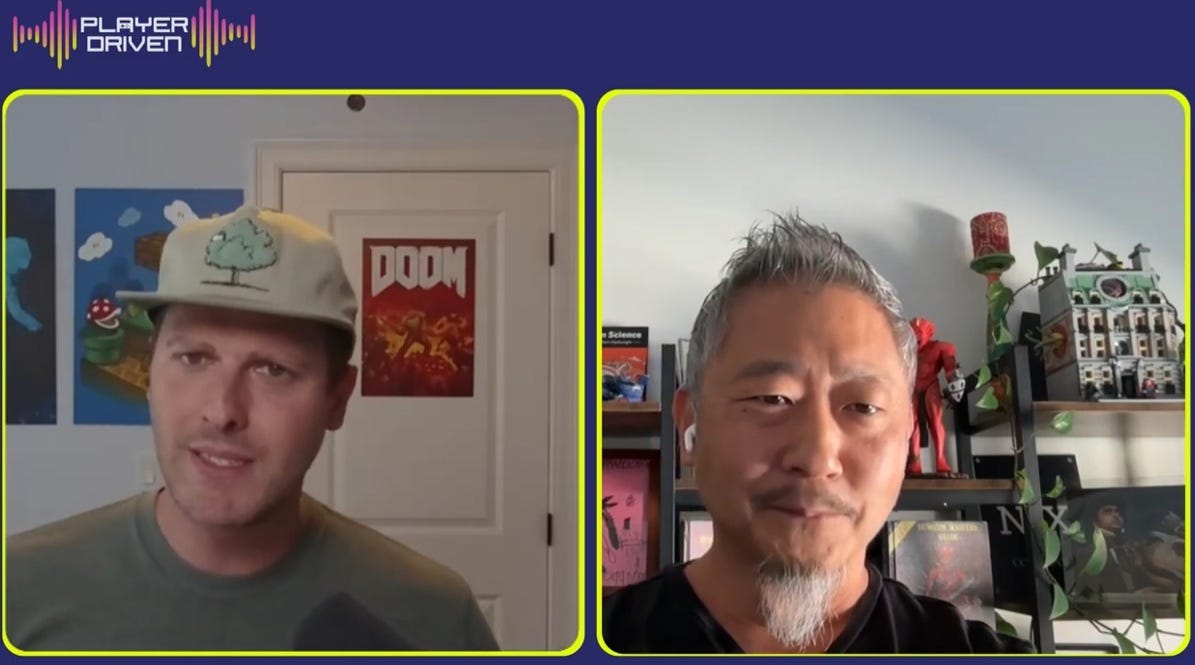
“You’re instantly immersed” in virtual environments that feature quality 3D graphics and a camera position that’s behind the character’s head, according to Mark Otero, CEO and co-founder of Azra Games. In a Player Driven podcast exchange with host Greg Posner in August, Otero continued, saying, “Star Wars Galaxy of Heroes, by the way, was the first third gen collectibles and combat RPG game in the West.”

The collectibles and combat RPG subgenre generally has players navigate a core combat game loop repeatedly in order to collect an array of characters with different strengths and weaknesses, upgrade them and their equipment/inventory, and pit them against increasingly potent NPCs (nonplayer characters backed by a kind of AI) in turn-based, strategic battles.

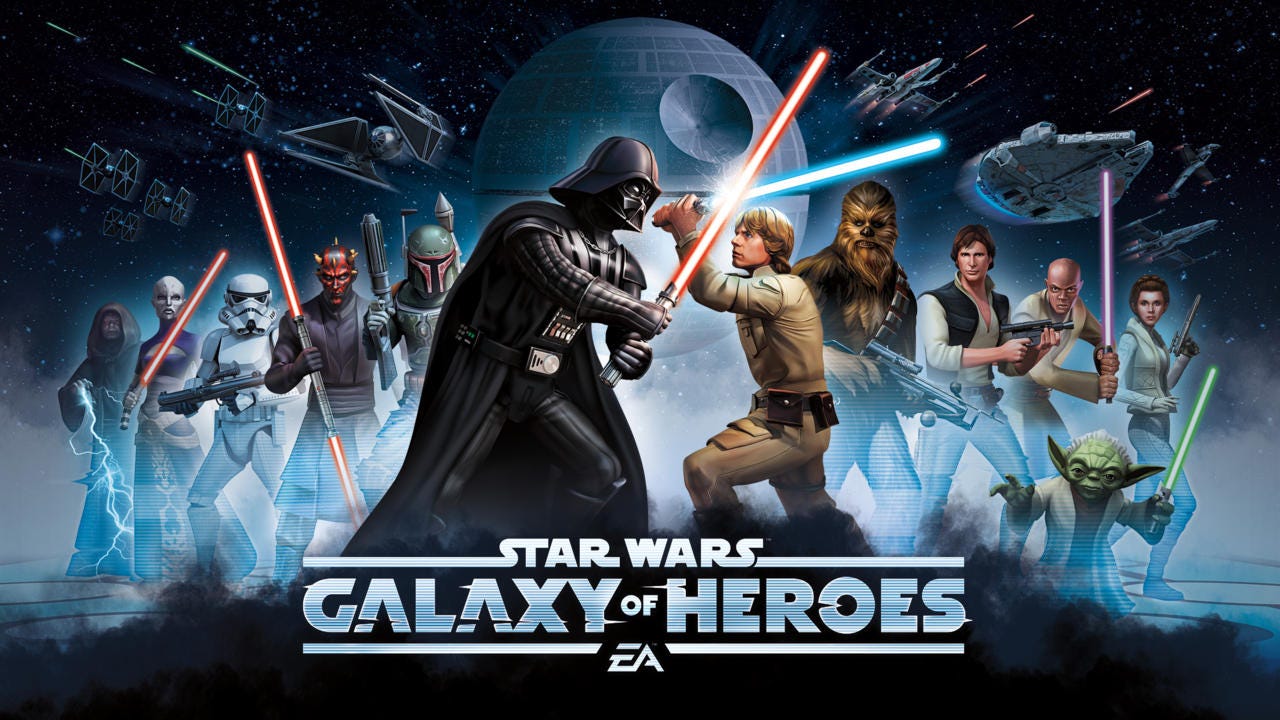
Star Wars Galaxy of Heroes was a smash hit for Electronic Arts (EA) when it debuted in late 2015. According to the game’s Wikipedia page, this mobile game exceeded 100 million downloads and had generated $1.4 billion worldwide by late 2021.

In this timeframe, Otero was the General Manager of EA Capital Games, the studio that developed, launched, and updated Star Wars Galaxy of Heroes (SWGOH). The game’s success of the didn’t just appear of out hyperspace. Otero had come to EA with a proven track record in the subgenre. How he got to that point—and where Otero appears to be headed with UnGodly in 2026—is an intriguing, circuitous, unique story that began in a small village in South Korea.

“It goes back, really, I think, to my childhood in South Korea, growing up in the ‘70s,” Otero told Posner. (Note: the full Player Driven episode is likely available on your favorite podcast platform.) Otero grew up in a “place called Uijeongbu, which had a U.S. military base there…I got exposure to Western literature, like Dungeons & Dragons and Conan…English is my second language.”

“In the ‘60s and ‘70s, for South Korea, it was one of the poorest countries in the world,” he continued. “And Dungeons & Dragons and role-playing games provided an escape for me. I was able to escape into these fantasy worlds and then ended up mastering the rule set…I needed this to help, you know, to manage some of the suffering at that time.”

Otero and his family immigrated to Sacramento, CA, in 1986.

“I was one of those nerds in high school that lugged around this big backpack, not necessarily with school books because we had lockers back then, but with three to four Dungeon & Dragon books and my binders worth of material,” Otero recalled. “I would, we would play Dungeons & Dragons in high school and all the way through college.”

Otero earned a computer science degree from a local State college in the 1990s and, in the mid-2000s, received an MBA from U.C. Davis. His first job out of grad school “was actually in finance, as an analyst,” Otero told Posner. “Franklin Templeton Investments, which is a great company, they ended up hiring me. And I did well enough to eventually manage a department in three years.”

“But I wasn’t fully happy. I thought I had it all. I had a house. I was dating on a regular basis. I was a young man in his mid- to late-20s at this point.”

“I was really unsatisfied because I felt like my life should have taken a different turn. And so I sold my house, moved in with my mom, spent six months revisiting my purpose in life.”

Otero’s thoughts eventually went back to his first true love: D&D-type RPGs.

“I’ve always wanted to make video games, specifically role-playing games,” he told Posner. “Roleplay, you know, for me is very personal because, as a child, it was an antidote to my own suffering, and role-playing games allowed me to explore fantasies and aspirations that I didn’t have the power to, um, to fully see through in real life…This is why I think role-playing games are so important for mankind.”

This reflective period at mom’s house yielded a two-step plan:

  1. Make some money

  2. Use that money to make an RPG.

“My mom thought I was absolutely batshit crazy [when I] opened up a yogurt shop,” Otero recalled. “You’re right. It has nothing to do with role-playing games, but it has everything to do with my story.”

Otero formulated his “own frozen yogurt, hired a food chemist, and it became a hit. It [Mochi Yogurt] was the most popular yogurt shop in Sacramento.”

Sweet!

“Then I created a bunch of apps that no one will ever remember, about 30 of them.”

Wait. What?

“They all failed, by the way, miserably failed. Because I was chasing what I thought I should be doing as a tech entrepreneur.”

No. Boo!

“On my 30th app, I decided, you know what? I’m about ready to run out of money. I’ve got to pursue something that I’m going to really care about…How about I make a game? And so I read every single game design book that was available in the market at the time. It was around 2008.”

“Most of them were pretty terrible. A lot of them just gave really bad advice. And so coming from a financial background of understanding and analyzing models and construction—models are things that you construct that can help predict either behavior or the future, um, of the market—I created models for role-playing games, my own inventions.”

“And I studied the market, put the models to work, and identified an opportunity in roleplay. And my first game was a hit.”

Sweet!

“In between serving yogurt shops, um, I was writing up a 30-page game design document for my first game, which was called Superhero City, a free-to-play [browser] game on Facebook.”

This was 2009. A dev who worked on Superhero City posted here that the game, effectively, put a twist on Mafia Wars (which I remember playing back in the day!).

“It was my first collectibles and combat RPG. The game went from making few hundred dollars a day after the game’s launch to making $1,000 a day two months later, to making over $20,000 day in six months.”

“I thought I just got lucky” the first time around, Otero told Posner. “So, I designed my second RPG game, in two weeks this time, utilizing my models. Made some changes. That game became an instant hit. It was making $20,000 to $40,000 every day, two months after launch.”

Otero’s bootstrapped studio, KlickNation, was off and running. Its success was soon noticed by bigger fish.

“We got into a really good position. It was a very profitable company when Electronic Arts and two other companies decided to competitively bid to acquire our company.”

EA bought KlickNation for an undisclosed sum in 2011, and renamed the studio BioWare Sacramento.

“BioWare was the the acquiring company within Electronic Arts,” Otero explained. “And as you know, BioWare has a storied history in role-playing games….Baldur’s Gate, the first one, was my favorite RPG game in the 2000s.”

“Working for Dr. Ray Muzyka, one of the co-founders there, was a dream come true.”

Otero was flying as high as any superhero by this point.

A single-player RPG set in the Advanced D&D universe, Baldur’s Gate debuted in 1998 and offered a quest-centric PvE (player vs. environment) experience. That’s not too far away from the type of RPG that KlickNation made.

The combination of EA’s exclusive gaming rights to the Star Wars IP, Dr. Muzyka’s mentoring and guidance, Otero’s inherent passion and talent, and the skill and hard work of the balance of the BioWare Sacramento team (which was renamed EA Capital Games in 2014) is arguably what led to the mobile gaming supernova that was SWGOH.
“What was really funny about meeting him [Dr. Muzyka] and going through this process of being acquired,” Otero recalled, was that “I had written down [in a] private journal of mine, as well as journaled at that time on a Google document, so you can see the timestamps, where our goal was to become the BioWare of Sacramento.”

“When I showed him that, he was absolutely blown away because it was very prophetic. I learned tremendously under his mentorship about quality, storytelling, not the mathematics of gaming or the models of gaming, but more of the quality of gaming itself.”

“Did you know there are over 50 Star Wars mobile games and none of them, except for Star Wars Galaxy of Heroes, cracked 100 million [downloads]?” Otero asked Posner.

“I’ll tell you two reasons [why]. One, it’s more important that you identify how technology and insights create an inflection point called a generational cycle…That is the most important decision a game maker must make. What has changed? What insight do I have that can capitalize on this technology evolution or breakthrough to improve the user experience?”

“The second reason is because most Star Wars games actually break the philosophy of fun.”

Otero’s philosophy (or hierarchy) of fun is something that we’ll revisit in the next subsection. For now, let’s close the loop on his nine seconds to fun idea (outlined in the opening block quote). In the podcast discussion, Otero described what he believes are the four generations of collectibles and combat RPGs, which have (conveniently!) set the table for UnGodly’s debut.

“Generation one of collectibles and combat RPGs, they were, effectively, the user experience, the moment to moment, was largely 2D menus where you click to combat, click to activity,” said Otero. “In a lot of cases, you didn’t see the combat.”

“You saw the stats and you also felt the stats as you accumulated power over time…but generation one games, you know, generally took about 30 to 45 minutes to understand the moment to moment.”

“Generation two games, as the mobile phones became more powerful, had more powerful graphical capabilities…[T]here were still 2D interfaces where you click to activity, click to combat, click to assemble your party of heroes and send them into combat. And you could you could see the combat.”

“Generation three came along in about 2011 to 2013, and made combat interactive where you had turn-based combat for the first time on mobile…[T]he core loop and the progression and the meta of building your party, the most powerful party, to destroy the most powerful enemies, all of that remained durable.”

“Third-generation collectibles and combat RPGs, like Star Wars Galaxy of Heroes, was six to nine minutes to understand the moment to moment within the game.”

“Generation one took 30 to 45 minutes. Generation two took half that time. Generation three took six to nine minutes. The breakthrough for generation four is that technology is once again playing a major role…[M]obile phones in tier one Western markets, their power, is equivalent or greater than the previous generation of consoles.”

A successful fourth gen game, Otero argued, must take advantage of 3D graphics and a “behind the head” camera position to convey what the game is about and deliver player fun not in nine minutes, but in nine seconds. For more color on UnGodly, its Web3 tech and NFT angles, and Otero’s philosophy, read on.

Azra Games’ Hierarchy of Fun...plus AI

I created [something] called the Azra Games hierarchy of fun. And you could think of this as Maslow’s hierarchy of needs…It has five layers. Each layer actually makes you feel something at different parts of the game.—Mark Otero

In their podcast discussion, Player Driven host Greg Posner asked Azra Games’ CEO and co-founder, Mark Otero, a follow-on question about forth gen collectibles and combat RPGs. Otero’s response stressed the importance of feel in these environments, which opened the door to his hierarchy of fun conception.

“If you look at Azra’s hierarchy of fun,” Otero explained, “the first layer, um, is the moment to moment experience…That is what people see immediately. Having never played your game, they see it. It’s how most people describe games. What’s the combat like? What’s the world like? What’s the graphics? What’s the art style? What’s the theme? What’s the lore?”

“That’s like dating. It’s the first impression. That makes you feel something, like, you either love the art or you hate the art…You love the music or you hate the music...You don’t want people to feel indifferent. You want them to feel one or the other.”
“Above that layer is your core loop…[T]hat also makes you feel something, too, because, as you’re engaging the game loop, you’re beyond the superficial stage of the game. And the game, now, is facilitating [an] understanding [of] the rules of the game…[P]eople…can often feel excited. They feel competent.”

“Once they do that, they go up to the next layer, which is the progression,” Otero continued. “The progression is when they, generally, are starting to have some semblance of rules mastery of the game, you know? And usually the player becomes very aware of how much effort they have to put in within the game to experience the rewards of the game as set out by the core loop.”

“The fourth layer is called the meta layer, or mastery. The fourth layer when the player goes, ‘I understand how this game works. I understand all the nuances of the 2% to 3% of the game that can help me perform even better within the game.’”

“The fifth layer is the emotional layer. This is a layer when you hear words like, ‘I love this game.’ Often they play every day.”

(Fans of Player Driven may find this “wheels within wheels” description of how “fun” can be sustained through interrelated game design systems similar to a separate podcast Greg and I did with NYU Professor Eric Zimmerman in November that touched on Balatro’s sticky loops [it’s about 38 minutes in to that episode].)

If you were to flip it [Azra Games’ hierarchy of fun], you could think of that as the player’s funnel into loving your game…In every stage of that funnel, of the player’s experience, they will feel something along the way. So it’s very important that the player feels something at the different stages of the game for different reasons.

Otero tied this hierarchal model back to his days at BioWare.

“What Ray [Muzyka] taught me was the moment to moment layer. He taught me the quality standards of how to elevate that to a world-class level.”

“When it came to the other layers, I had developed a form of competency and, in some cases, mastery, mathematically, of how game systems are constructed and put together because I was self-taught…But it was the top of the funnel experience that I truly am grateful for my experience at BioWare.”

Posner asked Otero if he thinks a version of the hierarchy of fun exists in most video games.

“I see it as facilitating a player’s fantasy,” Otero responded. ‘Whatever the fantasy may be…[M]ost, if not all games...do that, whether you’re a first person shooter, you know, whether you’re a role-playing game, whether you’re Candy Crush, whether you’re Clash of Clans.” (I’m still stuck in this game’s loops!)

“They’re all facilitating some incredible primal need of yours that is not being fully realized in your real life. And so games, in many ways, they’re different than traditional media like TV and movies in that you can interact with them.”

“You can interact with your fantasy and pursue it. With a movie, when you watch it once, you probably receive 70% of the entertaining value from that medium. With games, the entertaining value of that medium is interactive and progressive over time.”

“It adapts and changes with you,” continued Otero. “Especially as a live service, free-to-play game will do. And so this is what I mean by, ‘The game has chosen you.’ You think you have chosen the game. No, no, no, no! The game game has chosen you. And you have both found each other.”

Posner pivoted and asked Otero about the impact AI was having on Azra Games’ development processes. Otero’s response waxed philosophic.

“I say there are three fears in life,” he said. “[T]here’s what’s called the dumb fear, which is, you know, ‘Don’t run on the side of a cliff on a rainy day on a mountain because you might slip and fall and die.’”

“Next is the existential fear where, you know, ‘Is Russia or North Korea going to start a nuclear war?’ Well, we can’t we can’t change that, can we?”

“The third fear is the most important fear, in my opinion. It’s the performance fear, anxiety fear. So what we’re really talking about is individual performance…[T]he way I think about AI is, yes, one, it is exciting and scary. Two, what’s incredible about AI is [that] I see it as a lever.”

“If you’re a creative, whether you’re an engineer, whether you’re an artist, an illustrator, UX, UI, doesn’t matter. Your creative skills and your talent becomes magnified.”

“When we talk about fourth generation collectibles and combat RPGs, if you were not to utilize AI, it would likely cost you, assuming you know what you’re doing, it would likely cost you over $100 million.”

“How do you, as a small studio, who doesn’t have $100 million dollars create a fourth gen? You have to revisit and rethink how to allocate your talent for maximum productivity impact. In other words, you have to rethink your entire pipelines, all of them.”

Otero said that Arza Games has a staff of about 120 people working to complete UnGodly and support its successful launch next year across mobile devices, PCs and consoles.

In 2024-25, added Otero, “the predictability of AI outcomes is about 70% to 80% directionally good….It took us time to make that transition. It was not easy.”

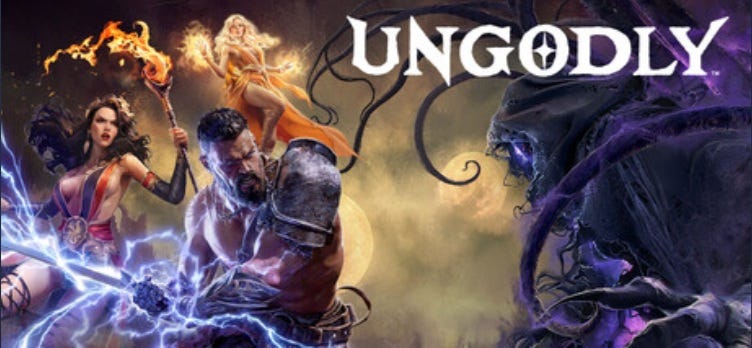
UnGodly: A Dark Power Fantasy For Cryptobros?

Will a masculine dark fantasy game still be desired in 10 years? Yes. In 20 years? Yes. In 50 years, probably so…Over the next 10 to 50 years, I would bank that masculine power fantasies will still be desired by a majority of men, and some woman, in that order….[I wanted] to come back and to build a masculine dark fantasy game, the type of games that inspired me as a child, where I ended up falling in love…you know, with some of these very masculine role models and myths and heroes.”—Mark Otero

Toward the end of their exchange in August, Posner asked Otero why he believed UnGodly will be well-received by a large player base next year. Otero’s answer, at a minimum, had a libertarian-tinged flavor.

“O]ver the last 10 years,” Otero said, “there’s been this incredible movement for inclusivity within games…[T]he execution and the thinking that went behind that was very poor.”

“And so when I founded the company back in 2022, the overwhelming consensus was, ‘You have to build an all-inclusive game that basically offends no one’ and oftentimes lectures you…about topics that are very nuanced and perhaps should be should be done in the privacy of your home.”

“I saw this [UnGodly] as an opportunity to be non-consensus,” Otero continued. “[W]e call this internally a divine crusade…[T]his isn’t a game that we want to make. We believe it’s a game we need to make.”

“[T]he main hero in our game, is his name is Vander. He is a bloody mercenary, but he was also once a father, a failed father…[H]e was also once a son who experienced tremendous tragedy in his family life. And so I share all that with you because in Ungodly, the world that we’re building, it is very familiar in terms of the archetypes, the myth-telling, the characters, the story.”

[T]he game starts off with our world broken,” said Otero, switching to a description of the kind of player, presumably, that UnGodly will “choose.”

“[T]hat’s actually what they actually feel in the modern world, where they feel like it’s broken. Maybe they can’t pay their bills. Maybe the partner they’re with doesn’t respect them and like them.”

“Maybe…they have shortcomings in terms of their career where they feel disempowered, whatever it is. There is something very wrong in our current world.”

“[W]e creatively translate that into a fictional world that’s broken. In this fictional world, there’s drug abuse. There are people in this fictional world who are supposed to be ruling us, who are utterly corrupt…[S]o we bring all this, not by telling you, but by having you experience these things, as a form of validation that, ‘We see you and you get to do something about it.’”

“We empower you,” Otero concluded. “That is the inspiration for UnGodly. And that is why its title is called that name. We live in a world that feels broken.”

So…we need a God (or a collection of upgradable Gods) to come along and fix our broken IRL world too…and they’ll “fix” it by smiting every opponent?
At the end of the podcast, Posner thanked Otero and, in passing, mentioned two popular user-generated game content creation platforms, Fortnite UEFN and Roblox. Otero picked up on the references and offered some advice to creators on those platforms—and shed more light on his own viewpoints in the process.

“If you are a zero to one independent game studio and there is consensus that your idea is great, consensus from the market in terms of what people tell you, consensus within your team, see that as a red flag,” advised Otero. “The hit commercial games, they’re all non-consensus because they take advantage of technology and deep insights about what that technology can offer.”

“Two, know your audience’s fantasy. Know who they are. Ignore what’s going on in modern ideology and focus on primal nature because you can always bank on primal nature being more true.”

“Thirdly, if you’re crazy enough to found a zero to one company, you can say goodbye to your friends, you can say goodbye to your family, your dog, your pets, because this is going to be your life for the next four to five years.”

Zero to One is a Peter Thiel book. Unprompted, Otero referenced this hardcore, conservative libertarian’s worldview twice in <5 minutes. What are the chances that was a coincidence rather than a dog whistle aimed at libertarians?

Lingering doubts about this assessment are expelled once one reviews Azra Games’ financial backers. Last October, Azra Games announced completion of a $42.7 million Series A funding round that “was led by Pantera Capital (Franklin Bi), with participation from a16z crypto (Arianna Simpson), A16Z GAMES (Jonathan Lai), and NFX (Gigi Levy-Weiss). This brings Azra’s total funding to date to $68.3 million.”

Andreessen Horowitz is, arguably, America’s preeminent techno-libertarian VC company. Both of its founders, Marc Andreessen and Ben Horowitz, have publicly backed the techno-libertarian worldview, repeatedly. Andreessen Horowitz has invested billions of dollars into crypto startups and has gone to the mat to prevent the U.S. government from regulating crypto. Andreessen and Horowitz personally contributed $3 million each to help build President Donald Trump’s new White House State Ballroom.

Andreessen Horowitz and Coinbase Ventures were also part of the $15 million seed round that was announced when Azra Games launched in 2022, back when it called itself “a blockchain games company.”

It all fits. The target audience. The game’s dark fantasy power myth, which is designed to make cryptobros feel potent in a world gone wrong (this pro-crypto site claims U.S. men were 2.8x more likely than women to own crypto as of 2023). The worldview of at least half of Azra Games’ top VC funders.

Otero deserves credit: his plan may pay off handsomely. UnGodly may become the West’s first successful fourth gen collectibles and combat RPG in 2026 precisely because all these pieces line up.

Is Otero a techno-libertarian true believer, however, or just pandering to his target audience and VC backers? UnGodly is far more dystopian than SWGOH or any other game Otero has made. It’s worth underscoring that NFT purchases will also be optional on most or all platforms.

Otero’s statement that UnGodly is “a game we need to make” argues that the former option is more likely to be true. The man said his team is on a “divine crusade.” At another point in the podcast, Otero came back to the anti-politically correct apple and took a second bite.

“[W]hen we talk about roleplay, I think as a civilization, Western civilization, has gotten more complex. I think as humans, we’ve also gotten much more sophisticated in not saying anything at all to each other anymore…[T]here is fear of repercussions if you say something that offends anyone.
“Because of that reality, for many people, that’s an even more important role where roleplay comes in…Where in the darkness of your room alone, [away] from prying eyes and ears, you get to fully express and explore fantasies that would otherwise potentially be shameful to others…[T]here is a need for roleplay now, even more so than before, because we’re just an incredibly over-polite society.”

Gotcha. More unfiltered “toxic masculinity” is the answer. Western civilization lacks enough IRL direct dick-ness. Our latent cryptobro overlords, should they become godlike IRL, would never contemplate rug pulling all the heretics outside their golden temple of Mammon, would they?

“[I]t goes to the philosophy of fun, which is, as a human, we oftentimes optimize across three different aspirations: Love, power, and wealth,” Otero explained to Posner.

“If you were to look at the weighted average of men across love, power, and wealth, and you would give them 10 points to allocate, you will see a pattern.”

“You do that for woman, give them 10 points of love, power, and wealth, you will also see a pattern.”

“[F]or men as a general population group, they like to weight very heavily on power and wealth…For women, they have an overwhelming, um, trend towards love.”

“[W]hen I’m designing a role-playing game, I know this. Role-playing games, the ones we make, are power fantasies.”

Star Wars was always a power fantasy between the forces of light and the forces of dark…[W]hen you recognize that Star Wars is a power fantasy, and you recognize that it’s about collecting toys or digital action figures, and you put those two together, you get a perfect, perfect match for collectibles and combat RPGs.”

I’ll leave it up to you to decide if Azra Games is building a game for players who want the light side of the Force and the Jedis to win, or for the dark side of the Force and the Sith to reign supreme.

If you go back 20 years on PC and console gaming, something incredible happened with the moment to moment experience that has remained a durable pattern for most blockbuster games: the camera angle changed from isometric view [2.5D overhead] to behind the head [3D]. Why is that important and why has that remained a durable, user-facing moment to moment breakthrough? It gives you instant immersion…You could bring that to mobile. And now, instead of it being six to nine minutes to fun, like third generation collectibles and combat RPGs, you get nine seconds to fun. That is a 40-60x improvement at the top of the funnel in Azra Games’ hierarchy of fun to get into the game immediately.—Mark Otero

“You’re instantly immersed” in virtual environments that feature quality 3D graphics and a camera position that’s behind the character’s head, according to Mark Otero, CEO and co-founder of Azra Games. In a Player Driven podcast exchange with host Greg Posner in August, Otero continued, saying, “Star Wars Galaxy of Heroes, by the way, was the first third gen collectibles and combat RPG game in the West.”

The collectibles and combat RPG subgenre generally has players navigate a core combat game loop repeatedly in order to collect an array of characters with different strengths and weaknesses, upgrade them and their equipment/inventory, and pit them against increasingly potent NPCs (nonplayer characters backed by a kind of AI) in turn-based, strategic battles.

Star Wars Galaxy of Heroes was a smash hit for Electronic Arts (EA) when it debuted in late 2015. According to the game’s Wikipedia page, this mobile game exceeded 100 million downloads and had generated $1.4 billion worldwide by late 2021.

In this timeframe, Otero was the General Manager of EA Capital Games, the studio that developed, launched, and updated Star Wars Galaxy of Heroes (SWGOH). The game’s success of the didn’t just appear of out hyperspace. Otero had come to EA with a proven track record in the subgenre. How he got to that point—and where Otero appears to be headed with UnGodly in 2026—is an intriguing, circuitous, unique story that began in a small village in South Korea.

“It goes back, really, I think, to my childhood in South Korea, growing up in the ‘70s,” Otero told Posner. (Note: the full Player Driven episode is likely available on your favorite podcast platform.) Otero grew up in a “place called Uijeongbu, which had a U.S. military base there…I got exposure to Western literature, like Dungeons & Dragons and Conan…English is my second language.”

“In the ‘60s and ‘70s, for South Korea, it was one of the poorest countries in the world,” he continued. “And Dungeons & Dragons and role-playing games provided an escape for me. I was able to escape into these fantasy worlds and then ended up mastering the rule set…I needed this to help, you know, to manage some of the suffering at that time.”

Otero and his family immigrated to Sacramento, CA, in 1986.

“I was one of those nerds in high school that lugged around this big backpack, not necessarily with school books because we had lockers back then, but with three to four Dungeon & Dragon books and my binders worth of material,” Otero recalled. “I would, we would play Dungeons & Dragons in high school and all the way through college.”

Otero earned a computer science degree from a local State college in the 1990s and, in the mid-2000s, received an MBA from U.C. Davis. His first job out of grad school “was actually in finance, as an analyst,” Otero told Posner. “Franklin Templeton Investments, which is a great company, they ended up hiring me. And I did well enough to eventually manage a department in three years.”

“But I wasn’t fully happy. I thought I had it all. I had a house. I was dating on a regular basis. I was a young man in his mid- to late-20s at this point.”

“I was really unsatisfied because I felt like my life should have taken a different turn. And so I sold my house, moved in with my mom, spent six months revisiting my purpose in life.”

Otero’s thoughts eventually went back to his first true love: D&D-type RPGs.

“I’ve always wanted to make video games, specifically role-playing games,” he told Posner. “Roleplay, you know, for me is very personal because, as a child, it was an antidote to my own suffering, and role-playing games allowed me to explore fantasies and aspirations that I didn’t have the power to, um, to fully see through in real life…This is why I think role-playing games are so important for mankind.”

This reflective period at mom’s house yielded a two-step plan:

  1. Make some money

  2. Use that money to make an RPG.

“My mom thought I was absolutely batshit crazy [when I] opened up a yogurt shop,” Otero recalled. “You’re right. It has nothing to do with role-playing games, but it has everything to do with my story.”

Otero formulated his “own frozen yogurt, hired a food chemist, and it became a hit. It [Mochi Yogurt] was the most popular yogurt shop in Sacramento.”

Sweet!

“Then I created a bunch of apps that no one will ever remember, about 30 of them.”

Wait. What?

“They all failed, by the way, miserably failed. Because I was chasing what I thought I should be doing as a tech entrepreneur.”

No. Boo!

“On my 30th app, I decided, you know what? I’m about ready to run out of money. I’ve got to pursue something that I’m going to really care about…How about I make a game? And so I read every single game design book that was available in the market at the time. It was around 2008.”

“Most of them were pretty terrible. A lot of them just gave really bad advice. And so coming from a financial background of understanding and analyzing models and construction—models are things that you construct that can help predict either behavior or the future, um, of the market—I created models for role-playing games, my own inventions.”

“And I studied the market, put the models to work, and identified an opportunity in roleplay. And my first game was a hit.”

Sweet!

“In between serving yogurt shops, um, I was writing up a 30-page game design document for my first game, which was called Superhero City, a free-to-play [browser] game on Facebook.”

This was 2009. A dev who worked on Superhero City posted here that the game, effectively, put a twist on Mafia Wars (which I remember playing back in the day!).

“It was my first collectibles and combat RPG. The game went from making few hundred dollars a day after the game’s launch to making $1,000 a day two months later, to making over $20,000 day in six months.”

“I thought I just got lucky” the first time around, Otero told Posner. “So, I designed my second RPG game, in two weeks this time, utilizing my models. Made some changes. That game became an instant hit. It was making $20,000 to $40,000 every day, two months after launch.”

Otero’s bootstrapped studio, KlickNation, was off and running. Its success was soon noticed by bigger fish.

“We got into a really good position. It was a very profitable company when Electronic Arts and two other companies decided to competitively bid to acquire our company.”

EA bought KlickNation for an undisclosed sum in 2011, and renamed the studio BioWare Sacramento.

“BioWare was the the acquiring company within Electronic Arts,” Otero explained. “And as you know, BioWare has a storied history in role-playing games….Baldur’s Gate, the first one, was my favorite RPG game in the 2000s.”

“Working for Dr. Ray Muzyka, one of the co-founders there, was a dream come true.”

Otero was flying as high as any superhero by this point.

A single-player RPG set in the Advanced D&D universe, Baldur’s Gate debuted in 1998 and offered a quest-centric PvE (player vs. environment) experience. That’s not too far away from the type of RPG that KlickNation made.

The combination of EA’s exclusive gaming rights to the Star Wars IP, Dr. Muzyka’s mentoring and guidance, Otero’s inherent passion and talent, and the skill and hard work of the balance of the BioWare Sacramento team (which was renamed EA Capital Games in 2014) is arguably what led to the mobile gaming supernova that was SWGOH.

“What was really funny about meeting him [Dr. Muzyka] and going through this process of being acquired,” Otero recalled, was that “I had written down [in a] private journal of mine, as well as journaled at that time on a Google document, so you can see the timestamps, where our goal was to become the BioWare of Sacramento.”

“When I showed him that, he was absolutely blown away because it was very prophetic. I learned tremendously under his mentorship about quality, storytelling, not the mathematics of gaming or the models of gaming, but more of the quality of gaming itself.”

“Did you know there are over 50 Star Wars mobile games and none of them, except for Star Wars Galaxy of Heroes, cracked 100 million [downloads]?” Otero asked Posner.

“I’ll tell you two reasons [why]. One, it’s more important that you identify how technology and insights create an inflection point called a generational cycle…That is the most important decision a game maker must make. What has changed? What insight do I have that can capitalize on this technology evolution or breakthrough to improve the user experience?”

“The second reason is because most Star Wars games actually break the philosophy of fun.”

Otero’s philosophy (or hierarchy) of fun is something that we’ll revisit in the next subsection. For now, let’s close the loop on his nine seconds to fun idea (outlined in the opening block quote). In the podcast discussion, Otero described what he believes are the four generations of collectibles and combat RPGs, which have (conveniently!) set the table for UnGodly’s debut.

“Generation one of collectibles and combat RPGs, they were, effectively, the user experience, the moment to moment, was largely 2D menus where you click to combat, click to activity,” said Otero. “In a lot of cases, you didn’t see the combat.”

“You saw the stats and you also felt the stats as you accumulated power over time…but generation one games, you know, generally took about 30 to 45 minutes to understand the moment to moment.”

“Generation two games, as the mobile phones became more powerful, had more powerful graphical capabilities…[T]here were still 2D interfaces where you click to activity, click to combat, click to assemble your party of heroes and send them into combat. And you could you could see the combat.”

“Generation three came along in about 2011 to 2013, and made combat interactive where you had turn-based combat for the first time on mobile…[T]he core loop and the progression and the meta of building your party, the most powerful party, to destroy the most powerful enemies, all of that remained durable.”

“Third-generation collectibles and combat RPGs, like Star Wars Galaxy of Heroes, was six to nine minutes to understand the moment to moment within the game.”

“Generation one took 30 to 45 minutes. Generation two took half that time. Generation three took six to nine minutes. The breakthrough for generation four is that technology is once again playing a major role…[M]obile phones in tier one Western markets, their power, is equivalent or greater than the previous generation of consoles.”

A successful fourth gen game, Otero argued, must take advantage of 3D graphics and a “behind the head” camera position to convey what the game is about and deliver player fun not in nine minutes, but in nine seconds. For more color on UnGodly, its Web3 tech and NFT angles, and Otero’s philosophy, read on.

Azra Games’ Hierarchy of Fun...plus AI

I created [something] called the Azra Games hierarchy of fun. And you could think of this as Maslow’s hierarchy of needs…It has five layers. Each layer actually makes you feel something at different parts of the game.—Mark Otero

In their podcast discussion, Player Driven host Greg Posner asked Azra Games’ CEO and co-founder, Mark Otero, a follow-on question about forth gen collectibles and combat RPGs. Otero’s response stressed the importance of feel in these environments, which opened the door to his hierarchy of fun conception.

“If you look at Azra’s hierarchy of fun,” Otero explained, “the first layer, um, is the moment to moment experience…That is what people see immediately. Having never played your game, they see it. It’s how most people describe games. What’s the combat like? What’s the world like? What’s the graphics? What’s the art style? What’s the theme? What’s the lore?”

“That’s like dating. It’s the first impression. That makes you feel something, like, you either love the art or you hate the art…You love the music or you hate the music...You don’t want people to feel indifferent. You want them to feel one or the other.”

“Above that layer is your core loop…[T]hat also makes you feel something, too, because, as you’re engaging the game loop, you’re beyond the superficial stage of the game. And the game, now, is facilitating [an] understanding [of] the rules of the game…[P]eople…can often feel excited. They feel competent.”

“Once they do that, they go up to the next layer, which is the progression,” Otero continued. “The progression is when they, generally, are starting to have some semblance of rules mastery of the game, you know? And usually the player becomes very aware of how much effort they have to put in within the game to experience the rewards of the game as set out by the core loop.”

“The fourth layer is called the meta layer, or mastery. The fourth layer when the player goes, ‘I understand how this game works. I understand all the nuances of the 2% to 3% of the game that can help me perform even better within the game.’”

“The fifth layer is the emotional layer. This is a layer when you hear words like, ‘I love this game.’ Often they play every day.”

(Fans of Player Driven may find this “wheels within wheels” description of how “fun” can be sustained through interrelated game design systems similar to a separate podcast Greg and I did with NYU Professor Eric Zimmerman in November that touched on Balatro’s sticky loops [it’s about 38 minutes in to that episode].)

If you were to flip it [Azra Games’ hierarchy of fun], you could think of that as the player’s funnel into loving your game…In every stage of that funnel, of the player’s experience, they will feel something along the way. So it’s very important that the player feels something at the different stages of the game for different reasons.

Otero tied this hierarchal model back to his days at BioWare.

“What Ray [Muzyka] taught me was the moment to moment layer. He taught me the quality standards of how to elevate that to a world-class level.”

“When it came to the other layers, I had developed a form of competency and, in some cases, mastery, mathematically, of how game systems are constructed and put together because I was self-taught…But it was the top of the funnel experience that I truly am grateful for my experience at BioWare.”

Posner asked Otero if he thinks a version of the hierarchy of fun exists in most video games.

“I see it as facilitating a player’s fantasy,” Otero responded. ‘Whatever the fantasy may be…[M]ost, if not all games...do that, whether you’re a first person shooter, you know, whether you’re a role-playing game, whether you’re Candy Crush, whether you’re Clash of Clans.” (I’m still stuck in this game’s loops!)

“They’re all facilitating some incredible primal need of yours that is not being fully realized in your real life. And so games, in many ways, they’re different than traditional media like TV and movies in that you can interact with them.”

“You can interact with your fantasy and pursue it. With a movie, when you watch it once, you probably receive 70% of the entertaining value from that medium. With games, the entertaining value of that medium is interactive and progressive over time.”

“It adapts and changes with you,” continued Otero. “Especially as a live service, free-to-play game will do. And so this is what I mean by, ‘The game has chosen you.’ You think you have chosen the game. No, no, no, no! The game game has chosen you. And you have both found each other.”

Posner pivoted and asked Otero about the impact AI was having on Azra Games’ development processes. Otero’s response waxed philosophic.

“I say there are three fears in life,” he said. “[T]here’s what’s called the dumb fear, which is, you know, ‘Don’t run on the side of a cliff on a rainy day on a mountain because you might slip and fall and die.’”

“Next is the existential fear where, you know, ‘Is Russia or North Korea going to start a nuclear war?’ Well, we can’t we can’t change that, can we?”

“The third fear is the most important fear, in my opinion. It’s the performance fear, anxiety fear. So what we’re really talking about is individual performance…[T]he way I think about AI is, yes, one, it is exciting and scary. Two, what’s incredible about AI is [that] I see it as a lever.”

“If you’re a creative, whether you’re an engineer, whether you’re an artist, an illustrator, UX, UI, doesn’t matter. Your creative skills and your talent becomes magnified.”

“When we talk about fourth generation collectibles and combat RPGs, if you were not to utilize AI, it would likely cost you, assuming you know what you’re doing, it would likely cost you over $100 million.”

“How do you, as a small studio, who doesn’t have $100 million dollars create a fourth gen? You have to revisit and rethink how to allocate your talent for maximum productivity impact. In other words, you have to rethink your entire pipelines, all of them.”

Otero said that Arza Games has a staff of about 120 people working to complete UnGodly and support its successful launch next year across mobile devices, PCs and consoles.

In 2024-25, added Otero, “the predictability of AI outcomes is about 70% to 80% directionally good….It took us time to make that transition. It was not easy.”

UnGodly: A Dark Power Fantasy For Cryptobros?

Will a masculine dark fantasy game still be desired in 10 years? Yes. In 20 years? Yes. In 50 years, probably so…Over the next 10 to 50 years, I would bank that masculine power fantasies will still be desired by a majority of men, and some woman, in that order….[I wanted] to come back and to build a masculine dark fantasy game, the type of games that inspired me as a child, where I ended up falling in love…you know, with some of these very masculine role models and myths and heroes.”—Mark Otero

Toward the end of their exchange in August, Posner asked Otero why he believed UnGodly will be well-received by a large player base next year. Otero’s answer, at a minimum, had a libertarian-tinged flavor.

“O]ver the last 10 years,” Otero said, “there’s been this incredible movement for inclusivity within games…[T]he execution and the thinking that went behind that was very poor.”

“And so when I founded the company back in 2022, the overwhelming consensus was, ‘You have to build an all-inclusive game that basically offends no one’ and oftentimes lectures you…about topics that are very nuanced and perhaps should be should be done in the privacy of your home.”

“I saw this [UnGodly] as an opportunity to be non-consensus,” Otero continued. “[W]e call this internally a divine crusade…[T]his isn’t a game that we want to make. We believe it’s a game we need to make.”

“[T]he main hero in our game, is his name is Vander. He is a bloody mercenary, but he was also once a father, a failed father…[H]e was also once a son who experienced tremendous tragedy in his family life. And so I share all that with you because in Ungodly, the world that we’re building, it is very familiar in terms of the archetypes, the myth-telling, the characters, the story.”

[T]he game starts off with our world broken,” said Otero, switching to a description of the kind of player, presumably, that UnGodly will “choose.”

“[T]hat’s actually what they actually feel in the modern world, where they feel like it’s broken. Maybe they can’t pay their bills. Maybe the partner they’re with doesn’t respect them and like them.”

“Maybe…they have shortcomings in terms of their career where they feel disempowered, whatever it is. There is something very wrong in our current world.”

“[W]e creatively translate that into a fictional world that’s broken. In this fictional world, there’s drug abuse. There are people in this fictional world who are supposed to be ruling us, who are utterly corrupt…[S]o we bring all this, not by telling you, but by having you experience these things, as a form of validation that, ‘We see you and you get to do something about it.’”

“We empower you,” Otero concluded. “That is the inspiration for UnGodly. And that is why its title is called that name. We live in a world that feels broken.”

So…we need a God (or a collection of upgradable Gods) to come along and fix our broken IRL world too…and they’ll “fix” it by smiting every opponent?

At the end of the podcast, Posner thanked Otero and, in passing, mentioned two popular user-generated game content creation platforms, Fortnite UEFN and Roblox. Otero picked up on the references and offered some advice to creators on those platforms—and shed more light on his own viewpoints in the process.

“If you are a zero to one independent game studio and there is consensus that your idea is great, consensus from the market in terms of what people tell you, consensus within your team, see that as a red flag,” advised Otero. “The hit commercial games, they’re all non-consensus because they take advantage of technology and deep insights about what that technology can offer.”

“Two, know your audience’s fantasy. Know who they are. Ignore what’s going on in modern ideology and focus on primal nature because you can always bank on primal nature being more true.”

“Thirdly, if you’re crazy enough to found a zero to one company, you can say goodbye to your friends, you can say goodbye to your family, your dog, your pets, because this is going to be your life for the next four to five years.”

Zero to One is a Peter Thiel book. Unprompted, Otero referenced this hardcore, conservative libertarian’s worldview twice in <5 minutes. What are the chances that was a coincidence rather than a dog whistle aimed at libertarians?

Lingering doubts about this assessment are expelled once one reviews Azra Games’ financial backers. Last October, Azra Games announced completion of a $42.7 million Series A funding round that “was led by Pantera Capital (Franklin Bi), with participation from a16z crypto (Arianna Simpson), A16Z GAMES (Jonathan Lai), and NFX (Gigi Levy-Weiss). This brings Azra’s total funding to date to $68.3 million.”

Andreessen Horowitz is, arguably, America’s preeminent techno-libertarian VC company. Both of its founders, Marc Andreessen and Ben Horowitz, have publicly backed the techno-libertarian worldview, repeatedly. Andreessen Horowitz has invested billions of dollars into crypto startups and has gone to the mat to prevent the U.S. government from regulating crypto. Andreessen and Horowitz personally contributed $3 million each to help build President Donald Trump’s new White House State Ballroom.

Andreessen Horowitz and Coinbase Ventures were also part of the $15 million seed round that was announced when Azra Games launched in 2022, back when it called itself “a blockchain games company.”

It all fits. The target audience. The game’s dark fantasy power myth, which is designed to make cryptobros feel potent in a world gone wrong (this pro-crypto site claims U.S. men were 2.8x more likely than women to own crypto as of 2023). The worldview of at least half of Azra Games’ top VC funders.

Otero deserves credit: his plan may pay off handsomely. UnGodly may become the West’s first successful fourth gen collectibles and combat RPG in 2026 precisely because all these pieces line up.

Is Otero a techno-libertarian true believer, however, or just pandering to his target audience and VC backers? UnGodly is far more dystopian than SWGOH or any other game Otero has made. It’s worth underscoring that NFT purchases will also be optional on most or all platforms.

Otero’s statement that UnGodly is “a game we need to make” argues that the former option is more likely to be true. The man said his team is on a “divine crusade.” At another point in the podcast, Otero came back to the anti-politically correct apple and took a second bite.

“[W]hen we talk about roleplay, I think as a civilization, Western civilization, has gotten more complex. I think as humans, we’ve also gotten much more sophisticated in not saying anything at all to each other anymore…[T]here is fear of repercussions if you say something that offends anyone.

“Because of that reality, for many people, that’s an even more important role where roleplay comes in…Where in the darkness of your room alone, [away] from prying eyes and ears, you get to fully express and explore fantasies that would otherwise potentially be shameful to others…[T]here is a need for roleplay now, even more so than before, because we’re just an incredibly over-polite society.”

Gotcha. More unfiltered “toxic masculinity” is the answer. Western civilization lacks enough IRL direct dick-ness. Our latent cryptobro overlords, should they become godlike IRL, would never contemplate rug pulling all the heretics outside their golden temple of Mammon, would they?

“[I]t goes to the philosophy of fun, which is, as a human, we oftentimes optimize across three different aspirations: Love, power, and wealth,” Otero explained to Posner.

“If you were to look at the weighted average of men across love, power, and wealth, and you would give them 10 points to allocate, you will see a pattern.”

“You do that for woman, give them 10 points of love, power, and wealth, you will also see a pattern.”

“[F]or men as a general population group, they like to weight very heavily on power and wealth…For women, they have an overwhelming, um, trend towards love.”

“[W]hen I’m designing a role-playing game, I know this. Role-playing games, the ones we make, are power fantasies.”

Star Wars was always a power fantasy between the forces of light and the forces of dark…[W]hen you recognize that Star Wars is a power fantasy, and you recognize that it’s about collecting toys or digital action figures, and you put those two together, you get a perfect, perfect match for collectibles and combat RPGs.”

I’ll leave it up to you to decide if Azra Games is building a game for players who want the light side of the Force and the Jedis to win, or for the dark side of the Force and the Sith to reign supreme.
If you go back 20 years on PC and console gaming, something incredible happened with the moment to moment experience that has remained a durable pattern for most blockbuster games: the camera angle changed from isometric view [2.5D overhead] to behind the head [3D]. Why is that important and why has that remained a durable, user-facing moment to moment breakthrough? It gives you instant immersion…You could bring that to mobile. And now, instead of it being six to nine minutes to fun, like third generation collectibles and combat RPGs, you get nine seconds to fun. That is a 40-60x improvement at the top of the funnel in Azra Games’ hierarchy of fun to get into the game immediately.—Mark Otero

“You’re instantly immersed” in virtual environments that feature quality 3D graphics and a camera position that’s behind the character’s head, according to Mark Otero, CEO and co-founder of Azra Games. In a Player Driven podcast exchange with host Greg Posner in August, Otero continued, saying, “Star Wars Galaxy of Heroes, by the way, was the first third gen collectibles and combat RPG game in the West.”

The collectibles and combat RPG subgenre generally has players navigate a core combat game loop repeatedly in order to collect an array of characters with different strengths and weaknesses, upgrade them and their equipment/inventory, and pit them against increasingly potent NPCs (nonplayer characters backed by a kind of AI) in turn-based, strategic battles.

Star Wars Galaxy of Heroes was a smash hit for Electronic Arts (EA) when it debuted in late 2015. According to the game’s Wikipedia page, this mobile game exceeded 100 million downloads and had generated $1.4 billion worldwide by late 2021.

In this timeframe, Otero was the General Manager of EA Capital Games, the studio that developed, launched, and updated Star Wars Galaxy of Heroes (SWGOH). The game’s success of the didn’t just appear of out hyperspace. Otero had come to EA with a proven track record in the subgenre. How he got to that point—and where Otero appears to be headed with UnGodly in 2026—is an intriguing, circuitous, unique story that began in a small village in South Korea.

“It goes back, really, I think, to my childhood in South Korea, growing up in the ‘70s,” Otero told Posner. (Note: the full Player Driven episode is likely available on your favorite podcast platform.) Otero grew up in a “place called Uijeongbu, which had a U.S. military base there…I got exposure to Western literature, like Dungeons & Dragons and Conan…English is my second language.”

“In the ‘60s and ‘70s, for South Korea, it was one of the poorest countries in the world,” he continued. “And Dungeons & Dragons and role-playing games provided an escape for me. I was able to escape into these fantasy worlds and then ended up mastering the rule set…I needed this to help, you know, to manage some of the suffering at that time.”

Otero and his family immigrated to Sacramento, CA, in 1986.

“I was one of those nerds in high school that lugged around this big backpack, not necessarily with school books because we had lockers back then, but with three to four Dungeon & Dragon books and my binders worth of material,” Otero recalled. “I would, we would play Dungeons & Dragons in high school and all the way through college.”

Otero earned a computer science degree from a local State college in the 1990s and, in the mid-2000s, received an MBA from U.C. Davis. His first job out of grad school “was actually in finance, as an analyst,” Otero told Posner. “Franklin Templeton Investments, which is a great company, they ended up hiring me. And I did well enough to eventually manage a department in three years.”

“But I wasn’t fully happy. I thought I had it all. I had a house. I was dating on a regular basis. I was a young man in his mid- to late-20s at this point.”

“I was really unsatisfied because I felt like my life should have taken a different turn. And so I sold my house, moved in with my mom, spent six months revisiting my purpose in life.”

Otero’s thoughts eventually went back to his first true love: D&D-type RPGs.

“I’ve always wanted to make video games, specifically role-playing games,” he told Posner. “Roleplay, you know, for me is very personal because, as a child, it was an antidote to my own suffering, and role-playing games allowed me to explore fantasies and aspirations that I didn’t have the power to, um, to fully see through in real life…This is why I think role-playing games are so important for mankind.”

This reflective period at mom’s house yielded a two-step plan:

  1. Make some money

  2. Use that money to make an RPG.

“My mom thought I was absolutely batshit crazy [when I] opened up a yogurt shop,” Otero recalled. “You’re right. It has nothing to do with role-playing games, but it has everything to do with my story.”

Otero formulated his “own frozen yogurt, hired a food chemist, and it became a hit. It [Mochi Yogurt] was the most popular yogurt shop in Sacramento.”

Sweet!

“Then I created a bunch of apps that no one will ever remember, about 30 of them.”

Wait. What?

“They all failed, by the way, miserably failed. Because I was chasing what I thought I should be doing as a tech entrepreneur.”

No. Boo!

“On my 30th app, I decided, you know what? I’m about ready to run out of money. I’ve got to pursue something that I’m going to really care about…How about I make a game? And so I read every single game design book that was available in the market at the time. It was around 2008.”

“Most of them were pretty terrible. A lot of them just gave really bad advice. And so coming from a financial background of understanding and analyzing models and construction—models are things that you construct that can help predict either behavior or the future, um, of the market—I created models for role-playing games, my own inventions.”

“And I studied the market, put the models to work, and identified an opportunity in roleplay. And my first game was a hit.”

Sweet!

“In between serving yogurt shops, um, I was writing up a 30-page game design document for my first game, which was called Superhero City, a free-to-play [browser] game on Facebook.”

This was 2009. A dev who worked on Superhero City posted here that the game, effectively, put a twist on Mafia Wars (which I remember playing back in the day!).

“It was my first collectibles and combat RPG. The game went from making few hundred dollars a day after the game’s launch to making $1,000 a day two months later, to making over $20,000 day in six months.”

“I thought I just got lucky” the first time around, Otero told Posner. “So, I designed my second RPG game, in two weeks this time, utilizing my models. Made some changes. That game became an instant hit. It was making $20,000 to $40,000 every day, two months after launch.”

Otero’s bootstrapped studio, KlickNation, was off and running. Its success was soon noticed by bigger fish.

“We got into a really good position. It was a very profitable company when Electronic Arts and two other companies decided to competitively bid to acquire our company.”

EA bought KlickNation for an undisclosed sum in 2011, and renamed the studio BioWare Sacramento.

“BioWare was the the acquiring company within Electronic Arts,” Otero explained. “And as you know, BioWare has a storied history in role-playing games….Baldur’s Gate, the first one, was my favorite RPG game in the 2000s.”

“Working for Dr. Ray Muzyka, one of the co-founders there, was a dream come true.”

Otero was flying as high as any superhero by this point.

A single-player RPG set in the Advanced D&D universe, Baldur’s Gate debuted in 1998 and offered a quest-centric PvE (player vs. environment) experience. That’s not too far away from the type of RPG that KlickNation made.

The combination of EA’s exclusive gaming rights to the Star Wars IP, Dr. Muzyka’s mentoring and guidance, Otero’s inherent passion and talent, and the skill and hard work of the balance of the BioWare Sacramento team (which was renamed EA Capital Games in 2014) is arguably what led to the mobile gaming supernova that was SWGOH.

“What was really funny about meeting him [Dr. Muzyka] and going through this process of being acquired,” Otero recalled, was that “I had written down [in a] private journal of mine, as well as journaled at that time on a Google document, so you can see the timestamps, where our goal was to become the BioWare of Sacramento.”

“When I showed him that, he was absolutely blown away because it was very prophetic. I learned tremendously under his mentorship about quality, storytelling, not the mathematics of gaming or the models of gaming, but more of the quality of gaming itself.”

“Did you know there are over 50 Star Wars mobile games and none of them, except for Star Wars Galaxy of Heroes, cracked 100 million [downloads]?” Otero asked Posner.

“I’ll tell you two reasons [why]. One, it’s more important that you identify how technology and insights create an inflection point called a generational cycle…That is the most important decision a game maker must make. What has changed? What insight do I have that can capitalize on this technology evolution or breakthrough to improve the user experience?”

“The second reason is because most Star Wars games actually break the philosophy of fun.”

Otero’s philosophy (or hierarchy) of fun is something that we’ll revisit in the next subsection. For now, let’s close the loop on his nine seconds to fun idea (outlined in the opening block quote). In the podcast discussion, Otero described what he believes are the four generations of collectibles and combat RPGs, which have (conveniently!) set the table for UnGodly’s debut.

“Generation one of collectibles and combat RPGs, they were, effectively, the user experience, the moment to moment, was largely 2D menus where you click to combat, click to activity,” said Otero. “In a lot of cases, you didn’t see the combat.”

“You saw the stats and you also felt the stats as you accumulated power over time…but generation one games, you know, generally took about 30 to 45 minutes to understand the moment to moment.”

“Generation two games, as the mobile phones became more powerful, had more powerful graphical capabilities…[T]here were still 2D interfaces where you click to activity, click to combat, click to assemble your party of heroes and send them into combat. And you could you could see the combat.”

“Generation three came along in about 2011 to 2013, and made combat interactive where you had turn-based combat for the first time on mobile…[T]he core loop and the progression and the meta of building your party, the most powerful party, to destroy the most powerful enemies, all of that remained durable.”

“Third-generation collectibles and combat RPGs, like Star Wars Galaxy of Heroes, was six to nine minutes to understand the moment to moment within the game.”

“Generation one took 30 to 45 minutes. Generation two took half that time. Generation three took six to nine minutes. The breakthrough for generation four is that technology is once again playing a major role…[M]obile phones in tier one Western markets, their power, is equivalent or greater than the previous generation of consoles.”

A successful fourth gen game, Otero argued, must take advantage of 3D graphics and a “behind the head” camera position to convey what the game is about and deliver player fun not in nine minutes, but in nine seconds. For more color on UnGodly, its Web3 tech and NFT angles, and Otero’s philosophy, read on.

Azra Games’ Hierarchy of Fun...plus AI

I created [something] called the Azra Games hierarchy of fun. And you could think of this as Maslow’s hierarchy of needs…It has five layers. Each layer actually makes you feel something at different parts of the game.—Mark Otero

In their podcast discussion, Player Driven host Greg Posner asked Azra Games’ CEO and co-founder, Mark Otero, a follow-on question about forth gen collectibles and combat RPGs. Otero’s response stressed the importance of feel in these environments, which opened the door to his hierarchy of fun conception.

“If you look at Azra’s hierarchy of fun,” Otero explained, “the first layer, um, is the moment to moment experience…That is what people see immediately. Having never played your game, they see it. It’s how most people describe games. What’s the combat like? What’s the world like? What’s the graphics? What’s the art style? What’s the theme? What’s the lore?”

“That’s like dating. It’s the first impression. That makes you feel something, like, you either love the art or you hate the art…You love the music or you hate the music...You don’t want people to feel indifferent. You want them to feel one or the other.”

“Above that layer is your core loop…[T]hat also makes you feel something, too, because, as you’re engaging the game loop, you’re beyond the superficial stage of the game. And the game, now, is facilitating [an] understanding [of] the rules of the game…[P]eople…can often feel excited. They feel competent.”

“Once they do that, they go up to the next layer, which is the progression,” Otero continued. “The progression is when they, generally, are starting to have some semblance of rules mastery of the game, you know? And usually the player becomes very aware of how much effort they have to put in within the game to experience the rewards of the game as set out by the core loop.”

“The fourth layer is called the meta layer, or mastery. The fourth layer when the player goes, ‘I understand how this game works. I understand all the nuances of the 2% to 3% of the game that can help me perform even better within the game.’”

“The fifth layer is the emotional layer. This is a layer when you hear words like, ‘I love this game.’ Often they play every day.”

(Fans of Player Driven may find this “wheels within wheels” description of how “fun” can be sustained through interrelated game design systems similar to a separate podcast Greg and I did with NYU Professor Eric Zimmerman in November that touched on Balatro’s sticky loops [it’s about 38 minutes in to that episode].)

If you were to flip it [Azra Games’ hierarchy of fun], you could think of that as the player’s funnel into loving your game…In every stage of that funnel, of the player’s experience, they will feel something along the way. So it’s very important that the player feels something at the different stages of the game for different reasons.

Otero tied this hierarchal model back to his days at BioWare.

“What Ray [Muzyka] taught me was the moment to moment layer. He taught me the quality standards of how to elevate that to a world-class level.”

“When it came to the other layers, I had developed a form of competency and, in some cases, mastery, mathematically, of how game systems are constructed and put together because I was self-taught…But it was the top of the funnel experience that I truly am grateful for my experience at BioWare.”

Posner asked Otero if he thinks a version of the hierarchy of fun exists in most video games.

“I see it as facilitating a player’s fantasy,” Otero responded. ‘Whatever the fantasy may be…[M]ost, if not all games...do that, whether you’re a first person shooter, you know, whether you’re a role-playing game, whether you’re Candy Crush, whether you’re Clash of Clans.” (I’m still stuck in this game’s loops!)

“They’re all facilitating some incredible primal need of yours that is not being fully realized in your real life. And so games, in many ways, they’re different than traditional media like TV and movies in that you can interact with them.”

“You can interact with your fantasy and pursue it. With a movie, when you watch it once, you probably receive 70% of the entertaining value from that medium. With games, the entertaining value of that medium is interactive and progressive over time.”

“It adapts and changes with you,” continued Otero. “Especially as a live service, free-to-play game will do. And so this is what I mean by, ‘The game has chosen you.’ You think you have chosen the game. No, no, no, no! The game game has chosen you. And you have both found each other.”

Posner pivoted and asked Otero about the impact AI was having on Azra Games’ development processes. Otero’s response waxed philosophic.

“I say there are three fears in life,” he said. “[T]here’s what’s called the dumb fear, which is, you know, ‘Don’t run on the side of a cliff on a rainy day on a mountain because you might slip and fall and die.’”

“Next is the existential fear where, you know, ‘Is Russia or North Korea going to start a nuclear war?’ Well, we can’t we can’t change that, can we?”

“The third fear is the most important fear, in my opinion. It’s the performance fear, anxiety fear. So what we’re really talking about is individual performance…[T]he way I think about AI is, yes, one, it is exciting and scary. Two, what’s incredible about AI is [that] I see it as a lever.”

“If you’re a creative, whether you’re an engineer, whether you’re an artist, an illustrator, UX, UI, doesn’t matter. Your creative skills and your talent becomes magnified.”

“When we talk about fourth generation collectibles and combat RPGs, if you were not to utilize AI, it would likely cost you, assuming you know what you’re doing, it would likely cost you over $100 million.”

“How do you, as a small studio, who doesn’t have $100 million dollars create a fourth gen? You have to revisit and rethink how to allocate your talent for maximum productivity impact. In other words, you have to rethink your entire pipelines, all of them.”

Otero said that Arza Games has a staff of about 120 people working to complete UnGodly and support its successful launch next year across mobile devices, PCs and consoles.

In 2024-25, added Otero, “the predictability of AI outcomes is about 70% to 80% directionally good….It took us time to make that transition. It was not easy.”

UnGodly: A Dark Power Fantasy For Cryptobros?

Will a masculine dark fantasy game still be desired in 10 years? Yes. In 20 years? Yes. In 50 years, probably so…Over the next 10 to 50 years, I would bank that masculine power fantasies will still be desired by a majority of men, and some woman, in that order….[I wanted] to come back and to build a masculine dark fantasy game, the type of games that inspired me as a child, where I ended up falling in love…you know, with some of these very masculine role models and myths and heroes.”—Mark Otero

Toward the end of their exchange in August, Posner asked Otero why he believed UnGodly will be well-received by a large player base next year. Otero’s answer, at a minimum, had a libertarian-tinged flavor.

“O]ver the last 10 years,” Otero said, “there’s been this incredible movement for inclusivity within games…[T]he execution and the thinking that went behind that was very poor.”

“And so when I founded the company back in 2022, the overwhelming consensus was, ‘You have to build an all-inclusive game that basically offends no one’ and oftentimes lectures you…about topics that are very nuanced and perhaps should be should be done in the privacy of your home.”

“I saw this [UnGodly] as an opportunity to be non-consensus,” Otero continued. “[W]e call this internally a divine crusade…[T]his isn’t a game that we want to make. We believe it’s a game we need to make.”

“[T]he main hero in our game, is his name is Vander. He is a bloody mercenary, but he was also once a father, a failed father…[H]e was also once a son who experienced tremendous tragedy in his family life. And so I share all that with you because in Ungodly, the world that we’re building, it is very familiar in terms of the archetypes, the myth-telling, the characters, the story.”

[T]he game starts off with our world broken,” said Otero, switching to a description of the kind of player, presumably, that UnGodly will “choose.”

“[T]hat’s actually what they actually feel in the modern world, where they feel like it’s broken. Maybe they can’t pay their bills. Maybe the partner they’re with doesn’t respect them and like them.”

“Maybe…they have shortcomings in terms of their career where they feel disempowered, whatever it is. There is something very wrong in our current world.”

“[W]e creatively translate that into a fictional world that’s broken. In this fictional world, there’s drug abuse. There are people in this fictional world who are supposed to be ruling us, who are utterly corrupt…[S]o we bring all this, not by telling you, but by having you experience these things, as a form of validation that, ‘We see you and you get to do something about it.’”

“We empower you,” Otero concluded. “That is the inspiration for UnGodly. And that is why its title is called that name. We live in a world that feels broken.”

So…we need a God (or a collection of upgradable Gods) to come along and fix our broken IRL world too…and they’ll “fix” it by smiting every opponent?

At the end of the podcast, Posner thanked Otero and, in passing, mentioned two popular user-generated game content creation platforms, Fortnite UEFN and Roblox. Otero picked up on the references and offered some advice to creators on those platforms—and shed more light on his own viewpoints in the process.

“If you are a zero to one independent game studio and there is consensus that your idea is great, consensus from the market in terms of what people tell you, consensus within your team, see that as a red flag,” advised Otero. “The hit commercial games, they’re all non-consensus because they take advantage of technology and deep insights about what that technology can offer.”

“Two, know your audience’s fantasy. Know who they are. Ignore what’s going on in modern ideology and focus on primal nature because you can always bank on primal nature being more true.”

“Thirdly, if you’re crazy enough to found a zero to one company, you can say goodbye to your friends, you can say goodbye to your family, your dog, your pets, because this is going to be your life for the next four to five years.”

Zero to One is a Peter Thiel book. Unprompted, Otero referenced this hardcore, conservative libertarian’s worldview twice in <5 minutes. What are the chances that was a coincidence rather than a dog whistle aimed at libertarians?

Lingering doubts about this assessment are expelled once one reviews Azra Games’ financial backers. Last October, Azra Games announced completion of a $42.7 million Series A funding round that “was led by Pantera Capital (Franklin Bi), with participation from a16z crypto (Arianna Simpson), A16Z GAMES (Jonathan Lai), and NFX (Gigi Levy-Weiss). This brings Azra’s total funding to date to $68.3 million.”

Andreessen Horowitz is, arguably, America’s preeminent techno-libertarian VC company. Both of its founders, Marc Andreessen and Ben Horowitz, have publicly backed the techno-libertarian worldview, repeatedly. Andreessen Horowitz has invested billions of dollars into crypto startups and has gone to the mat to prevent the U.S. government from regulating crypto. Andreessen and Horowitz personally contributed $3 million each to help build President Donald Trump’s new White House State Ballroom.

Andreessen Horowitz and Coinbase Ventures were also part of the $15 million seed round that was announced when Azra Games launched in 2022, back when it called itself “a blockchain games company.”

It all fits. The target audience. The game’s dark fantasy power myth, which is designed to make cryptobros feel potent in a world gone wrong (this pro-crypto site claims U.S. men were 2.8x more likely than women to own crypto as of 2023). The worldview of at least half of Azra Games’ top VC funders.

Otero deserves credit: his plan may pay off handsomely. UnGodly may become the West’s first successful fourth gen collectibles and combat RPG in 2026 precisely because all these pieces line up.

Is Otero a techno-libertarian true believer, however, or just pandering to his target audience and VC backers? UnGodly is far more dystopian than SWGOH or any other game Otero has made. It’s worth underscoring that NFT purchases will also be optional on most or all platforms.

Otero’s statement that UnGodly is “a game we need to make” argues that the former option is more likely to be true. The man said his team is on a “divine crusade.” At another point in the podcast, Otero came back to the anti-politically correct apple and took a second bite.

“[W]hen we talk about roleplay, I think as a civilization, Western civilization, has gotten more complex. I think as humans, we’ve also gotten much more sophisticated in not saying anything at all to each other anymore…[T]here is fear of repercussions if you say something that offends anyone.

“Because of that reality, for many people, that’s an even more important role where roleplay comes in…Where in the darkness of your room alone, [away] from prying eyes and ears, you get to fully express and explore fantasies that would otherwise potentially be shameful to others…[T]here is a need for roleplay now, even more so than before, because we’re just an incredibly over-polite society.”

Gotcha. More unfiltered “toxic masculinity” is the answer. Western civilization lacks enough IRL direct dick-ness. Our latent cryptobro overlords, should they become godlike IRL, would never contemplate rug pulling all the heretics outside their golden temple of Mammon, would they?

“[I]t goes to the philosophy of fun, which is, as a human, we oftentimes optimize across three different aspirations: Love, power, and wealth,” Otero explained to Posner.

“If you were to look at the weighted average of men across love, power, and wealth, and you would give them 10 points to allocate, you will see a pattern.”

“You do that for woman, give them 10 points of love, power, and wealth, you will also see a pattern.”

“[F]or men as a general population group, they like to weight very heavily on power and wealth…For women, they have an overwhelming, um, trend towards love.”

“[W]hen I’m designing a role-playing game, I know this. Role-playing games, the ones we make, are power fantasies.”

Star Wars was always a power fantasy between the forces of light and the forces of dark…[W]hen you recognize that Star Wars is a power fantasy, and you recognize that it’s about collecting toys or digital action figures, and you put those two together, you get a perfect, perfect match for collectibles and combat RPGs.”

I’ll leave it up to you to decide if Azra Games is building a game for players who want the light side of the Force and the Jedis to win, or for the dark side of the Force and the Sith to reign supreme.
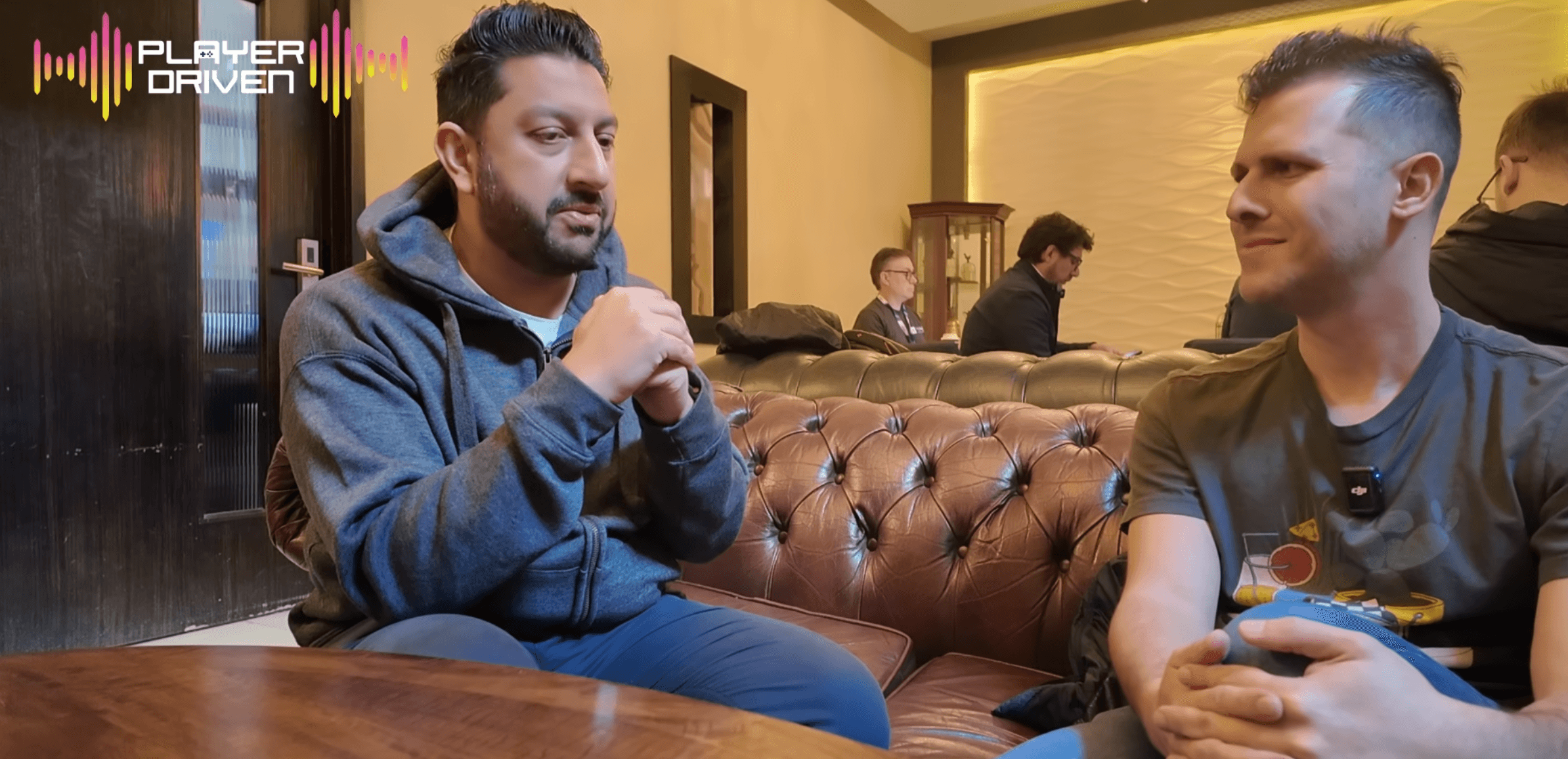
Share

Twitter

Facebook

Copy link

Share

Twitter

Facebook

Copy link

Share

Twitter

Facebook

Copy link