The consultancy’s Gamer Motivation Model is like a Swiss Army knife for understanding what motivates video game players
There's this generation of us who are all gamers, and we're getting older. How do you know, as you're looking at a particular genre, and you're thinking ahead, of how that genre is changing and growing and aging? What are ways you can hedge your bets in terms of keeping in older gamers, whereas they might have aged out before? Those are the kinds of questions, how we would go about addressing some of these questions, how we might use our existing data, and how we might work with clients to gather new data in a custom project to address those questions.—Nick Yee
Last week’s Player Driven blog introduced Nick Yee, analytics lead and co-founder of Quantic Foundry. The 11-year-old, Northern California-based consultancy brings to bear a fascinating mix of social science and data science to analyze the motivations of video game players; development studios and other organizations in and around gaming use the service to improve their products/services and internal processes.
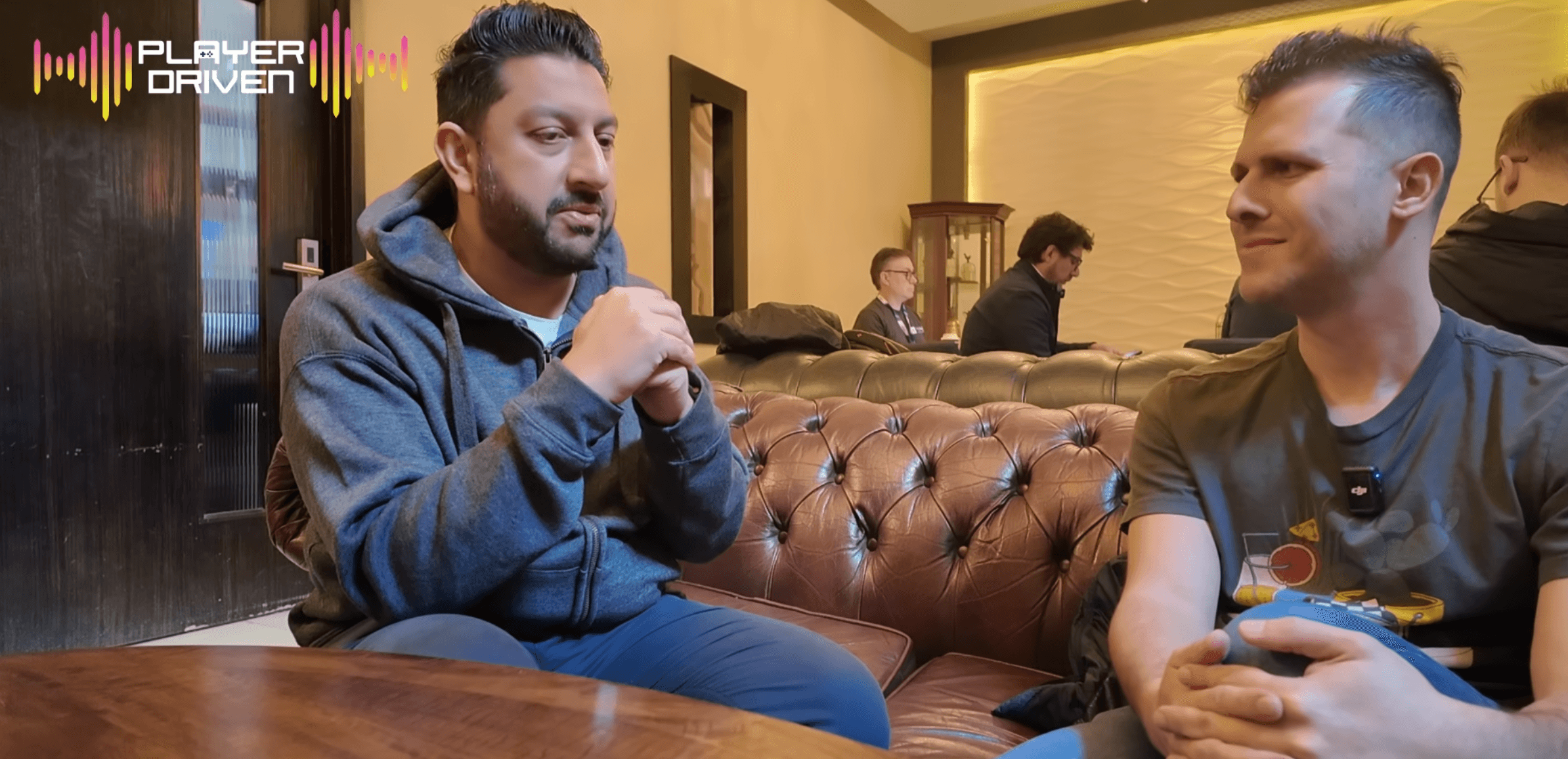
Yee was a guest of the Player Driven podcast in February. What follows is the second half of our profile of Yee and Quantic Foundry. In part, this profile highlights parts of the exchange that Player Driven’s founder and lead host, Greg Ponser, and myself had with Yee a couple months ago, augmented by new research and post-podcast feedback from Yee. We’ll conclude our profile this week with (1) a review of a conundrum found in Quantic Foundry’s Gamer Motivation Model (GMM)—namely, a prolonged slide in gamers’ interest in strategy-focused titles—and (2) a comparison of the top motivations that drive engagement among Grand Theft Auto Online and Fortnite gamers.
Note: Quantic Foundry didn’t this sponsor this profile; we heard good things about the work the company was doing from another guest, James Au, and reached out.
Enjoy…and don’t forget to sign up for our weekly newsletter and share this if you like it!
The Case of the Precipitous Drop in Strategy Game Engagement
I usually like to give more concrete numbers to people to help them understand what this difference looks like in more real-world terms. It's the same thing as all adult men in the U.S. losing nineteen pounds in weight. It's the same thing as everyone losing about seven points of IQ. That's the magnitude of difference in terms of this this finding in strategy.—Nick Yee
A topic Posner and I broached with Yee in our February podcast was a trend Quantic Foundry found in its dataset some years ago, which has since continued to spark significant interest and curiosity: A long-term slide in gamers’ interest in strategy-focused experiences.
Yee noted up front that he’s “a strategy gamer, and this data also bummed me out. And Nic [Ducheneaut, Quantic Foundry’s other co-founder] is also a strategy gamer.”
The finding hit close to home.
“We started collecting data in 2015” for the GMM, Yee explained. (Note: last week’s blog includes a GMM overview.) “Every year, we get about 200,000 new data points from current gamers. We’ve been asking the same questions about the appeal of strategic thinking and planning over the past ten years.”
“When we looked at the data during the COVID era, actually, we were constantly trying to re-norm the data, as some of these motivations were drifting. We expect kind of small drifts, like, small changes, right?”
“The thing we started really noticing in the COVID era was that, consistently, since 2015, the interest in strategic thinking and planning was declining,” Yee told us. “It wasn't a sudden drop. It was a very persistent, slow drop. By 2022, it had become the biggest difference among all the motivations of the twelve motivations that we were assessing. Over the past ten years, it was the one that changed the most.”
“In terms of the percentiles,” Yee elaborated, “if we anchor the number as a fiftieth, like, the average fiftieth percentile back in 2015, the average gamer in 2025 would only be at the 33rd percentile” in this specific motivation in Quantic Foundry’s GMM.
“For a while,” Yee clarified, “we kind of put this out as a finding, without a specific reason. We postulated some reasons in our blog post…It went viral on Reddit. What was interesting was, when people reacted to the finding, it became kind of a Rorschach test of what was wrong in the world today.”
Lol, where do we start?
“Games for Nerds”
The mysterious drop is strategy game interest found in the GMM was indeed slow and steady. At the Game Developers Conference (GDC) in San Francisco last March, Yee delivered a presentation that traced the fall in great detail.
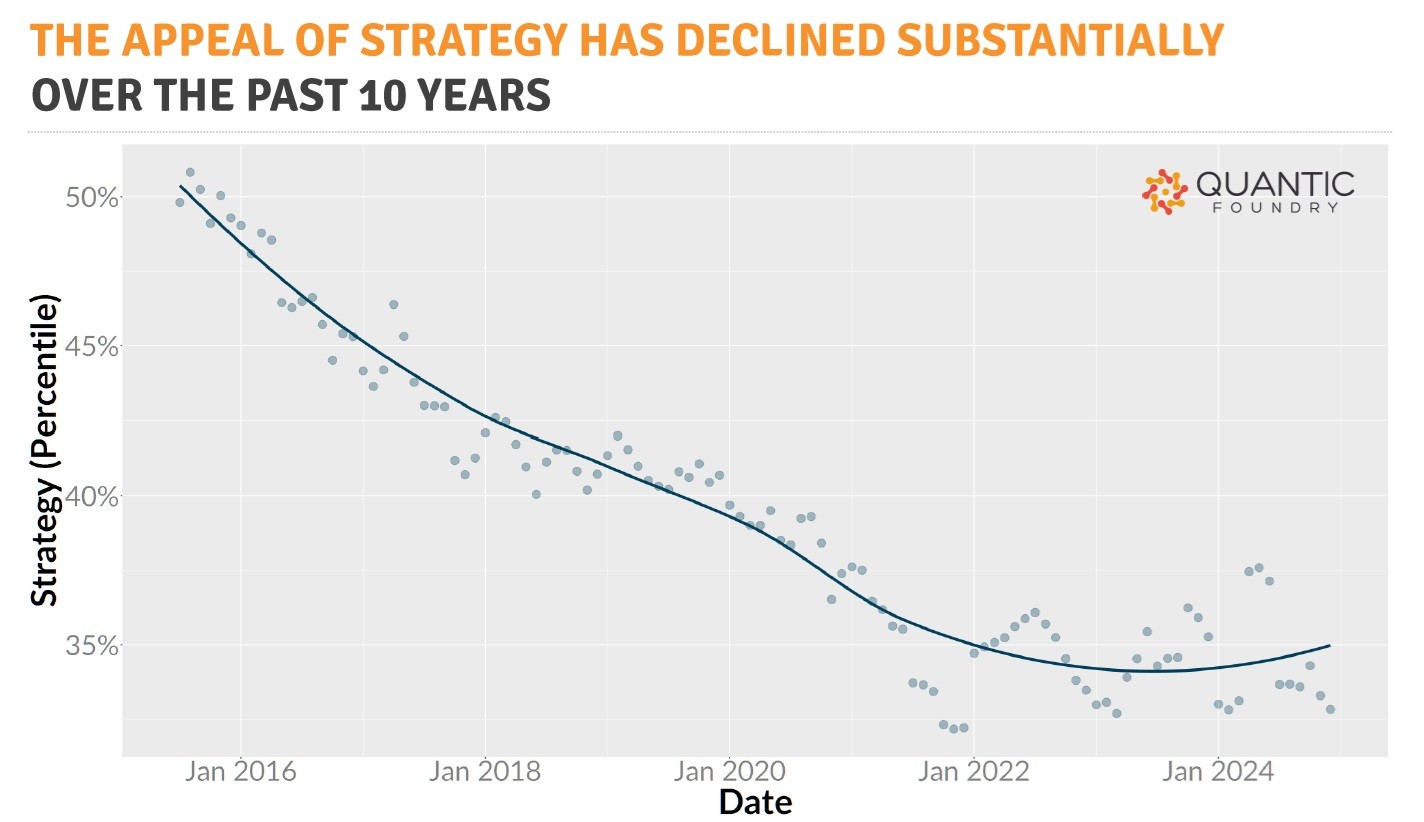
A slide from Nick Yee’s excellent GDC 2025 talk, Unlocking Gamer Motivations: Insights from 1.75+ Million Players Over a Decade, courtesy of Informa. Among other topics, Yee described the drop in motivation to play games that revolve around strategic thinking/planning mechanics and features, and he outlined some potential causes of the drop (note: a subscription to GDC Vault is required to access the session replay link above).
“In reddit, for example,” Yee told Posner and me in February, “gamers overwhelmingly blamed game developers. They were saying this [drop] is because game developers are making bad games. They're making very exploitative games and very, like, impulse loot boxes, and so forth.”
“On LinkedIn, where I have more of a marketing, consumer insights-oriented network,” Yee continued, “people were saying maybe this is just the mainstreaming of gamers that, you know…games used to be for nerds like us. And now ‘games for nerds’ are kind of in the minority. Is this just a reflection of that?”
Last, among Yee’s “academic friends, who are more in the digital media communication space, the easiest culprit was social media and gadgets…[and] this is just the game version of shortening attention spans. There wasn't really a clear answer.”
The game was afoot.
Slippin’ into Darkness
Posner asked Yee in our podcast if he’d made recent headway toward a root cause, and whether game designers/studios had recalibrated their investments in strategy games as a result of the decline.
“In the fall of 2025 there was this really interesting, serendipitous finding,” Yee said in response to the first half of Posner’s question. “The Financial Times reported that they reanalyzed some open-source data from, I think, USC that was tracking personality traits among a representative sample of U.S. people over time, roughly the past ten years. They were not tracking gamers.”
“The Financial Times’ reanalysis of that data was that, over the past ten years, conscientiousness had also dropped, substantially, in the population at large. Conscientiousness is the motivation for organization, self-discipline, planning. It’s the personality trait that most closely aligns with strategic thinking.”
In the field of psychology and psychometrics, conscientiousness is also one of OCEAN’s “big five” personality traits (which was briefly covered in last week’s blog).
“The eerie thing was,” Yee explained, “the effect size, so the magnitude of the drop that they had identified, was almost identical to the drop that we were seeing among gamers.”
Ah-ha!
Coincidence isn’t causality, but Yee implied that the U.S. population at large has experienced a recession in self-control, diligence, and attention to detail. In which case…yikes?!
“Whatever is happening among gamers,” Yee added, ominously, “It's not a gamer-specific thing. It's a population-level change.”
It could be social media. It could be gadgets. It could be the fact that we're reminded every day that our world, something in our in our everyday life, is unprecedented. Now that there's so much chaos in the world, maybe people find it hard to plan ahead.
“How is AI changing jobs and careers? What you majored in in college. There's so much uncertainty now compared with ten, twenty years ago.”
“We also found that the effect, this decline in strategy, was strongest among the youngest cohorts that we were studying. People who were teenagers. That was also, potentially, a point that it was something related to gadgets, social media, or the growing unpredictability of the world, because it's mostly impacting younger people.”
Rodger that. Relative to oldies (like me), U.S. teens and young adults have, since 2015, seen an erosion of interest in self-discipline, long-term planning and strategic thinking…and our chaotic world and/or a deepening addiction to smartphone-based social media apps/services is the top suspect…right?
“My academic friends, we're sitting here and, like, it's clearly the thing that you want to point to, but it could be something else.”
Drat—this whodunit case file remains open.
“You used to have to wait until either the evening news or the newspaper the next day,” Yee continued. “Now a bomb can go off in the random part of the world, and I can find that out in, like, thirteen seconds. That changes everything.”
“I have ADD ‘cause I gotta keep up with it. Strategy games just take too long to build things, or it's complex to actually…”
Yee paused, and reflected on his own love of strategy-centered video games.
“I don't know if you've ever played Europa Universalis, this series” from Paradox Development Studio and Paradox Interactive. “I'm learning Europa Universalis V,” which debuted last November.
“I've got a good hang of it, but on their official YouTube channel they have a series of tutorials that, in total, is seven hours long! Even after you've watched that entire series, you still won't know how to play the game because there's so much more hidden information underneath.”
“I've been, like, doing other stuff while watching these videos in the background. And I'm sitting there going, like, ‘Wow, this is really intense, you know. This is very much on the very upper end of strategy.’”
“Going back to your question, Greg, on how this changes how people think about game design, I think, in a sense, we've been seeing this change in terms of strategy games ourselves.”
“When you look back at the top games in 1997, ’98,” Yee recalled, “the top five games are all strategy games. You've got SimCity [Maxis’/EA’s SimCity 3000 debuted in early 1999 and their iconic title, The Sims, debuted early the following year], you've got, you know, other games that were all squarely in that genre. We've kind of, essentially, seen this shift, even within games that we call strategy games.”
“Now, there are often a lot of more chance elements, a lot more short-term kind of gratification elements. You saw [Blizzard’s] Hearthstone kind of shift to this, like, a lot of mechanics that were more randomized and that were much more ‘spiky.’”
“You see games like [LocalThunk's/Playstack's] Balatro. That takes a very strategic formula, but it's got a roguelike blend to it that kind of changes the feedback. It's more ‘spiky.’ There's more surprises. It's less long-term planning ‘cause you've also got to react. Sometimes you're just lucky, right?”
“I think we're seeing, you know, that shift in gaming, as well these mechanics that make long-term planning strategy more palatable in the current zeitgeist of ‘more surprises,’ more ‘making it more short-term.’”
“If you do like playing long-term,” Yee continued, “you'll still like Balatro. But if you're more of a spontaneous player, there's still something in Balatro that you'll enjoy from the moment-to-moment” experience, like “getting the new the new Joker Cards.”
For the record, Yee’s 2025 GDC presentation included the following slide that illustrated the relative drop in strategy-focused interest among the GMM’s youngest cohorts.
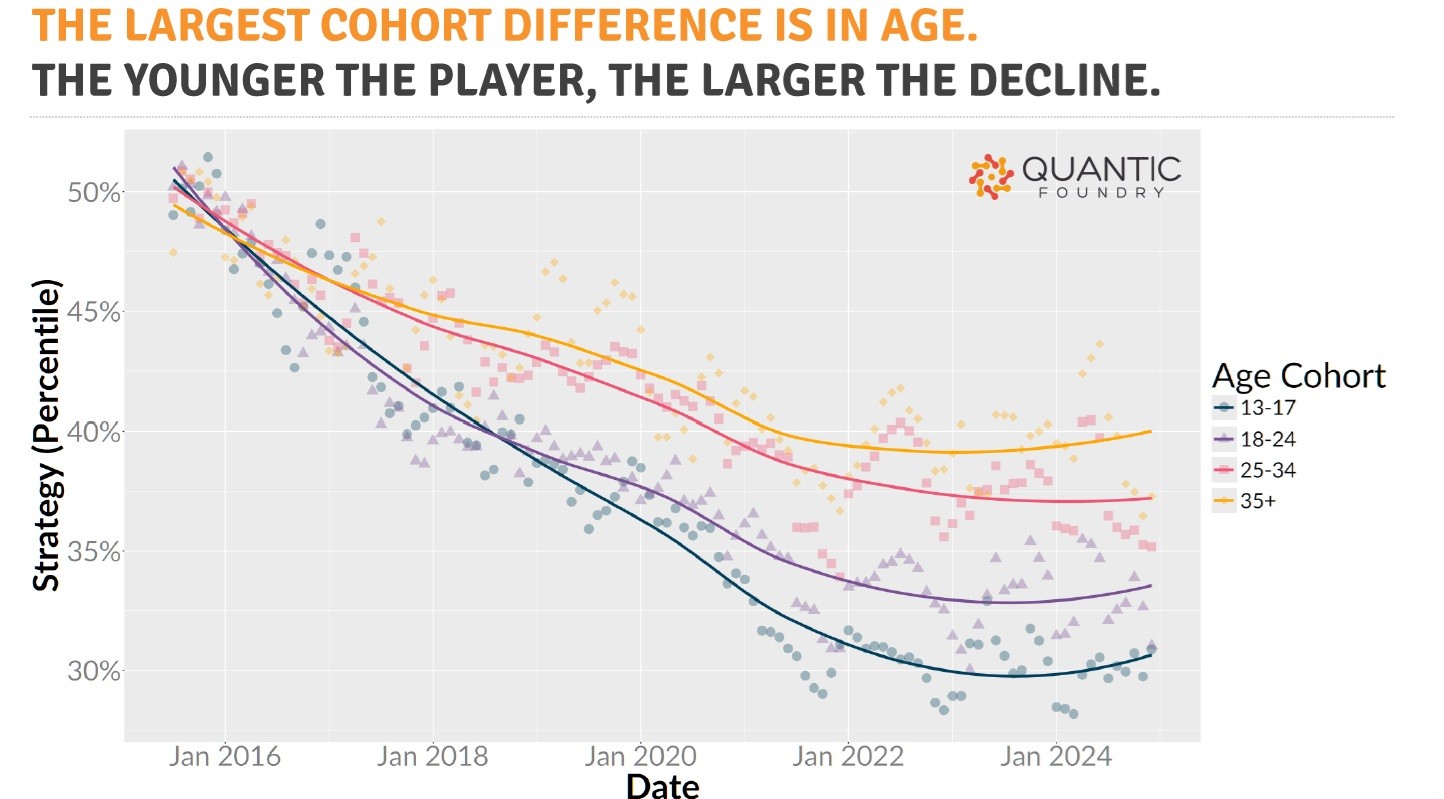
The verdict?
THE KIDS DID IT, with the help of two accomplices: addictive social media apps and an increasingly chaotic, unpredictable world, both which have (apparently) robbed Gen Alpha and Zoomers of some portion of their attention spans, and some of their abilities to stay laser-focused in games that require long-term thinking/planning skills.
LOCK ‘EM UP, I sez!
Distinguishing the GMM from Self-Determination Theory
Player Driven has looked into the psychology of gamers before—our profile of Crystin Cox at ArenaNet comes to mind—so we asked Yee to clarify how Quantic Foundry’s GMM differs from another psychology-centered model that we’re aware has been floated around in the gaming industry’s ether for over a decade: Self-Determination Theory (SDT).
“I think it's a great question,” Yee said in response to my question about this topic. “I think they’re complementary lenses. I think we're answering slightly different questions.”
Go on…
“SDT is really focused on universal needs. Things that increase engagement and satisfaction, whether it's in a medical setting, a gaming setting, watching TV, shopping in the supermarket, and so forth.”
“Their broad question” in a gaming context, Yee added, “is, ‘How are gamers the same in terms of what makes games more engaging?”
“We're asking a different question. We're asking, ‘How are gamers different in terms of what they're looking for in games?’”
“It's a difference between SDT and personality psychology research, which has a different model for what they're looking at within the gaming space.”
“I like to think of SDT as kind of like thermometer model,” Yee continued. “You're always trying to do better, right, on autonomy,” which is one of SDT’s three core human motivations, along with competence and relatedness.
“You're trying to hit an autonomy benchmark, or a competence benchmark. You're making sure that your game offers a high-quality amount of those motivations. So, in terms of autonomy, the more dialogue choices there are that impact the story, the more avatar customization options, the more ways there are to build your character or your squad in meaningful ways, the higher the autonomy that the gamers will feel.”
When you present it in a playtest setting,” he continued, SDT-oriented surveys ask “gamers to essentially rate the game in terms of how well it's allowing you [gamers] to do that. You ask them, ‘Hey, when you played the first ten minutes of Baldur's Gate, did you did you feel that you could make interesting choices? Did you feel your choices impacted the game? Did you feel that you could make the character that you wanted?’”
They're all questions that ask gamers to rate the game because you're trying to get that kind of thermometer rating, like, the hotter the better. This is why SDT is often used in the playtest process.
The studio has a “build of the game they're assessing. ‘Hey, how does it look like on the SDT metrics?’ And they're saying, ‘Hey, this the first ten minutes of Baldur's Gate. I think we're a little low on autonomy against genre baselines. Let's improve it.’”
“For us,” Yee said, “the metaphor I like to use is that we're more of answering a Goldilocks problem,” which refers to an adaption of the children’s story—by cognitive scientists and developmental psychologists—that frame preference-oriented questions.
“We're saying, ‘Some people like solo games and there are other people who like highly social, competitive games. What makes a game engaging for particular players? ‘Is the bed too soft for you? Is the porridge too hot for you?’”
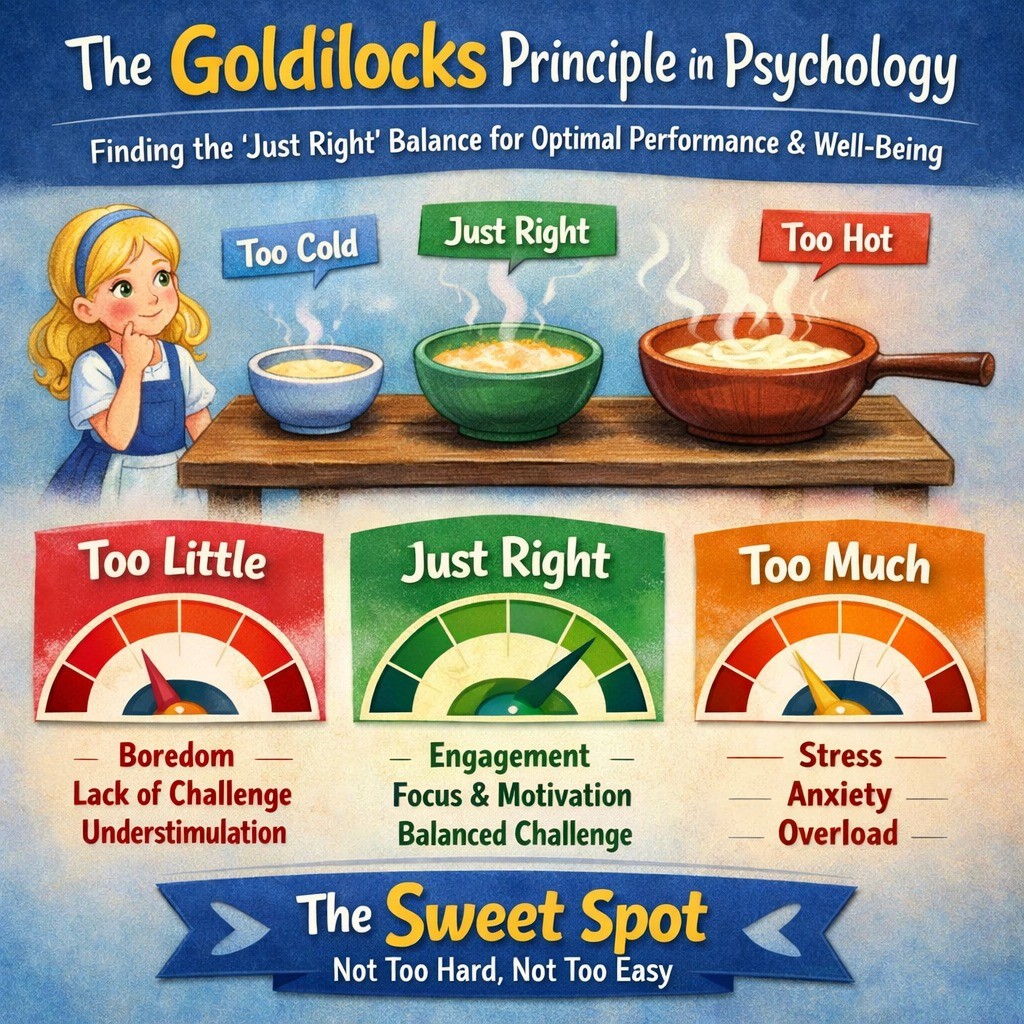
A visual summary of the Goldilocks principle in psychology, courtesy of OpenArt Labs’ AI image generator.
“In our motivation survey,” Yee told Posner and me, “we're asking gamers about their own gaming preferences to assess their underlying psychological motivation. We ask questions like, ‘When you play a game, how important is it for you to play it at the highest level of difficulty? How much do you enjoy thinking ten steps ahead?’”
“We're not asking questions about the game, but about you. And we're trying to assess what are semi-stable psychological traits that you have in the gaming context.”
Makes sense.
“To be clear,” Yee added, it “could be a video game. Maybe it's a board game. Maybe it's basketball and football in real life…In our survey [the GMM questionnaire], we're recording specifically to the video game experience.”
When working with clients, Yee further clarified, Quantic Foundry works “only with their game, and we're serving their gamers.”
“When you're playing Eve Online,” for example, a studio like CCP Games can better understand “how much of these things matter” with assistance from Quantic Foundry.
A Comparison of GTAO and Fortnite Gamer Motivations
Especially when you're looking at a tentpole game where they're trying to cater to many different playstyles, I think it's really important to avoid looking at the overall average. This is where, especially in bigger tentpole games, that you really need to start with some kind of players segmentation, of understanding who the distinct players are, and then building user personas, and tailoring mechanics and features to specific player types.—Nick Yee
As the podcast wound down, we asked Yee to veer back into the GMM—which today includes feedback from >2 million video game players around the globe—to illustrate some other pragmatic insights the consultancy can uncover for clients.
Yee was happy to do so.
More specifically, we asked Yee to compare and contrast the player bases of two titles that have proven remarkably popular and lucrative for 8+ years on multiple platforms: Rockstar’s Grand Theft Auto V Online (GTAO) and Epic Games’ Fortnite Battle Royale (Fortnite BR).
“When we looked at our data for GTA Online,” Yee said, “the motivations that were most distinct from average were: higher on destruction, higher on community, high on power.”
“Power is bigger numbers in the game. So, higher level equipment, with better stats. Spells that do more damage and so forth. So, that's power. And then destruction is blowing things up, using guns. Community is teamwork.”
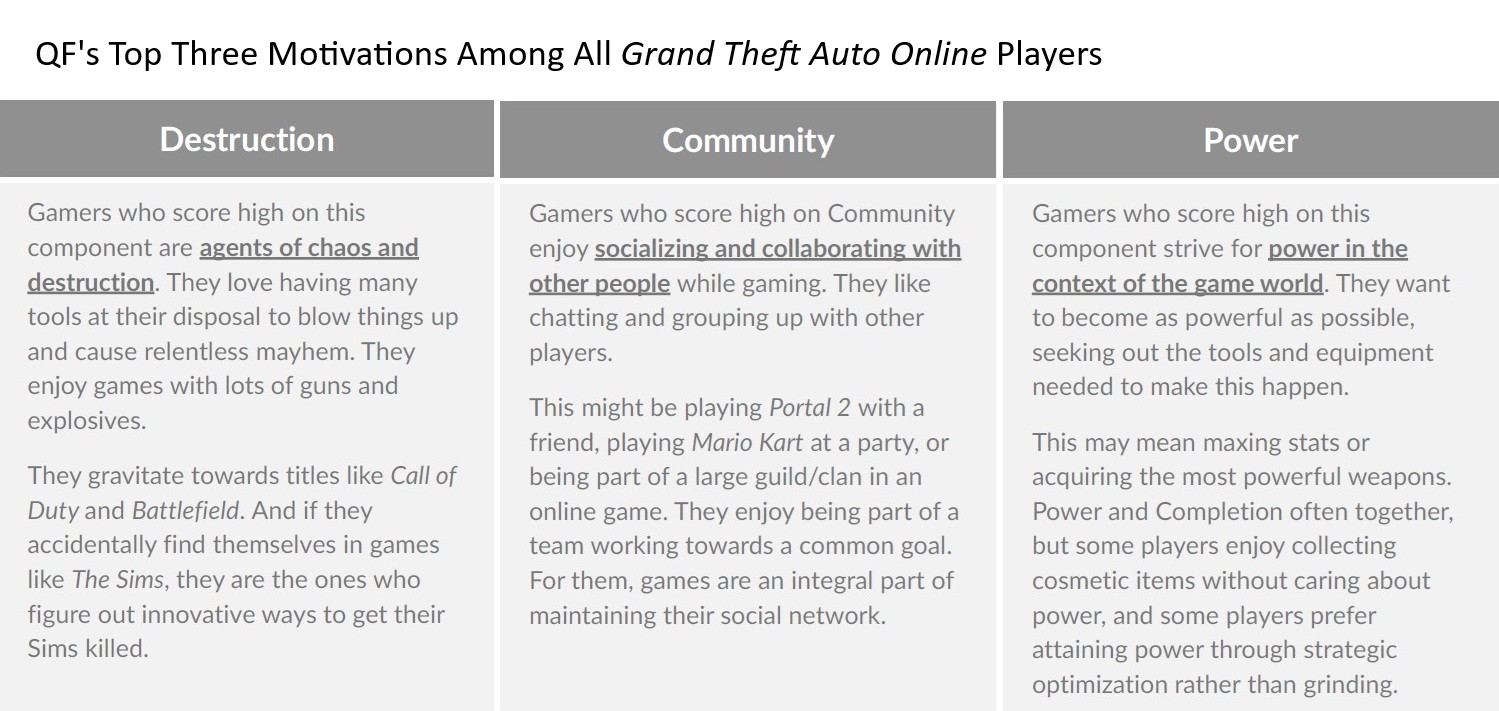
GTAO players’ top three motivations to play, according to Quantic Foundry’s GMM.
Yee was quick to point out that viewing the player bases of these massive games through a macro lens (as the figure above does) can be dangerous, even misleading.
“Say we identify the motivation drivers for each of the segments” in GTAO’s player base, Yee said, unpacking this notion. “Then, if the business question is, ‘What's the best future mechanics or features we [should] build in the game?’ there's now this empirical map in your game.”
Let’s imagine there are “five player types” within the GTAO player base, Yee elaborated. Assessed this way, we can now identify things such as here “are the percentage of player types in the game. Here's what drives them motivationally. I want to rank these twenty potential new features that I have. For each feature, I can go down the list and say, ‘If I build this feature, how many of these boxes for these player types will light up, will be happy with this feature?’”
That makes sense. Start with a rational segmentation, then consider each segment’s motivations separately.
Such an approach, Yee continued, allows designers and production teams to rank “the order of these potential features, of what's the best ‘bang for the buck’ in term the ROI, assuming we also have KPI on spends for each of the segments. You can quickly pivot into this empirical model where you can map, ‘If I make this feature, how many segments does it hit?’ ‘Does it hit the segments with higher spend than other segments?’ And then, for each of the features, you not only have a coverage metric, but also an ROI on spend metric.”
It's a means of connecting design efforts and measured live ops/service game results.
“And then, of course, once you have the model,” he clarified, “and you have these user personas, then we're also looking at, ‘Hey, for each of these player types, they have different motivations, they're playing other games alongside GTA. So, if I've identified these two particular segments as being high spend, and well aligned with our future development roadmap, what are the other games that they're currently playing?’ Like, on Facebook, or your ad program, I can target those gamers specifically, and also know what specific gaming motivations, with specific features and mechanics they're looking for and tailor marketing messages to them.”
So, the GMM can help connect the dots between marketing, social media, player community trust and safety efforts, and all the other efforts that studios/publishers undertake.
“When we did this project with the live services shooter game [note: this project was noted in last week’s blog post], in the in the debrief walkthrough call, they had people across their entire company sitting in.”
Whether they were on the design team, on the marketing team, on their data science team, because the player segment model that we were delivering to them, that we were providing them, was essentially providing the, like, a shared vocabulary, shared taxonomy, of their audience that made sense and was applicable and actionable across different team functions, they could now align on, ‘Hey, for our next season's feature roadmap, here are the five that we've picked based on coverage of the model.’
“The marketing team” Yee added, “then starts building up, ‘Okay, now I know here's how I can get more of these players. Here's where I can optimize my ad spend to prioritize these players.’ And then, the data science team, we provided them with a typing tool, a survey typing tool, so they could continually profile new gamers and check that that all these [things] they think they were addressing are moving, and changing, the right way. You know, when their marketing team thinks they're bringing in more of ‘Player type A,’ that they're seeing more of those players appear in the player base.”
“So, that's the typical kind of process and methodology we have and, again, the motivation framework is part of that that process, and then we kind of tailor the project, the survey questions, depending on what the client is particularly interested in. Are they trying to sustain their current players? Are they trying to find out how to grow the most with new players brought in? Are they in a late stage of their franchise and trying to think of what their next game ought to be? Are there unmet needs in their current gamers that they'll target better in the next game?”
“Oftentimes, we're working with clients who are answering more, like, marketing and consumer insights questions,” Yee added, switching gears. “If I have a game concept, right? Say I wanna make a game that scores high on storytelling and strategy at the same time.”
Check.
“‘Hey, what games in the current market are hitting those motivation benchmarks?’ ‘In the strategy space, it's historically been dominated by male players, but if I wanted to make a strategy game that was more appealing to female gamers, what would that look like?’”
“In our dataset, you could filter that by games that score high on story-strategy but, also, it'll over-index on female players to get a sense of if I want to make, that bridge. ‘Where's the current market sitting?’ ‘What additional motivations or changes to that typical strategy genre format [is needed] to shift to appeal to more female gamers, or older gamers, right?”
Posner and I asked Yee to run his GMM breakdown back but from a Fortnite Battle Royale gamer’s perspective.
“Their highest one,” Yee began, “competition, sticks out higher, and then...excitement...On GTAO we saw destruction, community, and power. And then on Fortnite [BR], we're looking at competition, excitement, and destruction.
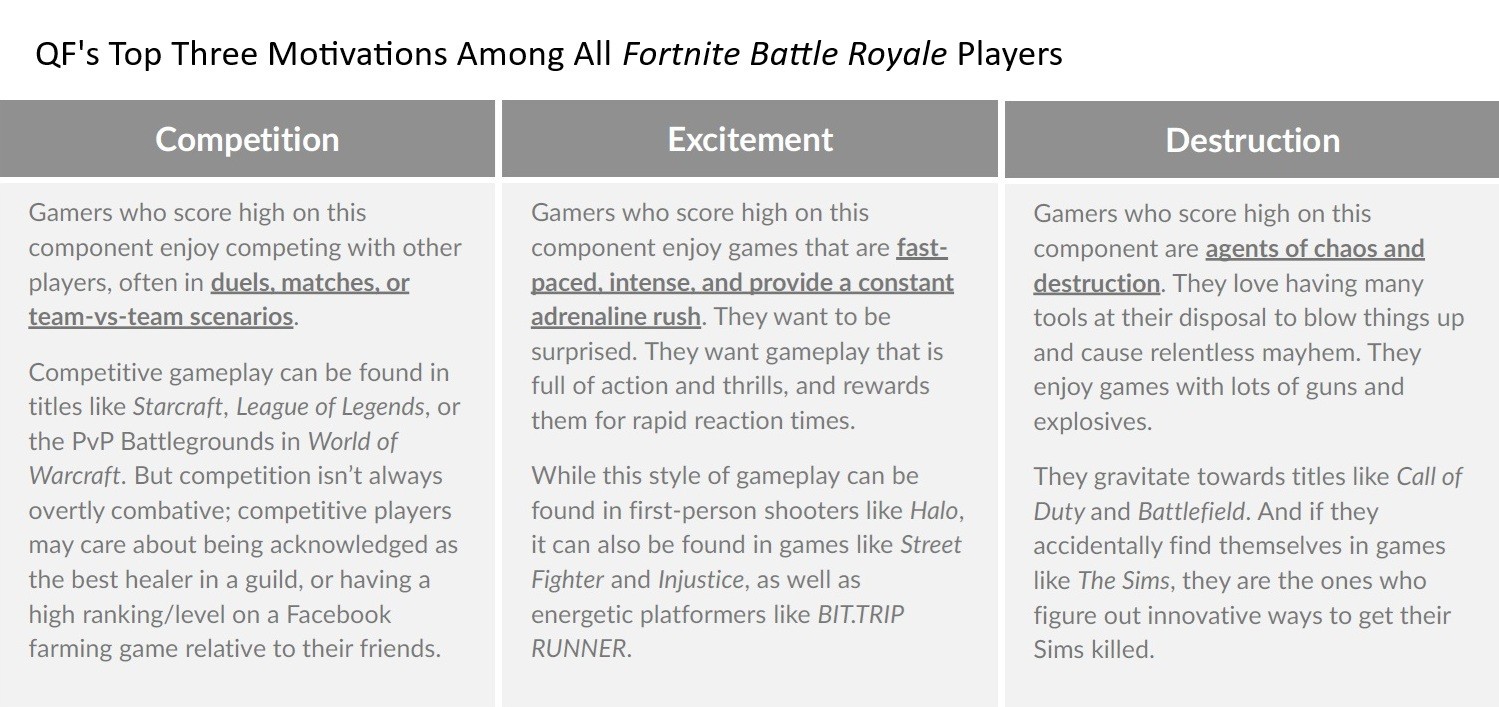
Fortnite players’ top three motivations to play, according to Quantic Foundry’s GMM.
“That makes sense,” Yee continued. “They overlap on destruction. On Fortnite [BR], the two that are different are competition and excitement. And excitement is a fast pacing, action-oriented surprises, thrills. So that's how it looks different” from a GMM standpoint.
“Again, I think with a lot of the questions, especially on these live service games where it's also a big tentpole game, you really have to start drilling into the player types to get anything, you know, actionable or meaningful.”
Yee took a quick detour to further illustrate this point.
“When you look at [Blizzard’s] World of Warcraft—another good example, right? They're trying to capture so much of the market by appealing to, just, like, very different playstyles. Until you drill down into a specific player type within your game, and really try to understand how they are different from the other player types, and optimizing for those player types, it's almost incredibly dangerous, in a tentpole game, to look at the overall average because then you may end up in this kind of Frankenstein solution where you've got players in there that either care very little about story, and very high about story, but no one who cares just average about story. But if you look at the average, that's what they look like.”
“Player segmentation is always,” Yee clarified, “our recommended first step, regardless of whether you're using our model or someone else's model. Start with that, and find the distinct player types” and build up and out from there.
We ended our discussion by asking Yee what was on tap next for Quantic Foundry.
Yee said that the team was “always meaning to put out a report on all twelve motivations, and break that down by gender, by age cohorts, by game platforms that they play on. We're hoping to get that out in the next month or so.”
Quantic Foundry was putting the final touches on a “sweeping report on the past ten years. How is industry changing from a gaming motivation standpoint, in terms of those tastes, as a way to help designers, publishers understand there are large trends that they need to be careful of, like, with strategy, and so forth.”
The report Yee referenced is now out. The 196-page report is priced at $3,250; more details are here.